
Can you use an 8 inch blade on a 10 inch table saw?
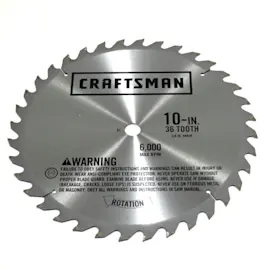
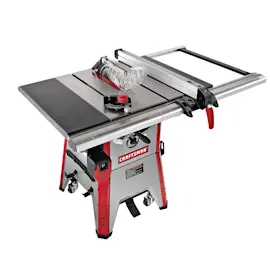
Yes, you can use an 8-inch blade on a 10-inch table saw like the Tradesman 8031 as long as the blade’s arbor hole matches your saw and the blade is rated for the saw’s RPM. The main tradeoff is reduced maximum cutting depth.
What changes when you drop from 10-inch to 8-inch
An 8-inch blade sits lower in the table, so it cannot cut as deep as a 10-inch blade.
- Shallower cut capacity: most 10-inch saws cut about 3-1/8 in. at 90°; an 8-inch blade is typically about 2-1/8 in. at 90°
- Less depth at bevel: bevel cuts lose additional depth
- Same kerf options: you can still choose thin-kerf or full-kerf blades (as long as the saw and splitter/riving knife setup allows it)
- Potentially smoother cuts: some users prefer an 8-inch blade for certain fine crosscuts because less blade is exposed
Fit and safety checks (do these every time)
Use this checklist before installing any blade on the Tradesman 8031 bench table saw.
- Arbor size match: the blade’s arbor hole must match the saw’s arbor (commonly 5/8 in. on many 10-inch saws)
- RPM rating: blade max RPM must be at least the saw’s no-load RPM
- Blade thickness vs. riving knife/splitter: the riving knife should be slightly thinner than the kerf; the kerf should be wider than the riving knife
- Washer and nut engagement: the arbor nut must fully engage threads; the blade must clamp flat
- Guard clearance: confirm the blade guard and anti-kickback pawls (if equipped) operate freely
8-inch “dado” note (common confusion)
Many 8-inch dado sets are designed to be used on 10-inch table saws because dado cuts are non-through cuts. The key is still arbor fit, RPM rating, and compatibility with your saw’s guarding and throat plate.
| Blade type | Typical use on a 10-inch saw | What you may need |
|---|---|---|
| 8-inch standard blade | General ripping/crosscutting with less depth | No special parts, just correct arbor/RPM |
| 8-inch dado set | Grooves, dados, rabbets (non-through) | Dado throat plate; remove guard only if required by the operation |
Why it matters
Using the correct blade size and setup reduces kickback risk, improves cut quality, and helps protect the motor and arbor bearings on your Tradesman 8031.
For more DIY safety context before working on wiring or switches, see are diy appliance repairs safe.
Last updated: February 2026
How many teeth are best for a table saw blade?
For the Tradesman table saw model 8031, the “best” blade tooth count depends on what you’re cutting: 40T is the best all-around choice for most ripping and crosscutting, while 24T cuts faster for ripping and 60T to 80T gives cleaner crosscuts in plywood and trim.
Quick tooth-count guide (what to use when)
- 24T to 30T: Fast ripping in thick hardwood or framing lumber (rougher edge)
- 40T: General-purpose blade for mixed ripping and crosscutting
- 50T: Combination blade when you want a slightly cleaner crosscut than 40T
- 60T to 80T: Fine crosscuts in plywood, melamine, and trim (slower feed)
- 80T+: Ultra-fine cuts; best when tear-out control matters more than speed
Tooth count vs. cut quality (simple comparison)
| Tooth count | Best for | Cut speed | Edge quality |
|---|---|---|---|
| 24T to 30T | Ripping | Fast | Fair |
| 40T | Everyday use | Medium | Good |
| 50T | Mixed use with cleaner crosscuts | Medium-slow | Very good |
| 60T to 80T | Crosscutting sheet goods | Slow | Excellent |
What else matters besides tooth count
Tooth count is only part of the result. These factors often make a bigger difference in how your Tradesman 8031 performs:
- Tooth grind: ATB for clean crosscuts; FTG for efficient ripping; TCG for abrasive sheet goods
- Kerf thickness: Thin-kerf blades reduce load on smaller saws; full-kerf blades can track straighter on heavier setups
- Blade sharpness and cleanliness: Pitch buildup and dull teeth cause burning and wandering cuts
- Fence and miter alignment: Misalignment can mimic a “bad blade”
Why it matters
Choosing the right tooth count helps you balance feed rate, motor load, and finish quality. Too many teeth for ripping can overheat and burn; too few teeth for plywood can splinter and tear out.
For more help confirming you have the correct model number before ordering accessories or replacement parts, use how to find your appliance model number (and what it means for parts).
Last updated: February 2026
How do I find the model number on my 8031?
The model number for your Tradesman bench table saw is used to match the correct diagrams and replacement parts; on model 8031, it’s typically printed on the rating/model tag attached to the saw’s frame or base. Once you find it, use the exact characters as shown.
Where to look on a Tradesman bench table saw
Check these common tag locations first:
- On the rear of the saw base or stand (near the power cord entry)
- On the underside of the table top, near the front edge
- On the side panel of the base, near the switch housing
- Near the motor mounting area (on the frame, not the motor label)
- Inside the cabinet (if your version has an enclosed base)
What the model tag looks like
Most table saw model tags include a few identifiers. Use the model number for parts lookups.
| Label item | What it’s used for | Example format |
|---|---|---|
| Model number | Finds correct parts diagrams | 8031 |
| Serial number | Identifies production run | Letters and numbers |
| Electrical rating | Confirms power requirements | Volts/amps/Hz |
Tips to avoid parts mismatches
Using the exact model tag info matters because small design changes can affect items like the switch, arbor parts, blade guard, or fence hardware.
- Write the model number exactly as printed (including any dashes or suffixes)
- Take a clear photo of the entire tag before ordering
- If the tag is worn, use a flashlight at an angle to make stamped text easier to read
- Do not use the motor’s label as the saw’s model number
Why it matters
The correct model number ensures we show the right Tradesman 8031 diagrams and compatible parts, which helps prevent ordering the wrong safety components or electrical parts.
For more help identifying model information, use [how to find your appliance model number (and what it means for parts)].
Last updated: March 2026