Installation guide
 Owner’s manual
 Error Codes


How can I tell how many cubic feet my Kenmore refrigerator is?
For your Kenmore 10653632300 side-by-side refrigerator, the most reliable way to confirm cubic feet is to look up the capacity specification in the 10653632300 owner's manual. If you need a quick estimate, you can calculate interior volume by measuring usable inside height, width, and depth, then dividing cubic inches by 1,728.
Fast ways to find the cubic feet
- Check the manual specs: Capacity is typically listed under “product specifications” in the 10653632300 owner's manual.
- Measure and calculate (good estimate): Measure the usable interior space, not the outside cabinet.
- Use model-family clues (rough only): Some older model families loosely correlate to size, but it is not an exact method.
- Compare to typical side-by-side sizes: Most side-by-side refrigerators are commonly about 20 to 26 cu. ft.
How to calculate cubic feet (step-by-step)
- Empty enough space to measure the main compartment (refrigerator and freezer separately if you want more detail).
- Measure height x width x depth in inches (usable space).
- Multiply to get cubic inches.
- Divide by 1,728 to convert to cubic feet.
Quick formula
| What you measure | Formula | Result |
|---|---|---|
| Interior space (inches) | H x W x D | cubic inches |
| Convert to cubic feet | (H x W x D) / 1,728 | cubic feet |
Measuring tips that improve accuracy
- Measure to the inside walls, not to bins, shelves, or door storage.
- If shelves reduce usable height, measure the largest open section and treat it as an estimate.
- For the freezer, measure around the ice maker area if installed; it reduces usable volume.
Why it matters
Cubic feet helps us match the right parts and accessories (like an ice maker assembly, water filter housing, or shelving) and it also helps when comparing energy use and storage needs across Kenmore refrigerator models.
Last updated: February 2026
What are the most common issues with 10653632300?
The most common issues we see with the Kenmore 10653632300 side-by-side refrigerator involve ice and water dispensing, warm temperatures from airflow or defrost problems, and door sealing or alignment concerns. These problems usually trace back to a few serviceable parts and basic maintenance checks in the owner's manual.
Most common symptoms and what they usually point to
- Ice maker not making ice: water supply issue, ice maker failure, or freezer temperature too warm
- Water dispenser slow or not dispensing: restricted supply, frozen reservoir/line, or valve issue
- Frost buildup or warm freezer/fridge: defrost system problem (heater, bi-metal, timer) or airflow restriction
- Noisy operation: fan blade interference, condenser fan wear, or ice buildup near the evaporator
- Door not closing or leaking air: gasket not sealing, door cam wear, or door alignment
Parts that commonly fix these problems
If your symptoms match, these model-compatible parts are common solutions:
| Symptom | Common part to check/replace | Example on this model |
|---|---|---|
| No ice | Ice maker assembly | Refrigerator ice maker assembly 2198597 |
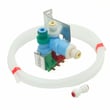
| No water to dispenser/ice maker | Water inlet valve | Refrigerator inlet valve W10408179 |
| Frosted evaporator, warm temps | Defrost heater or defrost bi-metal | Refrigerator heater WP2323198, refrigerator defrost bi-metal WPW10225581 |
| Clicking/humming, hard start | Start components | Refrigerator run capacitor WPW10662129 |
| Door won’t “pull in” or closes poorly | Door cam | Refrigerator door cam (black) WP2182179 |
Quick checks we recommend before ordering parts
- Confirm freezer is set near 0°F and fresh food near 37°F
- Make sure vents are not blocked by food packages
- Verify the household shutoff valve is fully open and the supply line is not kinked
- Inspect for frost/ice on the rear freezer panel (often a defrost clue)
- Check door seal contact all the way around; clean the gasket and mating surface
Why it matters
Ice/water issues can be as simple as a restricted supply, but defrost and airflow problems can quickly cause temperature swings, spoiled food, and heavy frost. Catching the root cause early helps protect the compressor and keeps the Kenmore 10653632300 running efficiently.
Last updated: March 2026
How do I find the model number on my 10653632300?
For Kenmore side-by-side refrigerator model 10653632300, the model number is printed on the model and serial number label inside the fresh food (refrigerator) compartment. Open the refrigerator door and look for the label on an inside wall; it lists both the model and serial numbers.
Where to look (fast checklist)
- Open the refrigerator (fresh food) door, not the freezer door
- Check the inside wall of the refrigerator compartment
- Look for a sticker or metal tag labeled “Model” and “Serial”
- Write down the full model number and serial number exactly as shown
- Record the purchase date if you still have it (helpful for service and parts)
What the label typically includes
| Label item | What it’s used for | Example format |
|---|---|---|
| Model number | Matching parts and diagrams | 10653632300 |
| Serial number | Identifying production details | Letters and numbers |
| Purchase date (your record) | Warranty and service history | Month/day/year |
Why it matters
We use the complete model number to match the correct Kenmore parts for your exact configuration (ice maker, water system, shelves, and door components). Even small model differences can change which parts fit.
Helpful tip for parts lookup
Once you confirm the model number, use it when ordering common replacements such as the whirlpool refrigerator ice maker assembly 2198597 or the refrigerator inlet valve W10408179 for water and ice issues.
For the exact label location and product record section, see the owner's manual.
Last updated: March 2026