Installation guide
 Owner’s manual
 Error Codes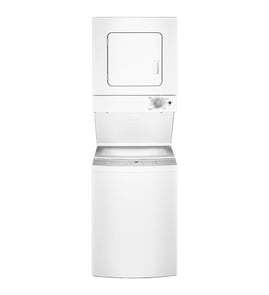


How do I fix the F3 E1 code on my Whirlpool washer?
The F3 E1 code on your Whirlpool WET3300SQ1 stacked laundry center points to a water level (pressure) sensing problem. We fix it by resetting power, then checking the pressure hose and air dome path for kinks, leaks, or clogs so the control can read the water level correctly.
Quick reset and safety
- Unplug the laundry center (do not use an extension cord).
- Wait 5 minutes.
- Plug back into a grounded outlet.
- Run a quick fill or rinse to see if the code returns.
For electrical and operating basics specific to this unit, follow the WET3300SQ1 owner's manual.
What to check if the code comes back
On this style of Whirlpool top-load washer, F3 E1 is usually caused by the pressure system not “seeing” the correct water level.
- Make sure both hot and cold faucets are fully on.
- Check inlet hoses for kinks.
- Clean clogged inlet valve screens (sediment can cause odd fill behavior).
- Inspect the pressure hose from the tub air dome to the pressure switch/sensor for cracks, pinches, or a loose fit.
- Clear soap scum or debris from the air dome port (a partial clog can trap air and confuse the reading).
- If the washer overfills or won’t stop filling, stop the cycle and shut off water until the issue is corrected.
Symptoms and likely causes
| What you notice | Most common cause | What we do first |
|---|---|---|
| Won’t fill or fills very little | Supply issue or clogged screens | Open faucets; clean inlet screens |
| Overfills or keeps filling | Pressure hose off/leaking or air dome blocked | Reseat hose; clear air dome |
| Fills, then stops and beeps | Intermittent pressure reading | Check hose routing for pinches |
When a part replacement is likely
If the hose and air dome are clear and secure but F3 E1 keeps returning, the water level switch/sensor or main control can be the failure point. At that stage, we use the diagnostic steps in the WET3300SQ1 installation guide to confirm wiring and component access before replacing anything.
Why it matters
The washer uses the water level signal to prevent overfilling and to time agitation and spin correctly. Fixing the pressure system restores normal fill levels, helps prevent leaks, and improves wash performance.
Last updated: February 2026
What is the average lifespan of a whirlpool dryer?
A Whirlpool dryer typically lasts 10 to 13 years with normal household use and basic care. For your Whirlpool stacked laundry center model WET3300SQ1, keeping airflow strong (lint screen and venting) is the biggest factor in reaching that lifespan; poor venting can shorten dryer life.
What most affects dryer lifespan
- Vent airflow and vent length: long runs and too many 90° turns increase heat and run time.
- Lint removal: clean the lint screen every load; remove lint from the exhaust vent periodically.
- Overloading: heavy loads strain the drum support system, belt, and motor.
- Heat stress: restricted venting can overheat components like thermostats and thermal cut-offs.
- Noise and vibration: early mechanical wear often shows up as squealing, thumping, or rumbling.
Maintenance schedule we recommend
Use your WET3300SQ1 owner's manual for the exact care instructions for this unit.
| Task | How often | Why it helps |
|---|---|---|
| Clean lint screen | Every load | Improves airflow and drying time |
| Check outside exhaust hood flap | Monthly | Confirms air is moving freely |
| Clean the entire exhaust vent run | About every 2 years (more with heavy use) | Reduces overheating and long dry times |
| Review vent routing (length, elbows, kinks) | Any time drying slows | Prevents performance loss and extra wear |
Venting details that matter on this model
The installation guidance for WET3300SQ1 calls for 4-inch heavy metal venting and avoiding plastic or foil vent. It also notes that vent runs longer than the chart allows can shorten dryer life and reduce performance. Use the fewest 90° turns possible and avoid kinks; rigid metal venting is preferred. See the WET3300SQ1 installation guide.
When repairs start to outweigh keeping it
If your dryer is near the 10 to 13 year mark, these are common “tipping point” signs:
- Dry times keep getting longer even after vent cleaning
- Repeated no-heat or overheating symptoms
- Loud rumbling or squealing from the drum area
- Multiple parts failing close together
Common wear parts tied to noise or heat
| Symptom | Part that often relates |
|---|---|
| Rumbling or thumping | Support WPW10314173 |
| Overheating or cycling heat issues | Dryer operating thermostat WP3387134 |
| Dryer overheats and shuts down | Cut-off kit 279769 |
Why it matters
A dryer can “still run” while restricted venting quietly increases heat, run time, and component stress. Keeping the vent system within the recommended setup is one of the simplest ways to get full service life from a Whirlpool dryer.
Last updated: February 2026
What is the capacity of the Whirlpool wet3300sq1?
The Whirlpool WET3300SQ1 stacked laundry center has a 2.6 cu. ft. washer wash basket capacity. For cycle-by-cycle loading guidance (bulky items, mixed loads, and water level expectations), we recommend checking the WET3300SQ1 owner's manual.
What “capacity” means on this model
Capacity is typically listed for the washer tub (wash basket), not the dryer drum. On the WET3300SQ1, the 2.6 cu. ft. figure helps you size loads so the agitator can circulate items and the washer can spin out water effectively.
Practical loading tips
- Fill the basket loosely; don’t pack items down.
- Keep bulky items (blankets, jackets) to smaller loads to prevent out-of-balance spinning.
- For best cleaning, leave space at the top so items can roll and move.
- If the washer bangs or walks, reduce load size and re-distribute items evenly.
- Use the correct cycle for fabric type; heavy cycles can handle thicker items but still need room.
Quick reference: what you can expect
| Item type | Typical load size in a 2.6 cu. ft. top-load basket | What to watch for |
|---|---|---|
| Everyday mixed laundry | Small to medium | Overfilling reduces agitation and rinsing |
| Towels/jeans | Small | Heavy items can clump and cause vibration |
| Bulky items | 1-2 items | Out-of-balance spin, poor water extraction |
Why it matters
Using the right load size helps prevent out-of-balance spinning, reduces wear on drive components (like the clutch and coupling), and improves drying results because clothes come out with less retained water.
Last updated: February 2026
What is the most common problem with whirlpool washers?
The most common Whirlpool washer problem is a no-spin or weak-spin condition. On the Whirlpool WET3300SQ1 stacked laundry center, the quickest checks are lid-closed operation, proper draining, and correct installation setup (leveling and drain hose height) as outlined in the WET3300SQ1 owner's manual.
What we check first (fast, no-parts steps)
- Confirm the lid is fully closed; this washer will not agitate or spin with the lid open.
- Wait through normal pauses; some cycles pause for about 2 minutes.
- Reduce load size and rebalance the load evenly in the basket.
- Verify the unit is level; an unlevel laundry center can vibrate and go off-balance.
- Check the drain hose setup: the top of the drain hose must be at least 39 in. (99 cm) above the floor and the hose needs an air gap (not taped/sealed).
Common causes when it still will not spin
If the basics above look good, these are the most frequent root causes we see on direct-drive Whirlpool-style washers:
| Symptom | Most likely area | What to do next |
|---|---|---|
| Won’t spin and water remains in tub | Drain path restriction | Inspect standpipe/air gap and hose routing; clear clogs. |
| Agitates but won’t spin (or makes grinding) | Drive connection | Inspect the motor-to-transmission coupler; replace if cracked. |
| Agitator “ratchets” or won’t move clothes well | Agitator dogs | Replace worn dogs if the top agitator slips. |
| Loud banging during spin | Off-balance/leveling | Re-level, rebalance load, confirm shipping materials were removed. |
Parts that commonly fix no-spin complaints
- Coupling 285753A (motor-to-gearcase drive coupler)
- Agitator dog 80040 (helps the agitator move clothing properly)
Why it matters
A washer that cannot spin leaves clothes soaking wet and can also trigger excessive vibration. Correct drain hose height, an air gap, and proper leveling prevent “stuck cycle” behavior and reduce noise and off-balance shutdowns.
Last updated: February 2026