Owner’s manual
 Error Codes


What are the common problems with Kenmore Elite refrigerators?
On the Kenmore Elite bottom-mount refrigerator model 59676609600, the most common problems we see are cooling complaints (runs too often or not cold enough), ice maker and water flow issues caused by low water pressure or a clogged filter, and door or drawer sealing/closing problems that let warm air in. See the 59676609600 owner's manual for model-specific troubleshooting steps.
Most common symptoms and what usually causes them
- Refrigerator runs too frequently: frequent door openings, warm room conditions, dirty condenser coils, or doors not sealing.
- Water leaks: poor water-line installation choices (plastic tubing, saddle valves) or loose connections.
- Slow water flow or small/hollow ice: low household water pressure, kinked copper line, or a restricted filter.
- Ice maker problems: low water pressure, freezer temperature set too warm, or an ice maker failure.
- Doors or crisper drawers not closing smoothly: drawers out of position, refrigerator not level, or dirty drawer channels.
Quick checks you can do first (before replacing parts)
- Confirm the freezer is set near 0°F and the fresh food section is set to a normal mid-range setting.
- Check door gaskets for a full seal and remove internal obstructions (bins, drawers, oversized containers).
- Clean condenser coils and allow 24 hours for temperatures to stabilize after changes.
- For dispenser/ice issues, confirm water pressure is 35 to 100 psi (35 psi minimum when using a filter).
- Inspect the water line for kinks and fully open the shutoff valve.
When a part is commonly involved
| Symptom | Commonly involved part | What it affects |
|---|---|---|
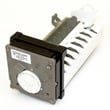
| No ice or poor ice production | Refrigerator ice maker D7824706Q | Ice harvest and fill cycle |
| Slow water flow, hollow cubes | Refrigerator water inlet valve assembly WP67006531 | Water supply into the refrigerator |
| Warm refrigerator section, uneven temps | Refrigerator electronic damper WPW10196393 | Cold-air flow from freezer to fresh food |
Why it matters
Most “not cooling” or “no ice” complaints trace back to airflow, sealing, or water pressure. Fixing those basics first prevents unnecessary part replacement and helps the compressor and evaporator system run normally.
Last updated: January 2026
Why is my refrigerator not getting cold at the bottom?
If your Kenmore Elite 59676609600 isn’t cold at the bottom, the most common causes are restricted airflow (blocked rear air grille under the crispers), dirty condenser coils, or a drawer/damper setting that is diverting cold air away from the lower section. Start with airflow and cleaning steps in the 59676609600 owner's manual.
Quick checks that fix most “warm bottom” complaints
- Make sure the rear air grille under the crisper drawers is not blocked by food packages.
- Remove any shelf liners (foil, wax paper, paper towels) that can reduce airflow.
- Avoid overcrowding shelves; packed shelves reduce circulation and slow cooling.
- Confirm doors close securely and nothing (drawers, bins, containers) is holding the door open.
- Clean the condenser coils (the manual recommends doing this about every 3 months).
Settings to verify (controls and pantry drawer)
Your model can route cold air to specialty drawers. The manual notes the Gourmet Pantry drawer has a temperature control that adjusts how much cold air enters that drawer; sending more cold air there can change temperatures in the main refrigerator.
Use this checklist:
- Set the refrigerator temperature to a normal mid-range setting, then wait 24 to 48 hours for temperatures to stabilize.
- If your unit has a pantry drawer control, move it from coldest toward cold/normal and recheck bottom-shelf temps.
- If the bottom is warm but the top is cold, focus on airflow restrictions and the damper system.
| Symptom | Most likely cause | What to do first |
|---|---|---|
| Bottom warm, top OK | Rear air grille blocked | Clear space in front of grille under crispers |
| Whole fridge warm | Dirty condenser coils | Clean coils, improve ventilation |
| Temps swing after drawer changes | Pantry/damper airflow shift | Reset drawer control, then adjust fridge control |
When a part is likely involved
If airflow is clear and coils are clean but the bottom still won’t cool, a failed air-control component can be the reason. On this model, an air-mixing issue can involve the refrigerator electronic damper WPW10196393.
Why it matters
Warm temperatures at the bottom usually mean the refrigerator is not circulating cold air correctly. Fixing airflow and coil cleanliness helps the compressor run less, protects food, and stabilizes temperatures.
Last updated: January 2026
What size is Kenmore refrigerator model 59676609600?
Kenmore refrigerator model 59676609600 is a bottom-mount style refrigerator; the exact exterior dimensions (width, height, depth) are listed in the installation and “measuring the opening” section of the 59676609600 owner's manual. For planning purposes, most bottom-mount refrigerators are roughly 30 to 36 inches wide, 65 to 70 inches tall, and 30 to 35 inches deep.
How to get the exact size for model 59676609600
Use the measurements from the manual so you can confirm fit with doors, hinges, and airflow clearance.
- Measure the cabinet opening (width, height, depth)
- Measure the refrigerator with doors closed
- Account for door swing clearance (handles and hinges)
- Leave space for airflow behind and above the unit
- Confirm water line routing if you have an ice maker
Typical size ranges (helpful for rough planning)
These ranges are common for Kenmore bottom-mount units, but your exact model can vary.
| Measurement | Typical range | What can change it |
|---|---|---|
| Width | 30 to 36 in. | cabinet style, door design |
| Height | 65 to 70 in. | hinge design, leveling legs |
| Depth | 30 to 35 in. | handles, door thickness |
Why it matters
Correct sizing prevents installation problems like doors that cannot open fully, a refrigerator that will not slide into the cutout, or restricted airflow that can reduce cooling performance and increase energy use.
Related installation tip (water and ice)
If you are connecting a water line for ice, confirm you have enough rear clearance and a secure connection. A common fitting used on many refrigerators is a 5/16-inch union such as the water supply tube union WP2300868.
Last updated: January 2026