 Owner’s manual




What is the average lifespan of a Kenmore washer?
A Kenmore washer typically lasts 10 to 15 years with normal household use and basic maintenance. For the Kenmore Elite 11049962600 specifically, good care (HE detergent, correct loading, and routine cleaning) is what most often determines whether it reaches the high end of that range; see the 11049962600 use & care manual.
What affects lifespan the most
These are the biggest factors that shorten or extend washer life, especially on front-load models like the 11049962600:
- Overloading (stresses the drive system, bearings, and suspension)
- Detergent choice (this model is designed for HE detergent; excess suds can cause issues)
- Moisture left in the door boot (can lead to odor, mildew, and leaks over time)
- Installation and leveling (vibration accelerates wear)
- Water quality and hose condition (sediment and aging hoses can cause fill and leak problems)
Typical lifespan expectations (what we see most often)
| Washer age | What’s common | What to do |
|---|---|---|
| 0 to 5 years | Mostly routine care | Keep it level; use HE detergent; clean regularly |
| 6 to 10 years | First repairs may show up | Address leaks/noise early; replace worn wear items |
| 10 to 15 years | More frequent repairs possible | Compare repair cost vs. overall condition |
Maintenance habits that help you reach 10 to 15 years
- Run the washer’s cleaning routine as described in the manual
- Leave the door slightly open between loads to dry the drum and boot
- Check pockets to reduce coins, screws, and debris reaching the drain system
- Keep loads balanced (mix small and large items)
- Inspect hoses periodically and replace if bulging, cracking, or leaking
When a “repair” can extend life significantly
On the 11049962600, a few common wear areas can be worth fixing if the washer is otherwise in good shape:
- Drain issues or slow draining (often tied to the drain pump or drain path)
- Leaks at the door opening (often tied to the door boot)
- Excessive vibration during spin (can be related to shock absorbers)
If you’re chasing a drain problem, the compatible replacement pump 280187 is one of the parts we commonly see involved.
Why it matters
Knowing the typical lifespan helps you decide whether to invest in maintenance and targeted repairs (like a pump or door boot) versus planning for replacement, especially once a washer is past the 10-year mark.
Last updated: January 2026
How to identify a Kenmore washer model?
To identify a Kenmore washer model, we look for the model/serial label on the washer cabinet. On the Kenmore Elite front-load washer model 11049962600, the label is commonly found around the door opening (door jamb) or on the cabinet near the control area; confirm the exact label location in the 11049962600 use & care manual.
Where to look on a Kenmore Elite 11049962600 (front-load)
Check these common spots first:
- Behind the washer door, around the door opening (door jamb)
- Along the front cabinet opening near the door latch area
- On the back of the control panel area (rear of the console)
- On the side of the main cabinet near the bottom edge
- On the rear panel of the washer cabinet
What to write down (and why)
Record the full model and serial exactly as shown on the label.
- Model number: identifies the exact design family and parts fit
- Serial number: helps match production changes and revisions
- Type/series code (if shown): can narrow down compatible parts
- Electrical rating (if shown): useful for diagnosing power issues
Quick ID checklist
| Item on label | Example format | Why it matters |
|---|---|---|
| Model number | 11049962600 | Ensures correct diagrams and parts |
| Serial number | Letters + numbers | Helps match manufacturing range |
| Brand | Kenmore | Confirms product line |
Why it matters
Kenmore model numbers can look similar, but small differences can change which door lock, water inlet valve, or drain components fit. Using the exact model number helps us match the right repair information and compatible replacement parts the first time.
Last updated: January 2026
How to hard reset kenmore washer?
To hard reset a Kenmore Elite washer model 11049962600, we recommend a simple power reset: turn the washer off, unplug it (or switch off the breaker) for 5 minutes, then restore power and select a cycle. This clears many temporary control glitches without changing settings.
Recommended reset steps for model 11049962600
We use these steps first because they are safe and work for most electronic front-load Kenmore washers.
- Press POWER to turn the washer off.
- Unplug the washer (or turn off the dedicated breaker).
- Wait 5 minutes.
- Plug back in (or turn breaker on).
- Press POWER, select Normal/Casual, then press and hold START for about 1 second.
- If the washer was mid-cycle, run Rinse/Drain & Spin to clear standing water.
For control and cycle behavior details specific to this washer, follow the steps in the 11049962600 use & care manual.
If the washer still acts “stuck” after a reset
A reset will not fix a mechanical failure or a part that is not operating correctly. If symptoms continue, check these common causes:
- Door not locking consistently (cycle will not start or pauses)
- Slow/no drain (cycle stops, won’t spin, or leaves water)
- Fill problems (won’t fill, fills slowly, wrong temperature)
- Excessive suds from non-HE detergent (can trigger long cycles and errors)
- Intermittent power supply (loose outlet, tripped breaker)
Quick symptom-to-part map (when a reset doesn’t help)
| Symptom after reset | What to check next | Model-compatible part example |
|---|---|---|
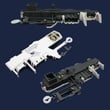
| Door won’t lock/start | Door latch/lock operation | Washer door lock WP8183270 |
| Won’t drain or stops mid-cycle | Drain path and pump | Pump 280187 |
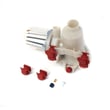
| Won’t fill or fills slowly | Screens/valve function | Washer water inlet valve WP8182862 |
Why it matters
A hard reset is a fast way to clear a temporary control-board logic issue. If the same problem returns right away, it usually points to a repeatable condition (drain, door lock, fill, or oversudsing) that needs troubleshooting or a part inspection.
Last updated: January 2026




