Installation guide
 Owner’s manual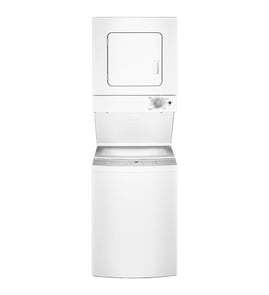



Is there such a thing as a combined washer and dryer?
Yes. There are two “combined” options: an all-in-one washer-dryer combo that washes and dries in one drum, and a stacked laundry center like the Whirlpool WET3300XQ0 that combines a washer and dryer in one space-saving unit (but they are separate machines). See the WET3300XQ0 owner's manual for operating and safety details.
What “combined” means (two common types)
- All-in-one washer-dryer combo: one drum does both washing and drying; you do not transfer clothes.
- Stacked laundry center (like WET3300XQ0): washer below and dryer above in one cabinet; you transfer clothes from washer to dryer.
- Stackable pair: two separate machines that can be stacked with a kit (not the same as a laundry center).
| Option | One drum? | Transfer clothes? | Typical drying style |
|---|---|---|---|
| All-in-one combo | Yes | No | Often ventless (condensing or heat pump) |
| Stacked laundry center (WET3300XQ0) | No | Yes | Typically vented dryer |
| Stackable pair | No | Yes | Vented or ventless depending on dryer |
What to consider before you buy or replace
- Venting: many laundry centers use a vented dryer; use rigid or heavy metal venting where possible because flexible venting can crush and trap lint.
- Electrical: confirm the outlet and grounding match the unit requirements.
- Dry time expectations: all-in-one combos often take longer to dry than a traditional vented dryer.
- Capacity and workflow: laundry centers keep a familiar washer-then-dryer routine; combos are convenient but can limit back-to-back loads.
Why it matters
Choosing the right “combined” setup affects installation (venting and electrical), cycle times, and how quickly you can run multiple loads. For the WET3300XQ0 laundry center, correct venting and safe operation practices are especially important.
Last updated: February 2026
What is the average lifespan of a whirlpool dryer?
A Whirlpool dryer typically lasts 10 to 13 years with normal household use and basic maintenance. For the Whirlpool stacked laundry center WET3300XQ0, keeping airflow strong (clean lint screen, correct venting) is one of the most important ways to help the dryer reach its full service life; see the WET3300XQ0 owner’s manual.
What affects dryer lifespan the most
- Venting length and turns: Long runs and too many 90° elbows reduce airflow, increase dry times, and can shorten dryer life.
- Lint control: Clean the lint screen before every load; lint buildup restricts airflow.
- Load size: Overloading strains the drum support system and drive components.
- Heat management: Poor airflow can overheat components like thermostats and thermal fuses.
- Usage pattern: Multiple loads daily typically shortens lifespan compared to light weekly use.
Quick maintenance checklist (best return for the effort)
- Clean the lint screen before each load.
- Check outside exhaust airflow; you should feel strong air movement.
- Use rigid metal venting where possible and minimize 90° turns.
- Avoid consistently overloading; let items tumble freely.
- If you hear thumping or squealing, inspect drum support parts early (a worn dryer drum support roller WPW10314173 can accelerate wear elsewhere).
Typical lifespan expectations
| Appliance section | Typical lifespan | What usually ends it first |
|---|---|---|
| Dryer (overall) | 10 to 13 years | Airflow restriction, overheating, wear items |
| Wear items (rollers, belt, idler) | 3 to 8 years | Heavy loads, high weekly usage |
| Controls/switches | 7 to 12 years | Heat, vibration, electrical wear |
Why it matters
A dryer that takes longer to dry is not just inconvenient; restricted venting and lint buildup raise operating temperatures and run time, which increases energy use and speeds up wear on key parts. Following the venting limits and airflow guidance in the WET3300XQ0 installation guide helps protect performance and longevity.
Last updated: February 2026
What is the capacity of the wet3300xq0?
The Whirlpool WET3300XQ0 stacked laundry center typically has a 2.5 cu. ft. washer and a 5.9 cu. ft. dryer. Use these capacities to size loads correctly so the washer can agitate freely and the dryer can tumble with good airflow; see the WET3300XQ0 owner's manual for cycle and loading guidance.
Capacity at a glance
| Component | Capacity | What it means for loading |
|---|---|---|
| Washer (top-load) | 2.5 cu. ft. | Small to medium loads; avoid packing clothes tightly |
| Dryer (electric) | 5.9 cu. ft. | Medium loads; leave space for tumbling and venting |
How we recommend using that capacity
- Fill the washer loosely; clothes should move easily during agitation.
- For bulky items (towels, hoodies, small blankets), run smaller loads to reduce out-of-balance spinning.
- In the dryer, do not overfill; good tumbling improves drying speed and reduces wrinkles.
- Clean the lint screen every load; restricted airflow makes even small loads dry slowly.
- Keep venting as straight and short as practical; long vent runs increase dry time and energy use.
Common “capacity” problems and what they point to
| Symptom | Most common cause | What to check first |
|---|---|---|
| Washer bangs or walks | Overloaded or uneven load | Redistribute load; reduce load size |
| Clothes still damp after drying | Overfilled drum or poor airflow | Lint screen, vent restriction, load size |
| Dryer takes too long | Venting too long or clogged | Vent path, hood flap, lint buildup |
Why it matters
Using the right load size protects key drive and suspension components, helps the Whirlpool washer spin smoothly, and lets the dryer maintain proper airflow for faster, more even drying.
Last updated: February 2026