Owner’s manual
 View engine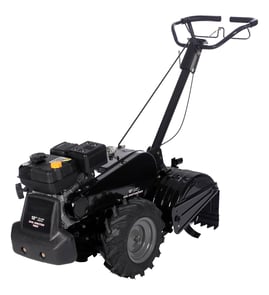



How often should I change the oil in my tiller?
For the Craftsman 917293311 rear-tine tiller, we change the engine oil after every 50 hours of operation or at least once a year (whichever comes first). We also check the oil level before starting and after each 5 hours of continuous use; this schedule helps prevent engine wear.
Recommended oil-change schedule
- Check engine oil level before each use
- Recheck oil after each 5 hours of continuous operation
- Change engine oil every 50 operating hours
- Change oil at least once per year even if you do not reach 50 hours
- Change oil more often in heavy load or high ambient temperatures
- Change oil more often in dusty or dirty conditions
Quick oil type guidance (what to use)
The manual specifies high-quality detergent oil with API service classification SF, SG, or SH. SAE viscosity depends on temperature; multi-viscosity oils (like 10W-30) can increase oil consumption above 40°F, so check the level more frequently.
| Situation | What we do | Why |
|---|---|---|
| Normal seasonal use | Change at 50 hours or yearly | Keeps lubrication fresh and reduces wear |
| Hot weather or heavy tilling | Change sooner than 50 hours | Heat and load break oil down faster |
| Dusty soil conditions | Change sooner than 50 hours | Dirt contamination accelerates engine wear |
Basic oil-change steps (high level)
Follow the procedure in the Craftsman 917293311 owner's manual. In general, we:
- Warm the engine briefly so oil drains more freely
- Park the tiller on a level surface
- Drain oil into a suitable container (avoid getting dirt into the engine)
- Reinstall and tighten the drain plug securely
- Refill through the oil fill tube to the correct level
Why it matters
Clean oil protects internal engine parts from friction and heat. Sticking to the 50-hour or annual interval is one of the simplest ways to extend engine life and keep your rear-tine tiller performing well.
Last updated: January 2026
Where is the model number on a Craftsman rear tine tiller?
On the Craftsman rear-tine tiller model 917293311, the model number is printed on the product identification label (model plate). On many rear-tine tillers, that label is typically placed on the tine shield/tine guard area or on the frame near the engine and controls; use the 917293311 owner's manual to confirm the exact label location and what information to record.
Where to look first (fast checks)
- Check the tine shield/tine guard area around the tines (rear of the machine).
- Look along the main frame rails on either side of the tiller.
- Inspect near the engine mounting area and belt/pulley guard.
- Check around the handle support/control panel area.
- Wipe dirt and oil off the label; a flashlight helps.
What the label usually includes
The ID label typically lists the model number and other details you may need when ordering parts.
| Label item | What it’s used for |
|---|---|
| Model number (example: 917293311) | Matching the correct parts diagrams and parts |
| Serial number | Identifying production run/version |
| Engine model info (if shown) | Engine-specific tune-up parts and service |
Why it matters
Using the exact model number helps us match the correct Craftsman parts for your rear-tine tiller, especially for drive and tine components where small design changes can affect fit.
Tip when ordering parts
If you’re replacing a wear item (like a belt or clutch cable), match it to the model number first, then verify the part by name and ID. For example, the husqvarna rear-tine tiller drive belt 591372401 is a model-matched drive belt option listed for 917293311.
Last updated: January 2026
What tiller is made in the USA?
Some tillers are made in the USA; Mantis Tillers are designed, engineered, and manufactured in the United States. For your Craftsman rear-tine tiller model 917293311, the best way to confirm country of manufacture is to check the product identification label and the documentation in the Craftsman 917293311 owner's manual.
How to confirm where a tiller is made
- Check the product ID plate on the tiller frame (often near the engine mount or handle support).
- Look for wording such as “Made in USA”, “Assembled in USA”, or an imported country listing.
- Compare the model number on the label to your paperwork to ensure it matches 917293311.
- Review the manual sections that list specifications and service information.
- If the label is missing, use the engine model and serial number to help identify origin.
“Made in” vs “assembled in”: quick comparison
| Label wording | What it usually means | What to do next |
|---|---|---|
| Made in USA | Manufacturing origin is the U.S. | Verify on the ID plate for the most accurate statement |
| Assembled in USA | Final assembly in the U.S.; parts may be global | Check the ID plate and packaging details |
| No origin listed | Origin not stated on the visible label | Use the ID plate, manual, and engine ID together |
Why it matters
Country-of-origin labeling can affect parts sourcing, service expectations, and compatibility when you are matching items like a drive belt, clutch cable, or tine hardware to your exact Craftsman model.
Last updated: January 2026
Can a tiller break new ground?
Yes. The Craftsman rear-tine tiller model 917293311 is designed to dig into and break up packed soil, so it can break new ground when you work in shallow passes and control depth and speed to prevent the tines from grabbing and pushing the machine forward. See the 917293311 owner's manual.
Best way to break new ground (without fighting the machine)
- Start with the throttle in a slower position until you get comfortable with handling.
- Make your first pass shallow; then deepen gradually on later passes.
- Aim for a typical working depth of 4 to 6 inches for tilling.
- If the soil is very hard, moisten it first; dry soil resists tine penetration and causes bouncing.
- Avoid extremely wet soil; it can ball up and clump instead of breaking apart.
- Leave a row untilled between passes, then come back between rows; wide turns are easier and the tiller tracks better.
Soil conditions that affect results
| Soil condition | What you will notice | What to do |
|---|---|---|
| Dry, hard ground | Tines struggle to penetrate; excessive bounce | Lightly moisten soil; reduce depth; slow down |
| Extremely wet ground | Soil balls up or clumps | Wait for soil to dry to a workable moisture level |
| Sod or tough sections | Tiller wants to climb or surge | Apply upward pressure on the handle or lower the depth stake |
Safety and control tips for hard ground
Hard ground can make the tines catch and propel the tiller forward. If that happens, let go of the handlebars and do not restrain the machine.
Also keep these basics in mind:
- Keep guards and shields in place.
- Keep children, pets, and bystanders away.
- Do not try to till too deep at too fast a rate.
Why it matters
Breaking new ground puts the highest load on the tines, belt drive, and transmission. Working in shallow passes protects the drivetrain, improves traction, and gives you a smoother seedbed with less bouncing and better control.
Last updated: January 2026