Owner’s manual
 Error Codes


What's the size of a side-by-side refrigerator?
Most side-by-side refrigerators are about 30 to 36 inches wide, 67 to 70 inches tall, and 29 to 35 inches deep. For your Kenmore 10659799990, use these as planning ranges, then confirm exact cabinet dimensions and required clearances in the owner's manual.
Typical size ranges (what to expect)
- Width: 30 to 36 in.
- Height: 67 to 70 in.
- Depth: 29 to 35 in. (often deeper if you include handles)
- Door swing: needs extra side clearance near walls
- Water line space: needed if you use an ice maker or water dispenser
Installation clearances (space you must leave)
Your Kenmore 10659799990 manual calls out these common minimum clearances:
- 1/2 in. on each side and at the top for ventilation
- Extra space behind the refrigerator for water line connections if an ice maker is installed
- 2 in. minimum on the hinge side when installed next to a fixed wall (so doors can swing open)
| What you are measuring | Include | Why it matters |
|---|---|---|
| Opening width | Cabinet opening, not trim | Prevents binding and vibration |
| Opening height | Floor to cabinet top | Avoids forced tilt-in installs |
| Depth | Case depth plus handles | Ensures doors can close fully |
| Side clearance | Hinge side near a wall | Allows full door swing and bin access |
Why it matters
Correct sizing prevents poor airflow (warm temps), door interference, and crushed water lines. Leaving the right clearance also helps the refrigerator run efficiently and reduces noise.
Last updated: February 2026
Where is the model number on a Kenmore side by side refrigerator?
On Kenmore side-by-side refrigerator model 10659799990, the model number is printed on the model and serial number label located on the inside wall of the refrigerator (fresh food) compartment. Use that label to record the full model number and serial number for parts lookup and service.
Where to look (fast checklist)
- Open the refrigerator (not freezer) door
- Look along the inside side walls near the front edge
- Check near the crisper area and shelf supports
- Look for a sticker or metal tag labeled “Model” and “Serial”
- Write down the full model number exactly as shown (including all digits)
What the label typically includes
| Item on label | What it’s used for |
|---|---|
| Model number (example: 10659799990) | Matching the correct parts diagram and parts list |
| Serial number | Identifying production details for service and compatibility |
| Purchase date (you record it) | Warranty documentation and maintenance records |
Why it matters
We use the model number to match your exact Kenmore configuration (doors, dispenser, ice maker, and water system). That prevents ordering the wrong part, especially for common replacements like a water filter, ice maker, or water inlet valve.
Helpful tip for parts ordering
Once you find the label, compare the model number on the tag to your parts page model (10659799990). For diagrams, maintenance info, and label location details, use the owner's manual.
Last updated: February 2026
How to clean the coils on a Kenmore side by side refrigerator?
For Kenmore side-by-side refrigerator model 10659799990, clean the condenser coils regularly by unplugging the refrigerator, accessing the coils (either behind the base grille or on the back), vacuuming dust and lint, then reinstalling the grille or moving the unit back into place and restoring power. See the owner's manual for the exact access method for your unit.
Steps to clean the condenser coils
- Unplug the refrigerator (or disconnect power).
- Find the coil location (your model can be one of two common styles):
- Style 1: coils behind the base grille
- Style 2: coils on the back of the refrigerator
- Clean the coils:
- Use a vacuum with an extended attachment.
- Work slowly to remove dust from the full coil surface.
- Reassemble and restore:
- If you removed the base grille, reinstall it.
- If you pulled the refrigerator out, roll it back and keep about 1 inch (2.5 cm) between the cabinet back and the wall.
- Plug the refrigerator back in.
Quick checklist (what we recommend)
- Vacuum coils until you no longer see dust buildup
- Clean around the front kickplate area and floor edges
- Keep the rear clearance at about 1 inch (2.5 cm) if coils are in back
- Recheck that the refrigerator is level after moving it
- Wipe up any loosened dust so it does not get pulled back into the condenser area
How often to clean the coils
Coils may need cleaning as often as every other month, especially if you have pets, heavy kitchen dust, or the refrigerator sits near a high-traffic area.
| Home condition | Typical coil-cleaning interval |
|---|---|
| Pets or lots of dust | Every 1 to 2 months |
| Average home | Every 3 to 6 months |
| Very clean, low dust | 6 to 12 months |
Why it matters
Clean condenser coils help your Kenmore refrigerator run more efficiently, maintain steadier temperatures, and reduce run time. That can also help prevent warm-fridge complaints caused by restricted airflow through the condenser area.
Last updated: February 2026
How to tell if a Kenmore refrigerator compressor is bad?
On Kenmore model 10659799990, a “bad compressor” usually shows up as poor or no cooling while the refrigerator still has power; you may also hear repeated clicking as the unit tries to start. Before condemning the compressor, we rule out normal operating sounds and basic airflow and power issues using the owner's manual.
Quick checks before blaming the compressor
- Confirm the refrigerator is plugged into a grounded 3-prong outlet and the breaker is not tripped.
- Make sure the refrigerator and freezer controls are not set to OFF.
- Give it 30 minutes if it may be in an automatic defrost cycle.
- Clean dirty condenser coils; dirty coils reduce heat transfer and can mimic compressor trouble.
- Verify doors seal fully; air leaks force long run times and warm temps.
What “normal compressor noise” sounds like on this model
Your manual explains that newer, high-efficiency compressors can run longer and may sound pulsating or high-pitched. These sounds alone do not mean the compressor is failing.
| Sound or symptom | Often normal? | What it usually points to |
|---|---|---|
| Pulsating or high-pitched running sound | Yes | High-efficiency compressor operating |
| Click when cycling on/off | Yes | Control or defrost timer cycling |
| Repeated click every few minutes with little/no cooling | No | Start device/overload issue or compressor not starting |
| Warm refrigerator and freezer, fans running | No | Sealed system or compressor problem (needs testing) |
Signs that point more strongly to a compressor or sealed-system problem
- Both compartments are warm even after controls are set correctly.
- The unit repeatedly tries to start (clicking) but does not stay running.
- The compressor is not running when it should be cooling (after basic checks above).
- Cooling is weak and never reaches safe temperatures.
Why it matters
A compressor is part of the sealed refrigeration system; misdiagnosing it can lead to unnecessary parts replacement. Doing the basic power, control, coil-cleaning, and door-seal checks first helps you pinpoint whether the issue is airflow/maintenance or a true sealed-system failure.
If you confirm a compressor-related failure and you are replacing parts, the model’s compressor listed for this refrigerator is the refrigerator compressor W10309994.
Last updated: February 2026
What does er if mean on a Kenmore refrigerator?
On Kenmore side-by-side refrigerator model 10659799990, ER IF is an ice-system airflow/fan related error; it shows up when the refrigerator senses the ice compartment is not getting proper cold-air movement. Start by clearing airflow restrictions and checking for ice buildup; then follow the diagnostic steps in the owner's manual.
What to do first (fast checks)
- Power reset: unplug the refrigerator for 5 minutes, then restore power.
- Make sure freezer vents and the ice bin area are not blocked by food packages.
- Empty the ice bin and remove any clumped ice that can restrict airflow.
- Check that the freezer door closes fully and the gasket seals all the way around.
- Look for frost or ice on the freezer back wall or around the ice chute area.
Common causes and what they point to
| What you notice | What it usually indicates | Next step |
|---|---|---|
| Little or no ice, ice bin area warmer than freezer | Restricted airflow to the ice area | Unblock vents, reduce overpacking, clear ice |
| Fan noise changes, rattling, or no fan sound | Fan obstruction or fan motor issue | Inspect for ice obstruction; test fan operation |
| Heavy frost buildup | Defrost system problem affecting airflow | Check for recurring frost; inspect defrost components |
Parts that can be involved (when symptoms match)
Use these only if your checks confirm the related failure:
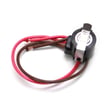
- Refrigerator defrost bi-metal WPW10225581 (if frost buildup keeps returning)
- Refrigerator heater WP2323198 (if defrost heat is not melting frost)
- Refrigerator ice bin WPW10670845 (if the bin is damaged or jams with ice)
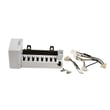
- Ice maker assembly - refrigerator ice maker by whirlpool 4317943 (if ice production does not recover after airflow is restored)
Why it matters
The ice maker depends on steady cold airflow. When airflow is restricted or the ice-area fan system is not working correctly, ice production drops and temperatures can drift warmer, which also increases frost and moisture problems.
Last updated: February 2026