Installation guide
 Owner’s manual
 Error Codes


What does PF stand for on a Kenmore dryer?
On the Kenmore 11075132412 dryer, PF stands for power failure. It means the dryer’s electrical power was interrupted during a cycle, so the cycle stopped and the control is alerting you that power was lost.
What to do when you see PF
- Press Pause/Cancel (or Stop) to clear the display.
- Re-select your drying cycle and press Push to Start to restart.
- Check that the dryer is plugged in firmly and the outlet is working.
- Check your home breaker or fuse; reset/replace if needed.
- If PF happens repeatedly, avoid using an extension cord or loose power strip.
Quick checks that often prevent repeat PF codes
- Make sure the outlet is not controlled by a wall switch.
- If the dryer is in a laundry closet, confirm the cord is not being pinched when the dryer is pushed back.
- If lights dim when the dryer starts, you may have a weak circuit connection (an electrician can confirm).
PF vs. other “power” symptoms
| What you notice | Most likely cause | What to check first |
|---|---|---|
| PF shows after a storm or flicker | Brief outage or voltage drop | Breaker, outlet, plug fit |
| Dryer won’t start at all | No power or start circuit issue | Breaker, door fully closed, start button |
| PF keeps returning mid-cycle | Intermittent power connection | Outlet, cord, house wiring |
Why it matters
A PF code is usually not a dryer failure; it is the dryer protecting the load and alerting you that the cycle did not finish normally. Clearing PF and fixing the power interruption helps prevent incomplete drying and repeated cycle restarts.
For control-panel operation details (cycle selection, Push to Start behavior, and basic troubleshooting), see the 11075132412 use & care manual.
Last updated: January 2026
How much does it cost to replace a heating element in a Kenmore dryer?
For Kenmore model 11075132412, we would not typically price a “heating element” replacement because this is a gas dryer; heat is produced by the burner system, not an electric heating element. Total repair cost depends on which gas-heat part failed and whether you DIY or hire service.
What you’ll usually pay (gas dryer vs. electric dryer)
A “heating element” cost range applies to electric dryers. For a gas dryer like 11075132412, costs usually center on ignition and safety components.
| Dryer type | Main heat source | Typical part(s) replaced | Typical cost driver |
|---|---|---|---|
| Gas dryer (11075132412) | Burner and ignition system | Igniter, gas valve coils, radiant sensor, thermal cut-off | Diagnosis + labor time |
| Electric dryer | Heating element | Heating element (sometimes with thermostats/fuses) | Element price + labor |
Common “no heat” parts for this model (and why they matter)
If your 11075132412 tumbles but won’t heat, these are common suspects:
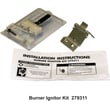
- Igniter 279311: heats up to ignite the gas burner.
- Dryer gas valve coil kit WPW10328463: opens the gas valve when energized; weak coils can cause intermittent heat.
- Dryer radiant sensor WP338906: detects burner flame/heat so the gas valve can stay open.
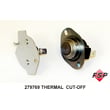
- Cut-off kit 279769: safety device that opens if the dryer overheats.
How to estimate your total replacement cost
Use this quick checklist to ballpark the total:
- DIY vs. pro service: labor is usually the biggest variable.
- Single part vs. multiple parts: ignition problems are sometimes fixed faster by replacing a matched set (for example, coils).
- Vent restriction: poor airflow can overheat the dryer and repeatedly trip safety parts.
- Access time: some repairs require more disassembly than others.
Why it matters
Calling it a “heating element” can send you to the wrong part. On a gas dryer like Kenmore 11075132412, accurate diagnosis helps you avoid replacing good parts and gets heat restored faster.
Helpful reference
- 11075132412 use & care manual: includes troubleshooting guidance for “no heat” and airflow issues.
Last updated: January 2026
What are common problems with Kenmore dryers?
Common problems we see on the Kenmore 11075132412 gas dryer include long dry times from restricted venting, no-heat conditions, the dryer not starting, and noise or vibration from worn drum support parts. Many of these issues trace back to airflow, door/start switches, or heat-safety components; see the 11075132412 use & care manual for model-specific troubleshooting steps.
Most common symptoms and what usually causes them
- Clothes take too long to dry: lint screen clogged, vent/hood restricted, crushed or too-long vent run
- No heat: gas supply valve closed, airflow restriction causing overheating protection to open, failed ignition components
- Won’t start: door not fully closed, failed start switch or door switch, power supply issue
- Loud thumping/squealing: worn belt, rollers, or other drum support components
- Burning smell or hot cabinet: blocked airflow, lint buildup in venting or cabinet
Quick checks we recommend first (fast, high-impact)
- Clean the lint screen every load and wash it periodically to remove residue.
- Confirm strong airflow at the outside exhaust hood while the dryer runs.
- Verify the gas shutoff valve is fully open (handle parallel to the pipe).
- Avoid overloading; heavy loads need room to tumble.
- If the dryer is in a closet, make sure the door has proper ventilation openings.
Parts that commonly solve these problems
If troubleshooting points to a failed component, these are common on this model:
| Symptom | Likely part to test/replace | Example compatible part for this model |
|---|---|---|
| Won’t start (door must be shut) | Door switch | Dryer door switch WP3406107 |
| Starts then stops or won’t run (overheat protection) | Thermal fuse / cut-off | Dryer thermal fuse WP3392519 |
| Squealing or drum not turning | Belt / drum support wear | Belt 341241 |
Why it matters
On the 11075132412, restricted venting is one of the biggest root causes because it increases drying time and can trigger heat-safety shutdowns. Fixing airflow first often prevents repeat failures of fuses, thermostats, and ignition-related parts.
Last updated: January 2026