Owner’s manual
 View engine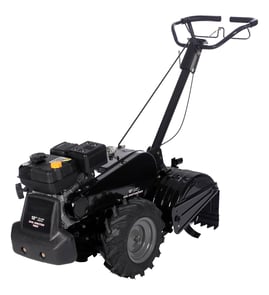


What tiller is made in the USA?
Some tillers are made in the USA; for example, Mantis states its tillers are designed, engineered, and manufactured in the U.S.A. If you are shopping for a USA-made tiller to compare with your Craftsman model 917297041, confirm the country of origin on the product data plate and in the 917297041 owner's manual.
- Check the product data plate (often on the frame near the engine or transmission).
- Look for “Made in …” or “Assembled in …” wording (these are not the same).
- Match the model number and serial number to the documentation.
- Review the packaging or dealer listing for origin statements.
- If you are buying used, ask for a clear photo of the data plate.
| Label you see | What it typically indicates | What to do next |
|---|---|---|
| Made in USA | Manufacturing origin claim | Verify on the data plate and documentation |
| Assembled in USA | Final assembly location; parts may be global | Ask where major components are sourced |
| Designed/engineered in USA | Product development location | Do not assume manufacturing origin |
Country-of-origin can affect parts sourcing, service expectations, and resale value. For your Craftsman 917297041 rear-tine tiller, the most reliable way to confirm specifications and identification details is to use the model-specific documentation and the data plate.
Last updated: January 2026
Where is the model number on a Craftsman rear tine tiller?
On the Craftsman rear-tine tiller model 917297041, the model number is shown in the documentation as “917.297041” and is typically found on the tiller’s model/serial label, most often on the tine shield/guard area or the main frame near the controls. Use the exact model number when ordering parts.
- Tine shield or tine guard (near the tines and safety shields)
- Main frame rail on the left side (near the belt guard area)
- Handle/control panel area (near the throttle and drive control)
- Near the engine mounting area or fuel tank bracket
- Park the tiller on a flat surface and let the engine cool.
- Wipe dirt off the frame and tine shield with a rag so the label is readable.
- Look for a sticker or metal tag that lists MODEL and often SERIAL.
- Match what you see to the format in the 917297041 owner's manual (it may appear with a dot as 917.297041).
| What you see on the label | What it means | What to use for parts |
|---|---|---|
| 917297041 | Same model number without punctuation | 917297041 |
| 917.297041 | Same model number with a dot | 917297041 |
We use the model number to pull the correct Craftsman parts diagrams and part listings (for example, drive and tine components). Using the exact model number helps avoid ordering a belt, cable, or hardware that does not fit your tiller.
Last updated: January 2026
How to lubricate a tiller?
For the Craftsman 917297041 rear-tine tiller, we lubricate the key moving points regularly and grease the transmission gear case once per season. Use engine oil on control and pivot points, and EP #1 grease at the right-hand gear case grease fitting to protect gears and reduce wear.
Use the lubrication chart in the 917297041 owner's manual as your map. Typical lube points include:
- Throttle control pivot and linkage
- Depth stake pin bracket
- Wheel hubs
- Right-hand (RH) gear case grease fitting (transmission)
- Any other pivots or moving joints that bind or squeak
The manual calls out two main lubricant types:
| Location | What to use | How often |
|---|---|---|
| Throttle control, depth stake pin bracket, wheel hubs | SAE 30 or 10W-30 motor oil | As needed; check before each use |
| RH gear case grease fitting (transmission) | EP #1 grease | Once a season (about 1 oz.) |
- Shut the tiller off and let hot parts cool; disconnect the spark plug wire for safety.
- Wipe dirt off fittings and pivot points so grit does not get pushed into moving parts.
- Apply a few drops of motor oil to pivots and linkages; work the control to spread it.
- Grease the RH gear case fitting with about 1 oz. of EP #1 grease (once per season).
- Wipe off excess oil or grease to reduce dirt buildup.
Proper lubrication keeps the transmission gears, wheel hubs, and control linkages moving freely. That reduces premature wear on drive components (like the drive belt and clutch system) and helps prevent binding, squealing, and poor tine performance.
Last updated: January 2026
How much does a Craftsman rear tine tiller weigh?
The Craftsman rear-tine tiller model 917297041 weight depends on its exact configuration (wheels, counterweights, and any installed accessories). For the correct specification for your unit, use the Product Specifications section in the 917297041 owner's manual.
Use these steps to get the most accurate number for your tiller:
- Open the Product Specifications section listed in the table of contents.
- Look for a line labeled weight, unit weight, or shipping weight.
- If more than one weight is listed, note which one applies to your need (shipping vs. assembled).
- Match the manual’s model number to your tiller’s ID tag: 917297041.
Most rear-tine tillers in this class are heavy enough that two-person lifting or a ramp is the safe approach. If you want to measure your actual unit, weigh it in a consistent condition.
- Remove loose accessories (if applicable)
- Clean off packed soil from tines and shields
- Keep fuel level consistent (full or empty) before weighing
- Use a platform scale, or weigh each wheel end separately and add totals
| Term | What it means | When to use it |
|---|---|---|
| Shipping weight | Packaged for delivery | Freight, receiving, storage |
| Assembled (dry) weight | Assembled without fuel | Loading ramps, lifting, transport |
| Operating weight | Ready to run with fluids | Real-world handling |
Knowing the correct weight helps us plan safe loading and tie-down, choose the right ramp capacity, and avoid damage when servicing drive components such as the husqvarna rear-tine tiller drive belt 591372401.
Last updated: January 2026