Owner’s manual
 Error Codes


What is the difference between force defrost RD and FD?
On Samsung model RF263AERS, RD (refrigerator defrost) runs a forced defrost focused on the fresh food (refrigerator) evaporator, while FD (full/forced defrost) runs a broader defrost cycle intended to clear heavier ice buildup across multiple cooling areas. Use RD for fridge-only frost symptoms; use FD when freezer or ice maker icing is also involved. See the RF263AERS owner's manual for the exact button sequence and display behavior.
When to use RD vs FD
- Choose RD when the refrigerator section is warm, airflow is weak in the fresh food compartment, or you see frost behind the fridge rear panel.
- Choose FD when you have widespread icing symptoms such as freezer airflow issues, repeated ice maker freezing, or heavy frost that returns quickly.
- If you are unsure, start with RD; if symptoms persist, move to FD after the unit returns to normal cooling.
What each mode typically affects
| Mode | Primary target | Best for | What you may notice |
|---|---|---|---|
| RD | Refrigerator evaporator area | Fridge-only frost and warm fresh food temps | Water dripping to drain, temporary fan noise changes |
| FD | Whole-unit defrost strategy | Heavy icing that impacts freezer and ice production | Longer defrost time, more melt water to the drain |
Before and after you run a forced defrost
- Move perishable food to a cooler if temps are already high.
- Place towels in the fresh food section if you have a history of water dripping.
- After defrost, confirm temps return to normal (Samsung commonly recommends about 3°C / 37°F for fridge and -19°C / -2°F for freezer).
- If you get water pooling or recurring ice, inspect the drain path; a restricted drain often causes repeat icing.
Why it matters
Using the right forced defrost mode helps you melt ice where it is actually blocking airflow. That restores proper cooling, reduces fan noise from ice contact, and can prevent repeat water leaks from an overwhelmed drain system.
Last updated: February 2026
Do all Samsung refrigerators take the same filter?
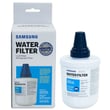
No. Samsung refrigerators do not all use the same water filter; the correct cartridge depends on the specific refrigerator model and filter housing. For the Samsung RF263AERS, the manual references a Samsung filtration system and a replacement cartridge type, so matching by model is the safest way to avoid fit issues and leaks (see the RF263AERS owner's manual).
How to identify the correct filter for RF263AERS
Use one of these methods (in order):
- Check the existing filter for a printed cartridge number.
- Look up the filter information by refrigerator model number RF263AERS.
- Confirm the filter style matches your housing (twist-in vs push-in; length and end-cap shape).
- After installing, flush water until it runs clear to purge air and carbon fines.
- Keep water pressure in the normal range for proper ice maker operation (the manual notes 20 to 125 psi).
What the RF263AERS manual tells us about filters
The RF263AERS documentation includes a “Water filter chart” and identifies the filtration system and cartridge family used with that system.
| Item in documentation | What it means for you | What to do before buying |
|---|---|---|
| Filtration system model reference | Filters are system-specific | Match the cartridge to your model, not just the brand |
| Replacement cartridge reference | There is a defined compatible cartridge type | Verify the cartridge number on your current filter or in the manual |
| Water pressure guidance (20 to 125 psi) | Low pressure can reduce ice and water performance | Confirm household pressure if dispensing is slow |
Why it matters
Using the wrong Samsung filter can cause poor fit, restricted water flow, leaks at the filter head, and weak ice production. Matching the cartridge to RF263AERS keeps the water dispenser and ice maker working as designed.
Last updated: February 2026
What is the most common problem with Samsung refrigerators?
For Samsung refrigerators like model RF263AERS, the most common customer-reported problems are ice maker issues (no ice, small cubes, freezing up) and cooling symptoms caused by airflow restriction from frost or a fan problem. We use the RF263AERS owner's manual to confirm operating requirements such as water pressure for ice production.
Most common issues we see
- Ice maker not making ice or freezing up in the ice room
- Water dispenser slow flow or no water
- Refrigerator section warm while freezer seems OK (airflow or fan related)
- Frost buildup that blocks vents and reduces cooling
- Water leaking or puddles (often tied to a clogged drain path)
Quick checks that solve many complaints
- Confirm water supply and pressure: This model needs 20 to 125 psi for proper ice maker operation.
- Purge air from the line: Dispense water until flow is steady.
- Check for blocked air holes/vents: Don’t pack food tightly against vents.
- Look for frost buildup: Heavy frost points to a defrost or airflow problem.
- Inspect for leaks at the back and under crispers: A restricted drain can cause water to collect.
Parts that commonly relate to these symptoms (when replacement is needed)
| Symptom | Common area to inspect | Example part for this model |
|---|---|---|
| No ice or slow fill | Water supply into refrigerator | Refrigerator water inlet valve DA62-01477A |
| Puddles/leaks inside | Drain path and drain tube | Refrigerator cabinet drain tube assembly DA97-04049H |
| Warm temps, poor airflow | Condenser area airflow | Refrigerator condenser fan DA31-00146B |
Why it matters
Ice maker and cooling problems often share the same root cause: restricted airflow or restricted water flow. Fixing the underlying cause protects food quality, stabilizes temperatures, and helps the refrigerator avoid excessive run time.
For deeper troubleshooting by symptom, we also use Samsung-specific guidance like why your Samsung fridge stopped making ice and how to fix it.
Last updated: February 2026