Installation guide
 Owner’s manual



How to reset Whirlpool dishwasher quiet partner 1?
To reset a Whirlpool Quiet Partner 1 style dishwasher like model WDT790SLYM1, we restore power to clear a stuck control: turn the dishwasher off, cut power at the breaker (or unplug), wait 1 to 5 minutes, then restore power and start a new cycle. Refer to the WDT790SLYM1 owner’s manual for the exact control-panel sequence.
- Press Cancel/Drain (if the dishwasher responds) and let it drain.
- Turn OFF power at the circuit breaker (or unplug under the sink).
- Wait 1 to 5 minutes.
- Turn power ON.
- Select a normal cycle and press Start/Resume.
- If the unit was mid-cycle, allow a minute for the control to reinitialize.
A “no reset” symptom is usually a power, door-latch, or control issue. Check these common causes:
- Door not fully latched (control will not start a cycle)
- Tripped breaker or loose power connection
- Water in the base from a leak (some models pause for protection)
- Keypad/control not responding (stuck key or failed control)
- Drain problem preventing a new cycle from starting
| Symptom | What to check | Common related part for WDT790SLYM1 |
|---|---|---|
| Hums but will not drain | Drain path and pump | Dishwasher drain pump WPW10348269 |
| Dead display or erratic behavior | Power supply, then control | Dishwasher electronic control board WPW10629159 |
A proper reset clears a locked-up electronic control and lets you confirm whether the problem is a one-time glitch or an ongoing issue (like a drain pump, wiring, or control board failure).
Last updated: January 2026
What does E1 F1 mean on a Whirlpool dishwasher?
On the Whirlpool WDT790SLYM1 dishwasher, the E1 F1 (often shown as F1 E1) error points to a water-sensing or draining problem; the dishwasher is detecting abnormal water conditions and may stop to prevent poor washing or overflow.
- Cancel the cycle and let the unit drain, then restart a normal cycle.
- Check the sink drain and disposer inlet for a clog (a blocked sink drain can back up the dishwasher).
- Confirm the drain hose is routed correctly: it should be looped up under the counter or connected to an air gap.
- Make sure the drain connection point is at least 20 inches above the floor.
- Inspect the drain hose for kinks, crushing, or grease buildup.
Correct drain routing prevents backflow that can trigger drain-related errors.
| Item to verify | What “correct” looks like | Why it matters |
|---|---|---|
| High loop or air gap | Hose is looped and secured under the counter, or uses an air gap | Prevents dirty water from siphoning back |
| Connection height | Drain connection is 20 inches minimum above the floor | Reduces backflow risk |
| Hose length | Do not exceed 12 ft total drain hose length | Helps the drain pump move water reliably |
For the exact routing and connection details, follow the WDT790SLYM1 installation guide.
If the hose routing is correct and the dishwasher still throws E1 F1, the most common next suspects are the drain system and water sensing components.
- If you hear humming but little or no draining: the dishwasher drain pump WPW10348269 is a common fix.
- If draining is slow or intermittent: check for restrictions at the hose, disposer inlet, and sump area.
- If the unit drains but the code returns: the turbidity (soil) sensor can be involved; see dishwasher turbidity sensor WPW10705575.
E1 F1 is the dishwasher telling you it cannot reliably manage water level or draining. Fixing hose routing and drain performance protects the pump, improves cleaning, and helps prevent leaks and standing water.
Last updated: January 2026
What's the most common problem with a Whirlpool dishwasher?
The most common problem we see on Whirlpool dishwashers like model WDT790SLYM1 is poor wash performance (dishes still dirty) caused by restricted water flow from a dirty filter, clogged spray arm holes, or low incoming water. Drain and start issues are also common but usually trace back to simple checks.
- Dirty dishes or grit left behind: filter needs cleaning, spray arm ports clogged, or water not heating well
- Water left in the bottom: drain path restricted, drain hose routing issue, or a weak drain pump
- Won’t start or stops quickly: door not latched, Start/Resume timing, or power supply issue
- Poor drying: rinse aid missing or low, or heater not operating correctly
- Long cycles: normal on energy-efficient models; many loads average 2 to 3 hours
Use these checks from the installation and operation guidance before replacing anything:
- Confirm the water supply is turned on
- Verify the door is closed tightly and latched
- Check the breaker/fuse if the unit is dead
- Start a short cycle; after about 2 minutes, open the door and confirm water is in the tub
- If Start/Resume is flashing, close the door within 3 seconds after pressing Start/Resume
If cleaning and basic checks do not solve it, these model-matched parts are frequent fixes:
| Problem you notice | Common fix | Example model-matched part |
|---|---|---|
| Standing water | Restore draining | Dishwasher drain pump WPW10348269 |
| Poor cleaning | Restore spray coverage | Dishwasher spray arm WPW10491331 |
| Poor drying or cool water | Restore heating | Dishwasher heater W10703867 |
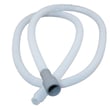
| Slow draining or leaks at drain path | Replace drain line | Dishwasher drain hose 8269144A |
Most “big” dishwasher complaints are really water-flow problems. When the filter, spray arm, or drain path is restricted, the dishwasher cannot circulate or remove soil correctly, so performance drops and cycles can seem inconsistent.
For model-specific operating tips and cycle behavior, follow the WDT790SLYM1 owner’s manual.
Last updated: January 2026