Owner’s manual
 Error Codes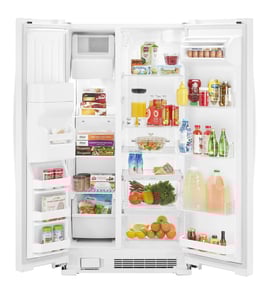


What size is a Kenmore 36350242000 refrigerator?
The Kenmore 36350242000 is a side-by-side refrigerator; its exact exterior dimensions and total capacity depend on the specific configuration listed in the product specifications. We use the clearances in the owner's manual to plan fit and airflow, then confirm the cabinet opening measurements before moving it in.
What “size” usually means (and what to measure)
When customers ask for refrigerator size, it typically refers to one or more of these:
- Overall width, height, and depth (for fitting the opening)
- Capacity in cubic feet (food storage space)
- Door swing clearance (space needed to open doors fully)
- Installation clearances (airflow space around the cabinet)
Quick measuring checklist
- Measure the opening width at top, middle, and bottom.
- Measure height to the lowest cabinet or soffit.
- Measure depth from back wall to the front edge of counters.
- Add space for door handles and door swing.
- Plan a path through doorways and hallways for delivery.
Model-specific installation clearances (from the manual)
For the Kenmore 36350242000, the manual calls for these minimum clearances for installation and airflow:
| Location | Minimum clearance |
|---|---|
| Sides | 5/8 in (16 mm) |
| Top | 1 in (25 mm) |
| Back | 1 in (25 mm) |
If the refrigerator sits against a wall, the manual also notes extra door clearance may be needed so the doors can open properly.
Why it matters
Correct sizing prevents poor cooling, noisy operation, and doors that do not open fully. Proper clearances also help the condenser and sealed refrigeration system run efficiently and maintain stable refrigerator and freezer temperatures.
Last updated: February 2026
Why is my Kenmore side by side ice maker not working?
If your Kenmore 36350242000 side-by-side refrigerator ice maker is not making ice, the most common causes are the feeler arm being in STOP (up), the freezer not reaching 15°F (-9°C) or colder, or a water supply issue (shutoff valve off, clogged tubing, or low water pressure). Use the owner's manual steps below to pinpoint the failure.
Quick checks (fastest fixes first)
- Confirm the ice maker feeler arm is in ON (down) and nothing blocks its movement.
- Make sure the freezer is cold enough; the ice maker starts operating at 15°F (-9°C) or below.
- If the refrigerator was just installed or restarted, allow up to 24 hours for ice production.
- Verify the household shutoff valve is fully open and the supply line is not kinked.
- If you recently added a filter, check for a clogged or incorrectly installed cartridge.
Water supply and filter issues to rule out
Water problems are a top reason the mold never fills.
- Check for a clogged supply line or restricted shutoff valve.
- Confirm the ice maker is connected to a cold water line.
- Make sure your home water pressure is in the typical operating range for this style of ice maker (20 to 120 psi).
- If the dispenser or ice maker is slow after a new connection, purge air by dispensing water for a couple minutes.
If you suspect a restriction at the filter, replacing the refrigerator water filter MWFP is a practical next step.
What you should hear and see
These clues help separate “no water” from “not cold enough.”
| Symptom | What it usually means | What to do |
|---|---|---|
| No ice, feeler arm down, freezer warm | Not at ice-making temperature | Set colder and wait 24 hours |
| No ice, freezer cold, mold is dry | Water supply or inlet valve issue | Check shutoff valve, line, filter |
| Buzzing at fill time but no water connected | Ice maker calling for water | Raise feeler arm to STOP until water is connected |
Why it matters
An ice maker depends on two things: freezer temperature and steady water flow. Fixing a simple shutoff valve, kinked copper tubing, or a clogged filter prevents repeated no-ice problems and protects the ice maker from running dry.
Last updated: February 2026
Where is the model number on a Kenmore side by side refrigerator?
On Kenmore model 36350242000 side-by-side refrigerators, the model and serial number are printed on an identification plate inside the fresh food (refrigerator) compartment. You’ll typically find it on the wall beside the top drawer or at the bottom, just inside the fresh food door. See the 36350242000 owner's manual for the exact label locations and diagrams.
Where to look (fast checklist)
Check these common spots inside the refrigerator section:
- Side wall beside the top drawer (crisper area)
- Lower wall near the bottom of the fresh food compartment
- Just inside the fresh food compartment door opening (near the hinge side)
- Behind or above the crisper drawers (you may need to slide a drawer out)
- Near the temperature controls area (less common, but worth a quick look)
What the label shows and why it matters
The identification plate usually includes both the model number and serial number. We use the model number to match the correct Kenmore parts list (door hinge, water inlet valve, defrost timer, light switch) and to ensure compatibility.
Model vs. serial number
| Item | What it’s used for | Example format |
|---|---|---|
| Model number | Identifies the exact refrigerator design and parts | 36350242000 |
| Serial number | Identifies the specific unit and production run | Letters plus numbers (varies) |
Tips for finding it if you don’t see it right away
- Use a flashlight; the plate is often low and easy to miss.
- Remove food bins and slide out the top drawer to check the side wall.
- Wipe condensation or dust off the surface; printing can be faint.
- Write the model and serial number down before ordering parts.
Why it matters before ordering parts
Kenmore side-by-side refrigerators can look similar across model families, but parts like a water filter, defrost components, and dispenser parts can differ. Using the exact model number helps us match the right replacement part the first time.
Last updated: February 2026
How to replace an ice maker in a side by side refrigerator?
To replace the ice maker in your Kenmore 36350242000 side-by-side refrigerator, we shut off the water supply, unplug the refrigerator, swap the ice maker assembly, then restart it with the feeler arm in the ON (down) position. Use the 36350242000 owner's manual for the exact shelf and bin positioning.
Before you start (safety and setup)
- Unplug the refrigerator.
- Turn off water at the shutoff valve.
- Pull the refrigerator out carefully; keep the water line from kinking.
- Protect the floor and have towels ready for small spills.
- If the ice storage bin is full, remove it first and set it aside.
Replacement steps (typical side-by-side process)
- Move the ice maker feeler arm to STOP (up).
- Remove the ice storage bin (support it front and back as you pull it out).
- Remove the freezer shelf or reposition it to access the ice maker area.
- Disconnect the ice maker wiring harness and water fill tube connection (if equipped).
- Remove mounting screws, lift the ice maker off its brackets, and transfer any matching brackets or parts from the old unit to the new one.
- Install the new ice maker, reconnect wiring and the fill tube, and reinstall the shelf and bin.
- Turn water back on, plug the refrigerator in, and check for leaks.
Restarting the ice maker correctly
The manual guidance for this model is specific:
- Set the feeler arm to ON (down) to start ice making.
- The ice maker will not run until the freezer reaches 15°F (-9°C) or below.
- Discard the first few batches of ice to flush the water line.
Quick reference
| Item | What to do | What to expect |
|---|---|---|
| Feeler arm | STOP (up) during service; ON (down) to run | Prevents unwanted cycling while you work |
| Freezer temperature | Get to 15°F (-9°C) or colder | First cubes typically take several hours |
| First ice | Throw away first few batches | Flushes impurities from the water line |
Why it matters
Correct shelf and bin placement under the ice maker helps cubes drop cleanly into the storage bin and prevents jams or clumping. Proper restart steps also reduce early water spillage (a brief double-cycle at first start can be normal).
Last updated: February 2026
What are the most common problems with Kenmore refrigerators?
The most common issues we see on Kenmore refrigerators like model 36350242000 are cooling problems, frost buildup, water and ice dispenser troubles, leaks, and noise or vibration. Many of these come down to airflow being blocked, doors not sealing, or a failing defrost or water-supply component; our 36350242000 owner's manual walks through the key checks.
Most common symptoms and what usually causes them
- Not cooling or running too much: blocked air vents, doors opened often, controls set incorrectly, warm room conditions
- Too warm or moisture inside: vents blocked, doors not closing, frequent door openings, humid weather
- Frost or ice crystals on frozen food: door not closing properly, frequent door openings
- Noisy or vibrating: unit not level, weak/uneven floor, water line tubing rattling behind the refrigerator
- Lights not working: loose or burned-out bulb, door switch issue
Quick checks we recommend first (fast, no parts)
- Confirm power and settings: make sure it is plugged in and the temperature control is not set to OFF; set controls to the manual’s “initial setting.”
- Check airflow: feel for airflow at the vents and move packages that block vents between the freezer and fresh food sections.
- Inspect door closing: remove items that keep the door from closing; reseat bins, shelves, and drawers.
- Level the refrigerator: adjust leveling legs/rollers so it rests solidly and doors align.
- Listen for icemaker valve buzzing: if the icemaker is ON but not connected to water, raise the feeler arm to STOP to prevent damage.
Common symptom-to-fix guide
| Symptom | What to check first | Parts that commonly relate (if needed) |
|---|---|---|
| Too warm / moisture | Blocked vents, door not closing, control settings | Defrost components such as refrigerator defrost timer WR9X489 or refrigerator defrost bi-metal thermostat WR50X122 |
| Lights out | Bulb seated, bulb burned out, door switch | 40-watt appliance light bulb 40A15 or light switch WR23X37285 |
| Water dispenser/ice issues | Water supply, filter age, valve function | Refrigerator water filter MWFP or water inlet valve assembly WR57X10023 |
Why it matters
Cooling, frost, and moisture problems usually start as airflow or door-seal issues; fixing those early helps the compressor run less, protects food quality, and prevents ice buildup that can lead to bigger repairs.
Helpful DIY guidance
- How to replace the water filter in a Kenmore refrigerator
- How to prevent water dispenser and ice maker problems
- How to diagnose a faulty refrigerator water inlet valve
Last updated: February 2026