 Owner’s manual
 Error Codes




What is the life expectancy of a GE dryer?
A GE dryer like model GFD55ESSN0WW typically lasts 10 to 13 years with normal household use. Consistent airflow maintenance (lint screen and venting) and avoiding overloads are the biggest factors that help this dryer reach the upper end of that range.
What affects lifespan the most
- Vent restriction (long runs, crushed duct, lint buildup) increases heat stress and run time
- Lint screen care (clean every load; wash off waxy residue when needed)
- Load habits (overloading strains the drum, belt, rollers, and motor)
- Installation quality (proper leveling and correct exhaust materials)
- Usage frequency (multiple loads daily shortens overall service life)
Maintenance schedule we recommend for GFD55ESSN0WW
Use the care and cleaning guidance in the GFD55ESSN0WW owner’s manual to keep performance consistent.
| Task | How often | Why it helps |
|---|---|---|
| Clean lint screen | Every load | Maintains airflow and drying efficiency |
| Inspect vent hood flap outside | Monthly | Confirms exhaust is not blocked |
| Clean/inspect exhaust ducting | At least yearly | Reduces dry time and heat buildup |
| Level the dryer (check for rocking) | As needed | Reduces vibration and wear |
Parts that commonly wear as a dryer ages
If your dryer starts squealing, thumping, or struggling to tumble, wear items are often involved.
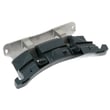
- Drum support rollers (noise, thumping): dryer drum support roller assembly WE03X10016
- Drum belt (won’t tumble, slipping): check the parts list for the correct belt for your exact configuration
- Idler assembly (squeal, belt tension issues): check the parts list for the correct idler for your exact configuration
Why it matters
A dryer that is taking longer to dry or running hotter than normal usually is not “just old”; it is often telling you airflow is restricted or a wear part is failing. Fixing those issues early can prevent bigger repairs and helps your GE dryer reach its full expected lifespan.
Last updated: January 2026
Is GFD55ESSNWW stackable?
Yes. The GE GFD55ESSN0WW dryer is designed to be stacked on top of a compatible front-load washer, but it must be installed using the correct GE stacking kit (GFA28KITN) and the stacking steps in the GFD55ESSN0WW owner’s manual & installation instructions.
What you need to stack this dryer
To stack the GE GFD55ESSN0WW safely, we recommend:
- A compatible front-load washer (dryer stacks only on a washer)
- The correct stacking kit: GFA28KITN (sold separately)
- Two people to lift and position the dryer
- A level floor and a properly leveled washer
- Proper venting to the outdoors (do not crush or kink the exhaust duct)
Key stacking rules (to avoid installation problems)
These points matter most during installation:
- Stack dryer on washer only (never washer on dryer)
- Do not modify the stacking kit hardware
- Level the washer first; then attach the dryer using the kit brackets
- Plan venting and power cord routing before you slide the stacked unit into place
- In mobile or manufactured homes, stacking a gas dryer is not permitted (if your unit is gas)
Quick compatibility checklist
Because washer compatibility can vary by series and depth, we use this as a practical checklist.
| Item | What to confirm | Why it matters |
|---|---|---|
| Stacking kit | Kit is GFA28KITN | Ensures brackets/spacers fit the cabinet design |
| Washer type | Front-load washer | Top-load washers are not designed for stacking |
| Depth match | Washer depth matches the kit bracket setup | Prevents overhang and instability |
| Venting | 4-inch metal ducting to outdoors | Helps prevent long dry times and airflow issues |
Why it matters
Stacking saves space, but it also increases the risk of vibration, tipping, and vent restrictions if the dryer is not secured correctly. Following the GE procedure and using the correct kit helps keep the cabinet stable and the dryer drying efficiently.
Last updated: January 2026
What brand of dryer has the least problems?
No single dryer brand can be identified as having the “least problems” for your GE GFD55ESSN0WW based on model-specific information; reliability varies more by design complexity, installation, and maintenance than by logo. For fewer issues, follow the care and venting guidance in the GFD55ESSN0WW owner’s manual.
What usually drives “least problems”
Across full-size residential dryers (including GE), the most common repeat issues are tied to airflow, heat management, and wear items.
- Restricted venting causes long dry times and overheating
- Lint buildup increases strain on the blower and heater system
- Overloading accelerates belt, roller, and idler wear
- Poor leveling can lead to vibration and noise
- Feature-heavy controls add more components that can fail
How we’d compare dryer “reliability” in a practical way
Instead of ranking brands, we recommend comparing designs and your home setup.
| What you choose | Tends to reduce problems because | Tradeoff |
|---|---|---|
| Simpler controls and fewer specialty features | Fewer electronic components and sensors | Less convenience (steam, WiFi, extra cycles) |
| Strong local service and parts availability | Faster repairs when something does wear out | May limit brand/model choices |
| Proper venting and routine cleaning | Prevents many “dryer not drying” and overheating complaints | Requires periodic maintenance |
Steps that help your GE GFD55ESSN0WW have fewer issues
These are the same basics GE highlights in the manual and troubleshooting tips.
- Clean the lint filter before each load; wash it if you notice waxy buildup
- Inspect and clean the exhaust duct at least once a year
- Keep the transition duct as short and straight as possible; avoid kinks or crushing
- Sort loads by fabric weight; heavy items take longer and can trap moisture
- If the dryer won’t start because the door won’t latch, check the dryer door latch WE01X29738
Why it matters
Most “problem” symptoms customers notice (slow drying, “Check Vent” light, overheating, noise) are often preventable. Choosing a well-supported model helps, but correct venting and regular lint removal usually make the biggest difference.
Last updated: January 2026
What is the most common problem with a GE dryer?
For the GE GFD55ESSN0WW dryer, the most common customer-reported issues we see are “no heat” and “clothes taking too long to dry.” In many cases, the root cause is restricted airflow (lint screen or venting) rather than a failed component; start with the basics in the GFD55ESSN0WW owner’s manual.
Quick checks first (fastest fixes)
- Clean the lint screen before every load; wash it with warm, soapy water if you notice a waxy film.
- Check the outside vent hood; make sure the damper opens freely.
- Inspect the vent duct for kinks, crushing, or long runs with too many elbows.
- Avoid overloading; large loads dry slower and can trigger airflow-related issues.
- If your model has it, note that ecoDry can extend dry times to save energy.
If the dryer runs but does not heat
On this GE model series, the manual troubleshooting points to power or gas supply issues first, then heat-control components.
| Symptom | Most likely category | What to check |
|---|---|---|
| Drum tumbles, no heat (electric) | Power supply | Verify both breakers/fuses are on (many electric dryers use two) |
| No heat (gas) | Gas supply | Confirm gas shutoff valves are fully open |
| Heats inconsistently | Airflow or temperature sensing | Vent restriction, sensor/thermostat behavior |
If airflow is good and you suspect a heat-control part, a common component to test/replace is the dryer heater assembly WE11X29790 (electric heat models).
If clothes take too long to dry
Restricted venting is the most common reason drying times increase.
- Follow the venting guidance and maximum vent-length rules in the manual
- Clean the exhaust duct periodically (many homes need it at least yearly)
- Separate heavy fabrics (towels, blankets) into smaller loads
For step-by-step help, use our dryer takes a long time to dry guide.
Why it matters
Poor airflow can cause long dry times, overheating, and repeated shutdowns. Keeping the lint screen and vent system clear helps your GE GFD55ESSN0WW dry faster and reduces strain on thermostats, sensors, and the heater circuit.
Last updated: January 2026





