 Error Codes

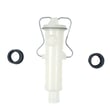
What are the common problems with Roper washing machines?
Common problems on Roper top-load washers like model RTW4300SQ0 are no spin, no agitation, no drain, excessive shaking, and fill issues. In most cases, the root cause is a worn drive component, a failed safety switch, or a restriction in the drain system.
Most common symptoms and what usually causes them
- Won’t spin or stops mid-cycle: lid switch failure, clutch wear, drive coupling damage
- Won’t agitate (but fills): worn agitator dogs, stripped agitator parts, drive coupling damage
- Won’t drain or drains slowly: clogged pump, kinked drain hose, debris in tub-to-pump path
- Loud noise during spin: worn clutch, drive block wear, gear case issues
- Excessive vibration or banging: weak suspension springs, unbalanced load, uneven leveling
Parts that commonly fix these problems on RTW4300SQ0
| Symptom | Common fix | Part to check first |
|---|---|---|
| No spin / intermittent spin | Lid safety not closing circuit | Washer lid switch assembly WP8318084 |
| No agitation / weak agitation | Agitator “ratcheting” worn | Agitator dog 80040 |
| No drain / humming pump | Pump jammed or leaking | Washer drain pump WP3363394 |
| Spins but slips / burning smell | Clutch slipping | Clutch 285785 |
| Motor runs but basket won’t move | Coupler broken | Coupling 285753A |
Quick checks we recommend before replacing parts
- Confirm the lid closes firmly; listen for a distinct click at the lid switch area.
- Redistribute the load; bulky items can throw the basket off balance and stop spin.
- Check the drain hose for kinks and make sure the standpipe is not blocked.
- If you hear a hum but no draining, suspect a jammed pump or obstruction.
- If agitation is weak and the top of the agitator “skips,” inspect the agitator dogs.
Why it matters
These washers rely on simple mechanical drive and safety circuits. A small failure (like a lid switch or agitator dogs) can mimic bigger problems, so checking the most common wear parts first saves time and avoids unnecessary motor or gear case replacement.
Related DIY help: troubleshooting a top load washer that wont drain or spin video
Last updated: February 2026
What is the most common washer repair?
On the Roper RTW4300SQ0 washer, the most common repairs are usually tied to won’t drain/won’t spin symptoms: clearing a drain restriction or replacing a failed drain pump or lid switch. These issues stop the cycle early and are often faster to diagnose than drive-system problems.
Most common fixes we see (and what they look like)
- Drain problems (most frequent): water left in the tub, humming pump, slow drain; often points to the washer drain pump WP3363394.
- Won’t spin or stops mid-cycle: lid not sensing closed; often points to the washer lid switch assembly WP8318084.
- Agitator not moving well: clothes not rolling over; commonly worn agitator dog 80040.
- No agitation or spin with motor running: direct-drive coupling failure; commonly the coupling 285753A.
- Excessive vibration or banging: out-of-level washer, overloaded tub, or worn suspension components (springs).
Quick checks before replacing parts
- Unplug the washer and confirm the tub is not overloaded.
- Check the drain hose for kinks and make sure it is not shoved too far down the standpipe.
- Listen during drain: a loud hum with little water movement often indicates a jammed or failing pump.
- Test the lid switch behavior: if the washer will not spin with the lid closed, the switch circuit is a prime suspect.
Symptom-to-part cheat sheet
| Symptom on RTW4300SQ0 | Most likely area | Common part to check |
|---|---|---|
| Won’t drain | Drain system | Washer drain pump WP3363394 |
| Won’t spin | Safety interlock | Washer lid switch assembly WP8318084 |
| Weak/no agitation | Agitator drive | Agitator dog 80040 |
| Agitates but won’t spin (or vice versa) | Direct-drive connection | Coupling 285753A |
Why it matters
Fixing the most common failure first (drain and lid-switch related) prevents repeat flooding, reduces motor strain, and gets your Roper washer back to completing cycles without jumping straight to higher-cost repairs like a clutch or gear case.
For step-by-step diagnosis, we recommend troubleshooting a top load washer that wont drain or spin video.
Last updated: February 2026
What is the most expensive part to replace on a washing machine?
On a Roper washer like model RTW4300SQ0, the most expensive repairs are typically major drive-system parts such as the gear case (transmission) or drive motor; these parts can cost hundreds of dollars before labor. In many washers overall, a tub or drum assembly and electronic control can also be top-cost items.
Most expensive parts (what we see most often)
- Gear case / transmission: high part cost and a longer, more involved repair
- Drive motor: expensive component; replacement often includes additional hardware checks
- Tub or basket-related assemblies: can be costly when bearings, seals, or the basket are involved
- Electronic controls (on models that use them): boards can be pricey and sometimes require diagnostics
RTW4300SQ0 examples from common high-cost categories
| Part category | Example part for RTW4300SQ0 | Why it gets expensive |
|---|---|---|
| Transmission / gear case | Pinion 3360629 | Major drivetrain component; labor is typically significant |
| Motor | Washer drive motor WP661600 | High-cost electrical/mechanical part; may require additional testing |
| Timer / control (model-dependent) | Washer timer WP8572976 | Control components can be costly and are often replaced as an assembly |
How we recommend deciding: repair vs replace
- Compare part cost + labor to the washer’s age and overall condition
- If multiple symptoms exist (noise plus leaking plus no spin), expect more than one part
- Check for simple, lower-cost causes first (lid switch, pump, coupling)
- If the washer will not spin or drain, start with a fast diagnosis path before buying big parts
Why it matters
The “most expensive part” is usually expensive because it is either a core drivetrain component (gear case, motor) or a major assembly (tub/basket). Those repairs take more time, require more disassembly, and can uncover related wear items like a clutch, coupling, or seals.
For no-drain/no-spin complaints, our quickest starting point is troubleshooting a top load washer that wont drain or spin video.
Last updated: February 2026







