Error Codes





Where is the model number on a Kenmore upright freezer?
For Kenmore upright freezer model 1069233380, the model number is printed on a rating label that’s usually inside the cabinet (often on a side wall or near the top/ceiling area). It can also be on the exterior back panel or behind the lower kick plate.
Look for a paper or foil label with the model number and serial number in these spots:
- Inside the freezer on the left or right interior wall
- Inside the freezer near the top (ceiling area)
- On the back of the cabinet (exterior)
- Behind or near the lower front kick plate or toe grille
- Along the door opening frame (around the gasket area)
- Use a flashlight; labels are often low-contrast and easy to miss.
- Check for frost or food packaging covering the label; clear the area first.
- If the label is worn, take a photo and zoom in to read it.
- Write down the full model number exactly as shown (all digits matter for parts).
| Label item | What it’s used for |
|---|---|
| Model number | Matching the correct parts list and diagrams |
| Serial number | Identifying production run details |
| Electrical ratings | Verifying power requirements for safe service |
We use the full model number to match the correct Kenmore parts and diagrams for your upright freezer. Even one missing digit can point to a different design, which can affect fit for items like a thermostat, defrost timer, or door hardware.
If you need help confirming the number you found, our guide on how to find your appliance model number (and what it means for parts) walks through what to look for and how to read the tag.
Last updated: February 2026
Is there a reset button on a Kenmore upright freezer?
Most Kenmore upright freezers, including model 1069233380, do not have a dedicated “reset” button. If the freezer is acting up, the practical reset is to power-cycle it (unplug for a few minutes, then restore power) and then re-set the temperature control.
- Unplug the freezer (or switch the breaker off).
- Wait 5 minutes to let the control and compressor protection reset.
- Restore power.
- Set the temperature back to your normal setting.
- Give the freezer 24 hours to fully stabilize after changes.
A power-cycle helps with minor control glitches, but repeated warming usually points to a defrost or cooling-system issue.
Common part-related suspects for this model include:
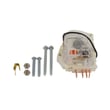
- Defrost control not advancing: defrost timer W10822278
- Temperature control not regulating: thermostat 4389248
- Compressor not starting reliably: start relay WP2262181
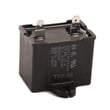
- Weak start components: run capacitor WPW10662129
- Door not sealing or closing consistently: closure (white) WPW10329686
| What you notice | What it often means | Parts to check on this model |
|---|---|---|
| Heavy frost on back wall, warmer temps | Defrost system not working | Defrost timer W10822278, thermostat 4389248 |
| Clicking, hum then stops, no cooling | Start components failing | Start relay WP2262181, run capacitor WPW10662129 |
| Door pops open or does not self-close | Door closer/cam issue | Closure (white) WPW10329686 |
A “reset” only clears temporary control states. If a defrost timer, thermostat, or start component is failing, the freezer can warm up again and risk food thawing, even after power is restored.
Last updated: February 2026
How to tell cubic feet of Kenmore refrigerator by model number?
For Kenmore model 1069233380, the model number by itself typically does not reliably encode the exact cubic-foot capacity. The most accurate way is to look up the capacity in the model’s specifications (when available) or calculate an estimate by measuring the usable interior space.
- Empty enough space to measure the main compartment.
- Measure interior dimensions in inches: width, depth, height.
- Multiply:
W x D x Hto get cubic inches. - Divide by 1728 to convert to cubic feet.
Tips for better accuracy
- Measure to the inside liner, not the door gasket.
- Subtract space taken by fixed shelves, bins, and the evaporator cover if they reduce usable volume.
- If it’s a freezer, measure the main cavity and any separate lower/upper compartments, then add them.
Many Kenmore models that start with 106 are Whirlpool-built. That prefix helps identify the manufacturing source and parts family, but it does not consistently tell you the exact capacity across all models.
| Method | What you get | Accuracy |
|---|---|---|
| Measure interior and divide by 1728 | Usable space estimate | High (if measured carefully) |
| Spec lookup by full model number | Manufacturer-rated capacity | Highest |
| Guessing from model number patterns | Rough guess | Low |
Cubic feet affects how much food you can store and can help when comparing replacement baskets, shelves, or door components for your Kenmore upright freezer model 1069233380.
If the door does not close tightly, frost buildup can reduce usable capacity over time. These model-matched parts can help address door-closing issues:
- Closure (white) WPW10329686
- Refrigerator door insulation, 2-piece 876370
- Refrigerator door bag insulation 606755
Last updated: February 2026
Why is my upright freezer leaking water on the floor?
Water on the floor from your Kenmore 1069233380 upright freezer is usually caused by a defrost drain that’s clogged or frozen, or by warm, humid air leaking in around the door and creating excess condensation that runs down and out.
- Make sure the freezer is level front to back and side to side; a tilted cabinet can route water toward the door.
- Check for frost buildup on the back interior panel (a clue the defrost system is struggling).
- Look for water droplets or a wet strip along the door opening (often points to an air leak).
- Inspect the bottom front edge of the door for gaps or sagging.
- Confirm the door closes firmly; a worn closer can leave the door slightly ajar.
A blocked drain is the most common reason an upright freezer “leaks” during or after defrost.
- Unplug the freezer.
- Remove items from the bottom area so you can access the drain trough (typically near the back floor).
- Melt any ice in the trough with warm water (not boiling) and towels.
- Flush the drain with warm water until it flows freely.
- If you find the door is not closing tightly, replace the closer components such as the closure (white) WPW10329686.
If the drain refreezes quickly, the freezer may not be defrosting normally.
| Symptom | What it often means | Common next step |
|---|---|---|
| Heavy frost on back wall | Defrost system not clearing ice | Test/replace defrost controls |
| Clicking or inconsistent defrost cycles | Defrost timer issue | Consider defrost timer W10822278 |
| Temps swing too warm then too cold | Control/defrost problem | Check thermostat and airflow |
Water on the floor is usually a symptom of an airflow, door-closing, or defrost-drain problem. Fixing the root cause helps prevent recurring ice buildup, temperature swings, and slippery-floor hazards.
Last updated: February 2026
How do I know if my compressor is bad in my Kenmore freezer?
If your Kenmore upright freezer model 1069233380 isn’t freezing, runs almost nonstop, or repeatedly clicks on and off, the compressor system is a top suspect. Before condemning the compressor, we check the start components, airflow, and defrost system because those failures can mimic a “bad compressor.”
- Freezer is warm and the compressor runs constantly with little or no improvement
- You hear repeated clicking every few minutes (start attempt, then shutoff)
- Compressor is very hot to the touch and shuts off on overload
- You measure proper power to the compressor circuit but it will not start
- Frost pattern on the evaporator is weak or uneven (sealed system concern)
- Listen and feel: If the compressor is running, confirm the evaporator fan is moving air.
- Check the defrost system: A defrost failure can ice up the evaporator and stop airflow; a common part to inspect is the defrost timer W10822278.
- Inspect the start components: A failed relay or capacitor can prevent a good compressor from starting; for this model, check the start relay WP2262181 and run capacitor WPW10662129.
- Condenser area: Clean dust buildup and confirm the condenser fan (if equipped) runs when the compressor runs.
| Symptom | Most common cause | What we do next |
|---|---|---|
| Clicks every 2 to 10 minutes, won’t run | Start relay/capacitor, or locked compressor | Test/replace relay/capacitor first |
| Runs constantly, still warm | Low refrigerant, weak compressor, airflow issue | Check frost pattern and airflow |
| Compressor runs, no airflow inside | Evaporator fan or heavy frost blockage | Check fan and defrost system |
| Very hot compressor, trips overload | Poor ventilation, failing start parts, failing compressor | Verify airflow, then test start parts |
Replacing a compressor or sealed system parts is a major repair. Verifying the start relay WP2262181, run capacitor WPW10662129, and defrost operation (including the defrost timer W10822278) prevents unnecessary cost and gets your freezer cooling faster.
Last updated: February 2026