 Owner’s manual
 Error Codes



What model Kenmore refrigerator do I have?
If you’re on the parts page for Kenmore model 59672253202, that model number is the identifier we use for your refrigerator. To confirm it on the appliance, match the model number from the rating label inside the fresh food (refrigerator) section to 59672253202.
Where to find the model number label
On Kenmore bottom-mount refrigerators like 59672253202, the model and serial number label is typically inside the refrigerator compartment.
- Look on the left wall inside the fresh food section
- Check near the crisper area or along the side wall
- If you do not see it right away, look along the inner cabinet walls where shelves mount
- Write down both the model number and serial number exactly as shown
What to do once you find it
Use the model number to make sure you’re ordering parts that fit your exact configuration (door style, icemaker setup, and internal components).
| What you see on the label | What it’s used for |
|---|---|
| Model number (example: 59672253202) | Matching diagrams and compatible replacement parts |
| Serial number | Identifying production details for service and part lookups |
| Purchase date (your records) | Warranty and maintenance history |
Why it matters
Kenmore refrigerators can look similar across multiple model numbers, but parts like an ice maker, light bulb, door hardware, or control boards can vary. Matching the label to 59672253202 prevents ordering the wrong refrigerator parts.
Helpful reference
Your owner's manual also explains where to record and locate the model and serial number information.
Last updated: February 2026
Where is the water filter on a bottom freezer refrigerator?
On the Kenmore 59672253202 bottom-mount (bottom freezer) refrigerator, the water filter is typically located inside the fresh food (refrigerator) compartment behind a small push-tab cover. Press the tab in and slightly downward so the cover drops open, then pull the filter straight out.
How to find it fast
- Open the refrigerator (top) door and look along the upper interior area first.
- Check the back wall or upper right corner area for a small filter cover.
- Look for a push-tab style door that hinges downward when released.
- If you do not see a cover, check the lower interior corners of the fresh food section.
- Confirm the exact location and removal steps in the owner's manual.
Basic removal and install steps (push-tab cover style)
- Press in on the cover tab and slightly downward; let the cover hang open.
- Turn or release the filter (style varies by cartridge) and pull it out.
- Insert the new filter fully, then lock it in place.
- Close the cover.
- Dispense water for several minutes to purge air and carbon fines (if your model has a dispenser).
What to check if water flow is weak after a filter change
Your refrigerator needs adequate household water pressure for the filter system to work correctly.
| Check | What we look for | Why it helps |
|---|---|---|
| Supply valve type | Avoid self-piercing saddle valves | They restrict flow and clog over time |
| Water pressure | 20 to 100 PSI (35 PSI minimum recommended with filters) | Prevents slow fill and small ice cubes |
| Air in the line | Burp air by running water | Restores steady flow |
Why it matters
A correctly installed filter and proper water pressure help prevent slow water dispensing, hollow or small ice cubes, and ice maker fill problems. If you are troubleshooting ice production, our common refrigerator ice maker problems and solutions guide is a good next step.
Last updated: February 2026
How to tell cubic feet of Kenmore refrigerator by model number?
For Kenmore model 59672253202, the most reliable way to get cubic feet is to look up the capacity listed in the specifications section of the 59672253202 owner's manual. If you cannot find a capacity spec there, you can estimate it by measuring the usable interior space and converting cubic inches to cubic feet.
Best ways to find capacity (in order)
- Check the specifications section in the 59672253202 owner's manual.
- Look for a model and serial label inside the fresh food section (commonly on the left wall) and match it to the manual’s model list.
- If you have the original sales paperwork, capacity is often listed with the model.
- Use measurement to estimate capacity (helpful when shelves and bins differ from original).
How to estimate cubic feet by measuring
- Empty the compartment you are measuring (refrigerator section and freezer section separately).
- Measure the usable interior:
- Width (inches)
- Depth (inches)
- Height (inches)
- Multiply:
width x depth x height = cubic inches. - Convert to cubic feet:
cubic inches ÷ 1728 = cubic feet.
Quick conversion table
| What you have | What to do | Result |
|---|---|---|
| Interior inches (W x D x H) | Multiply to get cubic inches | Total cubic inches |
| Cubic inches | Divide by 1728 | Cubic feet |
Why the model number alone is not enough
Kenmore model numbers (including the 596 prefix) identify the product line and configuration, but they do not consistently encode the exact interior volume. Capacity can also vary slightly by revision, insulation thickness, and the way “usable space” is defined.
Why it matters
Knowing cubic feet helps you compare storage space, choose correctly sized organizers, and set realistic expectations for cooling recovery after door openings or loading groceries.
Last updated: February 2026
How to tell if a Kenmore refrigerator compressor is bad?
On Kenmore refrigerator model 59672253202, a bad compressor usually shows up as poor or no cooling even though the unit has power, along with repeated clicking or a high-pitched hum that never leads to steady cooling. Before condemning the compressor, we verify airflow, condenser coil condition, and start components using the checks in the 59672253202 owner's manual.
Quick symptoms that point toward a compressor problem
- Refrigerator and freezer temperatures stay warm while the unit seems to run often
- Repeated clicking from the compressor area (start attempt then shutoff)
- Compressor is very hot to the touch after trying to run (use caution)
- You hear a high-pitched hum from the compressor but cooling does not improve (the manual notes compressor hum can be normal when operating)
- The refrigerator runs too frequently, especially with dirty condenser coils
Rule out common look-alikes first (most important)
Many “bad compressor” calls are actually airflow or maintenance issues.
- Clean the condenser coils; dirty coils can make the refrigerator run too frequently and cool poorly
- Check door sealing and closing; poor gasket seal or internal obstructions can cause long run times
- Confirm the unit is level; leveling helps doors close correctly and reduces warm air leaks
- Allow for defrost mode; the manual notes the refrigerator can be in defrost mode and may restart after about 40 minutes
What you can safely check at home
| Check | What you’re looking for | What it suggests |
|---|---|---|
| Condenser coils | Dust and pet hair buildup | Overheating, long run times, weak cooling |
| Door gaskets and door closing | Gaps, torn gasket, drawers/bins preventing closure | Warm air infiltration, frost, long run times |
| Sound pattern | Clicks every few minutes, or hum with no cooling | Start issue, overload trip, or compressor trouble |
| Time | No restart after defrost window | Likely component or control issue |
Parts that are commonly involved when the compressor will not start
If the compressor is not running and you hear clicking, the start circuit is often involved.
- Refrigerator overload WP12555902 (protects the compressor by shutting it off if it overheats)
- Refrigerator capacitor wp65889-4 (helps the compressor start and run)
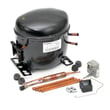
- If sealed-system work is needed, the compressor itself is refrigerator compressor W10160407
Why it matters
A compressor is part of the sealed refrigeration system; misdiagnosing it can lead to unnecessary cost. Checking coils, doors, leveling, and defrost behavior first helps you pinpoint whether you have a maintenance issue, a start-component failure, or a true compressor problem.
Last updated: February 2026
What are the common problems with Kenmore Elite refrigerators?
Common problems we see in Kenmore Elite refrigerators (including bottom-mount designs like model 59672253202) are warm temperatures, water leaks, ice maker troubles, odors, and doors that do not seal or close correctly. Many of these issues trace back to dirty condenser coils, airflow blockages, or defrost and fan-related problems; use the 59672253202 owner's manual to match symptoms to the correct checks.
Most common symptoms and what usually causes them
- Food temperature too warm: temperature controls need adjustment, condenser coils are dirty, rear air grille is blocked, or the door is opened too often.
- Water leaking: often tied to door sealing issues, leveling problems, or ice maker fill and drain concerns.
- Ice maker not making ice or poor ice harvest: inlet tube icing, low water flow, or a failing ice maker assembly.
- Odors: spills, spoiled food, or a dirty compartment; gaskets that do not seal can worsen odors.
- Door not closing properly: internal obstructions (bins, drawers, oversized containers) or gasket sealing problems.
Quick checks we recommend before replacing parts
- Confirm temperatures and airflow
- Set fresh food to about 37°F and freezer to about 0°F.
- Make sure vents are not blocked by packages.
- Clean condenser coils
- Dirty coils can make the refrigerator run longer and cool poorly.
- Check door sealing and closing
- Look for gaps, torn gasket areas, or drawers that are not fully seated.
- If the issue is ice production
- Verify the household water supply is on and flow is strong.
- If the ice maker itself is failing, replacement is often the fix.
Parts that commonly solve these problems (when diagnosis points there)
| Symptom | Likely part area | Example part for 59672253202 |
|---|---|---|
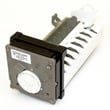
| No ice or irregular ice harvest | Ice maker assembly | Refrigerator ice maker D7824706Q |
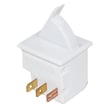
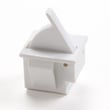
| Light does not turn on, door-related behavior seems off | Door/light switch | Refrigerator switch W11396033 |
| Cooling issues with hard starting or clicking | Start components | Refrigerator overload WP12555902 |
Why it matters
Warm temperatures, leaks, and poor door sealing can force longer run times, create frost or moisture problems, and lead to food spoilage. Addressing airflow, coil cleanliness, and door sealing first prevents unnecessary part replacement and helps restore stable cooling.
Last updated: February 2026





