Owner’s manual
 Error Codes



Where is the drip pan on a Kenmore Elite refrigerator?
On the Kenmore Elite 79571323413 bottom-mount refrigerator, the drip pan is typically located at the bottom rear of the cabinet near the compressor and condenser area, and it slides out after you remove the lower rear access cover. Use the 79571323413 owner's manual for the exact access steps for your configuration.
How to access the drip pan
- Unplug the refrigerator (or switch off power at the breaker).
- Pull the refrigerator straight out to create working space.
- Remove the lower rear access cover (the thin panel near the floor).
- Look for a shallow plastic pan sitting on rails or a ledge near the compressor.
- Slide the pan out carefully to avoid spilling water.
What you may need
- 1/4-inch nut driver or Phillips screwdriver (varies by cover fasteners)
- Work gloves (sheet metal edges can be sharp)
- Towels or a shallow tray (to catch water)
- Mild soap and warm water for cleaning
- Flashlight for visibility behind the unit
Quick location guide (most common layouts)
| Refrigerator style | Most common drip pan location | Typical access |
|---|---|---|
| Bottom-mount (like 79571323413) | Bottom rear by compressor | Remove lower rear cover |
| Top-freezer | Bottom rear by compressor | Remove rear cover |
| Side-by-side | Bottom rear by compressor | Remove rear cover |
Why it matters
The drip pan collects defrost water so it can evaporate. If it is cracked, out of position, or overflowing, you can get water on the floor, odors, or moisture around the compressor compartment.
If you see water under the refrigerator
- Check that the pan is seated flat and not warped.
- Inspect the defrost drain path; a clogged drain can overwhelm the pan.
- If the pan area is icy or you see recurring puddles, inspect the drain tube for blockage; the refrigerator drain tube 5251JA3003D is a common related part on this model.
Last updated: January 2026
What are the common problems with Kenmore Elite refrigerators?
Common problems we see on the Kenmore Elite 79571323413 bottom-mount refrigerator include warm temperatures (cooling system or airflow issues), water leaking (often a defrost drain problem), ice maker troubles, and unusual noises from fans or the compressor. Use the 79571323413 owner's manual to match symptoms to the right checks and settings.
Most common symptoms and likely causes
- Not cooling or weak cooling: dirty condenser area, failed evaporator fan motor, temperature sensor issues, or compressor/start components
- Water leaking inside or under the unit: clogged or frozen defrost drain, damaged drain tube, or ice buildup in the drain trough
- Ice maker not making ice: water supply issue, inlet valve problem, or failed ice maker assembly
- Buzzing, clicking, or humming: compressor overload/start device issues, fan blade rubbing ice, or normal defrost sounds
- Frost buildup in freezer: door not sealing, frequent door openings, or defrost system/airflow problems
Quick checks we recommend before replacing parts
- Confirm the temperature settings and give the refrigerator 24 hours to stabilize after changes.
- Make sure vents inside the fresh food and freezer sections are not blocked by food packages.
- Check door gaskets for gaps; a poor seal drives frost and temperature swings.
- Look for ice or debris around the evaporator fan area (noise plus warm temps often point here).
- If you see water, inspect the defrost drain path for clogs or freezing.
Parts that commonly solve these issues (when testing confirms failure)
| Symptom | Part to consider | Example part for model 79571323413 |
|---|---|---|
| Leaking water | Drain components | Refrigerator drain tube 5251JA3003D |
| No ice or slow ice | Water supply control | Refrigerator water inlet valve AJU73672505 |
| No ice (mechanical failure) | Ice maker module | Lg refrigerator ice maker assembly model AEQ72909603 AEQ72909603 |
| Warm temps, fan noise | Air circulation | Refrigerator evaporator fan motor EAU65058315 |
| Clicking/buzzing at compressor | Start/overload protection | Refrigerator compressor overload protector 6750CL0001D |
Why it matters
Catching airflow, drain, and start-device problems early helps protect food temperatures and reduces strain on major components like the compressor.
Last updated: January 2026
What does DH mean on Kenmore Elite refrigerator?
On Kenmore Elite model 79571323413, dH (often shown as Er dH) points to a defrost heating problem: the refrigerator is not warming the evaporator enough during the defrost cycle, so frost can build up and airflow can drop. Check the defrost circuit steps in the 79571323413 owner's manual.
What you may notice when dH shows up
- Refrigerator section warming up while the freezer still seems cold
- Frost or ice buildup on the rear freezer panel
- Weak airflow from vents, or noisy fan from restricted airflow
- Water leaking or ice under the crisper area after a defrost melt
- Ice maker performance dropping because temperatures are unstable
Most common causes (and what to check first)
Start with the easiest checks before testing electrical parts.
- Heavy frost on the freezer back wall: indicates a defrost system issue (heater, sensor, wiring, or control)
- Door not sealing: warm, moist air leaks in and overwhelms defrost; inspect gaskets and door alignment
- Blocked air vents: overpacked freezer can restrict airflow and mimic cooling problems
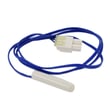
- Defrost sensor/thermistor out of range: a bad sensor can prevent proper defrost operation; this model uses temperature sensing in the control logic (see the refrigerator temperature sensor 6500JB2002X if replacement is needed)
- Control not powering the heater: if the sensor and wiring check out, the main control can be involved
Basic troubleshooting steps (safe DIY)
- Unplug the refrigerator for safety.
- Inspect for frost behind the rear freezer panel.
- Check door sealing: close a dollar bill in the gasket; you should feel steady resistance when pulling.
- Clear vents and improve airflow: leave space around vents and avoid blocking the return air path.
- If frost is heavy, manually defrost (doors open, towels down) to restore cooling temporarily, then diagnose the defrost circuit.
Quick guide: symptom to likely area
| What you see | Most likely area to inspect | Why it matters |
|---|---|---|
| Solid frost sheet on freezer back panel | Defrost heater circuit, sensor, wiring | Frost blocks airflow to fresh food section |
| No heavy frost, but temps swing | Sensor readings, control logic | Bad temperature input can trigger false defrost faults |
| Water pooling after defrost | Drain path and drain tube | A restricted drain can refreeze and worsen icing |
Why it matters
A true dH/Er dH condition usually means frost is building up on the evaporator; that reduces airflow, raises refrigerator temperatures, and can strain the evaporator fan and compressor over time.
Last updated: January 2026
What size is Kenmore refrigerator model 79571323413?
Kenmore Elite bottom-mount refrigerator model 79571323413 is a full-size unit; the “size” you’ll want is its exterior dimensions (W x D x H) plus total capacity in cubic feet. For the exact published dimensions and required clearances for your specific configuration, use the 79571323413 owner's manual.
What “size” usually means for a bottom-mount refrigerator
When shoppers ask for size, it’s typically one of these:
- Width: fit between cabinets and through doorways
- Depth: how far it sticks out past counters (often varies with handles)
- Height: clearance under upper cabinets and at the hinge cover
- Capacity (cu. ft.): total storage volume
- Clearances: space needed for airflow and door and drawer swing
How to measure your 79571323413 accurately
Use a tape measure and record the widest and tallest points.
- Measure width across the widest point (often door edges)
- Measure height from floor to the highest point (hinge cover area)
- Measure depth two ways: cabinet only, then including handles
- Measure the cabinet opening and the delivery path (doors, hallways)
- Confirm door swing and freezer drawer clearance near walls or islands
Quick spec worksheet
| Spec to record | Why you need it |
|---|---|
| Width (in.) | Cabinet opening and delivery path |
| Depth with handles (in.) | Counter projection and aisle space |
| Depth without handles (in.) | Built-in look and clearance planning |
| Height (in.) | Overhead cabinet clearance |
| Capacity (cu. ft.) | Storage planning |
Why it matters
Correct dimensions prevent fit problems, protect door alignment, and help you choose compatible accessories and parts such as the refrigerator water filter 9690 AGF80300801.
Last updated: January 2026