 Owner’s manual
 Error Codes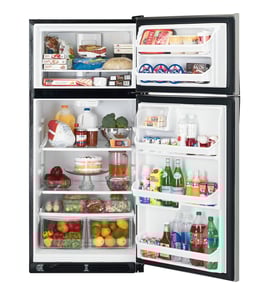



What is the top part of a fridge called?
On a Kenmore top-mount refrigerator like model 11171219610, the top compartment is the freezer compartment (often just called the freezer). It is the section designed to keep foods frozen and typically houses the ice maker when one is installed.
Common names you will see
Different manuals and parts diagrams may use slightly different wording for the same “top part”:
- Freezer
- Freezer compartment
- Freezer section
- Freezer door (the outer door for the top compartment)
- Freezer liner (the interior wall/box of the freezer)
For the exact terminology used for your Kenmore 11171219610, check the owner's manual.
What the freezer does (and what’s usually up there)
In a top-mount design, the freezer is more than just storage; it supports cooling for the whole refrigerator.
- Maintains sub-freezing temperatures for long-term food storage
- Helps drive overall cooling (cold air is distributed to the fresh food section)
- Often includes an evaporator cover and air vents
- May include an optional ice maker (if equipped)
Quick comparison: top-mount vs other layouts
| Refrigerator layout | Where the freezer is | What people commonly call the “top part” |
|---|---|---|
| Top-mount (your 11171219610) | Top | Freezer |
| Bottom-freezer | Bottom | Fresh food (refrigerator section) |
| Side-by-side | Left or right side | Freezer side or refrigerator side |
| French door | Bottom drawer | Fresh food doors (top), freezer drawer (bottom) |
Why it matters
Knowing the correct name helps when you are troubleshooting temperature issues, airflow problems, frost buildup, or ice maker concerns. It also helps you match the right section when following diagnostic steps in the owner's manual.
Last updated: February 2026
How to tell cubic feet of Kenmore refrigerator by model number?
For Kenmore model 11171219610, the capacity is 14.2 cubic feet. We list this in the model’s documentation, so you can confirm it quickly without measuring the interior.
Where to find the cubic feet for your model
The most reliable way is to check the specifications section in the 11171219610 owner's manual. That spec is tied to the exact model number, which avoids mix-ups with similar-looking Kenmore refrigerators.
If you need to estimate capacity by measuring (backup method)
If you are comparing refrigerators or the label is missing, you can estimate interior volume:
- Empty the compartments so you can measure accurately
- Measure interior width, height, and depth in inches (ignore door bins and curved walls)
- Multiply:
width x height x depthto get cubic inches - Divide by 1728 to convert cubic inches to cubic feet
- Expect your estimate to be slightly higher than “usable” space because shelves, drawers, and air channels reduce storage room
Quick conversion table
| What you have | What it means | Formula |
|---|---|---|
| Interior measurements (inches) | Approximate total interior volume | (W x H x D) / 1728 |
| Published capacity (cubic feet) | Standardized model spec | Use the manual spec |
Why model numbers do not always reveal cubic feet
Kenmore model numbers are primarily identifiers for the design series and configuration (top-mount, bottom freezer, etc.). Some Kenmore prefixes in other series may hint at size, but it is not consistent enough to rely on for an exact cubic-feet value.
Why it matters
Capacity affects food storage planning, energy use expectations, and whether replacement shelves, bins, and optional ice maker setups fit your needs. Using the documented spec for 11171219610 keeps comparisons accurate.
Last updated: February 2026
Can I replace fridge parts myself?
Yes, for Kenmore refrigerator model 11171219610, we can safely replace many non-sealed-system parts ourselves (bins, shelves, some door hardware, and some ice maker or water filter items). Any repair that could contact refrigerant tubing or involves the power cord should be handled by trained service personnel.
Good DIY repairs vs. repairs to leave to a pro
Many refrigerator fixes are straightforward, but this model uses flammable refrigerant (R600a), so we treat sealed-system areas as off-limits for DIY.
Typically DIY-friendly
- Replacing or adjusting shelves, drawers, and door bins
- Cleaning the condenser area and improving airflow around the cabinet
- Basic ice maker and water supply checks (if equipped)
- Replacing a water filter (if your unit uses one)
- Cleaning and inspecting door gaskets for gaps and tears
Leave these to trained service personnel
- Anything that could puncture or heat refrigerant tubing (evaporator, condenser, sealed-system lines)
- Defrosting with mechanical devices or sharp tools
- Electrical diagnostics beyond basic checks
- Replacing a damaged power cord (this is a safety-critical repair)
Safe DIY checklist before you start
Use this quick checklist to avoid common mistakes.
- Unplug the refrigerator before removing panels or touching wiring
- Never puncture, cut, or drill near cooling lines (risk of fire or explosion with R600a)
- Do not use mechanical devices to speed up defrosting
- Protect floors; use towels for meltwater and a shallow pan if needed
- Take photos of wire connections and fastener locations as you disassemble
Quick decision table
| What you’re doing | DIY level | Why |
|---|---|---|
| Replace shelves/bins | Easy | No electrical or sealed-system exposure |
| Clean/inspect door gasket | Easy | Improves sealing and temperatures |
| Replace water filter | Easy | Restores water flow and taste |
| Work near evaporator/condenser tubing | Pro only | Flammable refrigerant tubing risk |
| Replace power cord | Pro only | Shock and fire safety requirement |
Why it matters
DIY repairs can save time and money, but on model 11171219610 the biggest risk is damaging sealed-system tubing that contains R600a. Staying with “bolt-on” parts and routine maintenance keeps the repair safe and effective.
For model-specific safety warnings and service precautions, follow the owner's manual. For common water filter steps, use how to replace the water filter in a Kenmore refrigerator.
Last updated: February 2026
Can you still get parts for Kenmore refrigerators?
Yes. You can still get replacement parts for Kenmore refrigerators, including the Kenmore 11171219610 top-mount refrigerator. The key is matching parts to your exact model number so the fit, wiring, and mounting points are correct; our owner's manual also helps you identify what you need.
How we recommend finding the right part
- Confirm the full model number on the rating label: 11171219610
- Use the model-based parts list to match the exact component (for example: door gasket, thermostat, fan motor)
- Compare your original part’s shape, connectors, and mounting holes before ordering
- If your refrigerator has an optional ice maker, match parts to the ice maker kit used on your unit
- Use the diagrams to verify location and quantity (screws, brackets, covers)
Common Kenmore refrigerator parts customers replace
| Part type | What it fixes | Common symptom |
|---|---|---|
| Door gasket (door seal) | Air leaks | Frost buildup, warm temps, sweating around door |
| Evaporator fan | Air circulation | Freezer cold but fridge warm, noisy fan |
| Defrost components | Frost control | Heavy frost on back wall, poor cooling |
| Water filter (if equipped) | Water quality and flow | Slow dispenser, bad taste/odor |
If you are troubleshooting instead of replacing parts
Error codes and symptom checks can narrow the part you actually need.
- For model-family error code help, use Kenmore 111 model top freezer refrigerator error codes
- For water filter guidance (if your unit is equipped), use how to replace the water filter in a Kenmore refrigerator
Why it matters
Kenmore refrigerators often share similar-looking parts across different series, but small differences (connector style, bracket position, sensor type) can prevent a correct fit. Using the exact model number 11171219610 keeps the repair accurate and avoids repeat failures.
Last updated: February 2026
What are the most commonly replaced parts in a refrigerator?
In a Kenmore top-mount refrigerator like model 11171219610, the most commonly replaced parts are the ones that affect sealing, airflow, temperature sensing, and water or ice functions. Door gaskets, fans, sensors, and ice maker or water components tend to wear first because they run often and directly impact cooling performance.
Most common refrigerator parts people replace
- Door gasket (door seal): stops warm air leaks that cause frost and long run times
- Evaporator fan motor: moves cold air through the fresh food section and freezer
- Condenser fan motor: cools the condenser and compressor area (on many designs)
- Thermistor or temperature sensor: helps the control maintain stable temperatures
- Defrost components: defrost heater, defrost thermostat, or defrost sensor (varies by design)
- Water inlet valve (if equipped): controls water flow to the ice maker and dispenser
- Ice maker assembly (optional): common wear item when ice production slows or stops
Quick symptom-to-part guide
| Symptom | Common part to check | What you usually notice |
|---|---|---|
| Frost buildup, warm temps | Door gasket | Moisture, ice around door, poor seal |
| Freezer cold but fridge warm | Evaporator fan | Weak airflow, uneven temps |
| Loud buzzing or rattling | Fan motor or blade | Noise changes when door opens/closes |
| Temps swing up and down | Thermistor/sensor | Food freezing or spoiling intermittently |
| No ice or slow ice | Water inlet valve or ice maker | Small cubes, no fill, no harvest |
Why these parts fail most often
These components cycle frequently and are exposed to moisture, temperature changes, and normal wear. A small air leak at the door gasket or a weak evaporator fan can make the refrigerator run longer, which accelerates wear on other cooling-system parts.
Safety note before DIY checks
This model uses flammable refrigerant (R600a); we recommend avoiding any service that involves puncturing or heating sealed-system tubing. For model-specific safety and handling guidance, use the owner's manual.
If you’re troubleshooting ice or water issues, our guide on how to prevent water dispenser and ice maker problems helps you narrow down whether the issue is supply, filtration, or a failing valve or ice maker.
Last updated: February 2026





