Owner’s manual
 Error Codes


What does the AA mean on a Samsung refrigerator?
On Samsung refrigerator model numbers, the letters after the slash (such as “/AA”) identify a version or production code used by the manufacturer. For most owners, “AA” does not change the day-to-day features you use; it mainly helps match the correct parts and documentation for your RF23HCEDBSR.
Samsung often prints the full model code on the rating label, while retailers and listings may shorten it.
- It helps us match the correct RF23HCEDBSR owner's manual for your exact unit
- It can help distinguish cosmetic or internal revisions (even when the feature set looks the same)
- It improves parts accuracy when ordering items like sensors, valves, or an ice maker
- It’s most important when there are multiple “looks alike” versions of the same base model
When you’re shopping for Samsung refrigerator parts, use the complete model from the rating label (including anything after a slash) whenever possible.
| What you enter | Usually OK for | Best use case |
|---|---|---|
| RF23HCEDBSR | General browsing, diagrams | When you’re just identifying assemblies |
| RF23HCEDBSR/AA-00 | Exact part matching | When you’re ready to buy a replacement part |
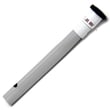
If you’re troubleshooting cooling or temperature swings, a failed sensor is a common cause; the refrigerator temperature sensor DA32-10104N is one example of a model-matched temperature sensing part used on this platform.
Small suffix codes like “/AA” reduce the chance of ordering the wrong Samsung refrigerator part (ice maker, water inlet valve, control panel, or sensor) and help ensure the instructions you follow match your exact build.
Last updated: February 2026
What is the most common problem with Samsung refrigerators?
The most common Samsung refrigerator problems are cooling performance issues (warm fridge or freezer), ice maker failures, and water leaks. On the Samsung RF23HCEDBSR, these symptoms usually trace back to airflow restrictions from frost buildup, a weak fan/evaporator area, or water supply and drainage problems; start with the basics in the RF23HCEDBSR owner's manual.
- Fresh food section warms up while the freezer seems OK (or the reverse)
- Ice maker stops producing ice or makes small, hollow cubes
- Water under the crisper drawers or a sheet of ice on the freezer floor
- Loud buzzing, grinding, or clicking (often fan or ice path related)
- Dispenser issues: slow water flow or no ice dispensing
- Confirm doors seal and close fully; blocked bins or a misaligned flipper can cause warm temps.
- Set temperatures to typical targets: 37°F fresh food and 0°F freezer; allow 24 hours to stabilize.
- Clear vents inside both compartments; avoid packing food tightly against air returns.
- If you see frost on the back wall, do a full manual defrost (unplug and leave doors open) and then monitor.
- If the ice maker is the issue, verify the water line is on and pressure is strong; then follow why your Samsung fridge stopped making ice and how to fix it.
| Problem area | What you notice | Parts that commonly relate on this model |
|---|---|---|
| Temperature sensing | Temps swing, food freezes or warms unexpectedly | Refrigerator temperature sensor DA32-10104N, refrigerator temperature sensor DA32-00033C |
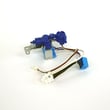
| Water supply to ice maker/dispenser | No ice, slow fill, leaking at back | Refrigerator water inlet valve DA62-04027A |
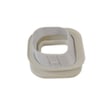
| Drainage/defrost melt water | Water pooling inside, ice on freezer floor | Refrigerator drain cap DA67-01301A |
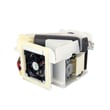
| Ice production hardware | Ice maker dead, jams, inconsistent harvest | Refrigerator ice maker MKV190CL2BASH |
Cooling, ice, and leak complaints are often connected. Frost buildup can block airflow and strain fans; a restricted drain can turn defrost water into leaks; and low water flow can look like an “ice maker failure” when the real issue is supply. Addressing the root cause protects food quality and reduces repeat breakdowns.
Last updated: February 2026
How do I run a diagnostic test on my Samsung refrigerator?
On Samsung refrigerator model RF23HCEDBSR, you run the built-in self-diagnostic by using the control panel’s self check/diagnostic function and then reading any error code shown on the display. The exact button sequence depends on the specific control panel version, so we follow the steps listed for your model.
Use the procedure in the RF23HCEDBSR manual so the button sequence matches your exact display.
- Make sure the refrigerator is powered on and not in Cooling Off (Demo) mode
- Close both fresh food doors and the freezer drawer fully
- Start the self check/diagnostic from the control panel using the model-specific steps
- Watch the display for a code, blinking segments, or a completion indication
- Write down the code exactly as shown before you clear it or exit
Most Samsung refrigerator diagnostics report a problem area (cooling, defrost, fan, sensor, ice maker, or communication) using a code.
| What you see on the display | What it indicates | Best next step |
|---|---|---|
| An error code appears | A fault is detected in a system | Record the code; troubleshoot that system first |
| No code after the test completes | No active fault detected | Monitor temperatures and operation for 24 hours |
| The same code returns after a power reset | Ongoing problem | Inspect wiring, connectors, and the related component |
- Confirm vents are not blocked by food packages
- Verify door gaskets seal and doors close without resistance
- Do a control reset: unplug (or switch off breaker) for 2 minutes, then restore power
- Allow 15 to 30 minutes after the test for normal cooling control to stabilize
Diagnostics help us pinpoint the system to check first, which saves time and prevents replacing the wrong part. For example, temperature-related codes often lead to checking a sensor such as the refrigerator temperature sensor DA32-10104N.
Last updated: February 2026