 Owner’s manual
 Error Codes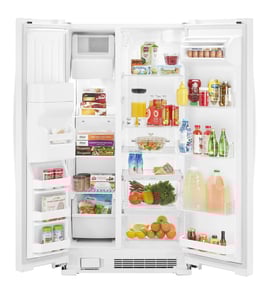


How can I tell how many cubic feet my Kenmore refrigerator is?
For your Kenmore side-by-side refrigerator model 3639565412, the most reliable way to confirm cubic feet is to check the refrigerator’s rating plate for a capacity listing (often shown as “Cu. Ft.” or “Total volume”). If it is not listed, we can estimate capacity by measuring the interior and converting cubic inches to cubic feet using the formula below.
Fast ways to find the capacity
- Check the rating plate inside the fresh food compartment (commonly on a side wall) or near the base/kick plate area.
- Look in the specifications section of the 3639565412 owner's manual.
- Estimate by measuring the interior (best when the label is missing or unreadable).
- Use the model family range as a clue: this manual covers “Side by Side 20-27 Models,” so many units in this group fall in that general capacity range.
How to estimate cubic feet by measuring
- Empty the compartment enough to measure accurately.
- Measure the usable interior of the refrigerator section:
- Height (inches)
- Width (inches)
- Depth (inches)
- Multiply: H × W × D = cubic inches.
- Convert to cubic feet: cubic inches ÷ 1728 = cubic feet.
Quick reference table
| What you have | What to do | Result |
|---|---|---|
| Rating plate shows “Cu. Ft.” | Record that number | Exact capacity |
| Manual lists capacity/specs | Use the spec value | Exact capacity |
| Only interior measurements | Use H × W × D ÷ 1728 | Close estimate |
Why it matters
Knowing cubic feet helps us match the right refrigerator parts and accessories (like shelves, bins, and ice and water dispenser components) and it also helps when comparing replacement units or planning kitchen clearances.
Last updated: February 2026
How do I reset a Kenmore refrigerator?
To reset your Kenmore refrigerator model 3639565412, we recommend a simple power reset: unplug the refrigerator (or switch off the circuit breaker) for about 5 to 10 minutes, then restore power. This clears many minor control and cooling glitches and restarts normal operation; confirm settings in the owner's manual.
Reset methods that work most often
- Power cycle reset: Unplug for 5 to 10 minutes, then plug back in.
- Control OFF reset (vacation-style): For extended absences, the manual notes moving the numbered control to OFF and shutting off power; then restore power and return controls to normal settings.
- After a power outage: Restore power, then verify the temperature controls are set correctly and the unit is not simply in a normal defrost pause.
What to check right after the reset
The manual’s “Before You Call for Service” guidance points to a few quick checks that commonly explain a “no power” or “not cooling” complaint.
- Make sure the temperature control is not set to OFF.
- Confirm the refrigerator is plugged in securely.
- Test the outlet with a lamp to rule out a tripped circuit.
- Remember the refrigerator can be in a defrost cycle where the compressor may not run for about 30 minutes.
- If you moved the refrigerator, make sure it is not sitting on or rolling over the power cord.
Quick reference: symptoms vs. next step
| What you notice | What we recommend next |
|---|---|
| Lights are off and nothing runs | Check outlet power and breaker; verify control is not OFF |
| Runs but not cooling yet | Allow up to 30 minutes for defrost cycle to finish |
| Cooling is uneven after reset | Recheck control settings; confirm vents are not blocked |
| Dispenser or ice issues continue | Inspect for ice jams and dispenser issues; use the how to disassemble a Kenmore refrigerator dispenser guide |
Why it matters
A reset is useful because it restarts the refrigerator’s normal operating sequence and clears minor electronic hiccups. Checking the control setting, outlet power, and defrost timing prevents unnecessary parts replacement and gets you back to stable temperatures faster.
Last updated: February 2026
Where is the model number on a Kenmore side by side refrigerator?
On Kenmore side-by-side refrigerator model 3639565412, the model number is printed on the refrigerator’s identification label (the same label that lists the serial number). We use that label information to match the correct parts and diagrams for your exact unit.
Most common places to check
Look for a paper or foil label in one of these spots:
- Inside the fresh food compartment on a side wall (often near the top)
- On the ceiling of the fresh food compartment near the light
- On the inside edge of the refrigerator door (hinge side)
- Behind the base grille area (less common, but possible)
How to find it quickly
Use this simple process so you do not miss the label:
- Open the refrigerator door and scan the side walls at eye level
- Check near the light housing and temperature control area
- Inspect the door frame and the door liner edge
- Wipe the area with a damp cloth if the label is dusty or faded
- Write down the full model number and serial number exactly as shown
What the label typically shows
The same label usually includes both identifiers.
| Item on label | What it’s used for |
|---|---|
| Model number | Matches parts, diagrams, and service information |
| Serial number | Identifies the production run and helps confirm compatibility |
Why it matters
Kenmore side-by-side refrigerators can look similar across multiple series, but parts like a defrost thermostat, door switch, or ice dispenser components can vary by model. Using the exact model number helps us get you the right replacement the first time. For model-specific identification details and service sections, use the owner's manual.
Last updated: February 2026
Why is my Kenmore side by side ice maker not working?
If your Kenmore 3639565412 side-by-side refrigerator ice maker isn’t making ice, the most common causes are the icemaker feeler arm being in the STOP (up) position, the water supply being turned off or restricted, or the freezer temperature being too warm to freeze cubes properly. See the owner's manual for the exact checks for your model.
Quick checks we recommend first
- Make sure the icemaker feeler arm is in the ON (down) position (not STOP/up).
- Confirm the household water shutoff valve is fully open.
- Check the water supply line behind the refrigerator for kinks or crushing.
- Verify the freezer is cold enough; slow freezing and no ice often point to a warm freezer.
- Look for ice stuck in the mold or fill area that can hold the feeler arm up.
- Empty and re-seat the ice bin; piled cubes can shut the icemaker off early.
What to do based on what you see
| What you notice | Likely cause | What to do next |
|---|---|---|
| Feeler arm is up | Icemaker is turned off | Lower the arm to turn icemaking on |
| No water entering icemaker | Water supply off or restricted | Open shutoff valve; straighten line; clear restriction |
| Cubes are tiny or hollow | Clogged shutoff valve or weak water flow | Check for blockage; restore strong water flow |
| Freezer not cold | Temperature setting or cooling issue | Set freezer colder; allow 24 hours to stabilize |
Parts that commonly fix “no ice” symptoms
If water flow to the icemaker is weak or intermittent, the inlet valve is a frequent failure point. If the dispenser area is involved (ice not dispensing even when ice is made), dispenser solenoid or auger components are common.
- Refrigerator water valve WR57X10051 (controls water flow into the refrigerator and icemaker)
- Refrigerator ice dispenser solenoid collar WR62X23154 (helps actuate the dispenser door/solenoid mechanism)
- Refrigerator ice container assembly WR17X4312 (bin and internal components that can bind or mis-seat)
Why it matters
An icemaker depends on two things: cold freezer temperatures and steady water flow. When either one is off, you can get no ice, slow ice production, or small cubes. Fixing the root cause prevents repeat clogs, overflow, and dispenser jams.
Last updated: February 2026





