Error Codes


What model is my Whirlpool electric range?
Your Whirlpool electric range model number is printed on the appliance’s model and serial tag. On many Whirlpool freestanding ranges like model RF365PXYN2, that tag is typically found behind the storage drawer or warming drawer at the bottom front of the range.
Where to look on a Whirlpool range
Check these common tag locations (in this order):
- Behind the bottom storage drawer or warming drawer (pull the drawer out and look on the frame)
- On the oven door frame (open the oven door and look around the front frame)
- On the side trim near the oven opening
- On the back panel of the range (if you can safely access it)
How to read the tag (model vs. serial)
The tag usually lists both a model number and a serial number.
| What you see | What it’s used for | Example format |
|---|---|---|
| Model number | Identifies the exact design so you get the right parts | RF365PXYN2 |
| Serial number | Identifies the production run and date details | Letters and numbers |
Tips to avoid ordering the wrong part
Once you find the model number, match it exactly (letters and numbers) before choosing parts.
- Write it down exactly as shown (no extra spaces)
- Take a clear photo of the tag for reference
- Use the full model number when selecting parts like a bake element or light bulb
- If the oven is not heating, start with the bake element WP308180 as a common failure item
Why it matters
Whirlpool ranges often look similar across multiple model series, but internal parts like the bake element, terminal block, and surface element receptacle can vary by model. Using the exact model number helps ensure correct fit, safe wiring connections, and proper heating performance.
Last updated: January 2026
What is the life expectancy of a Whirlpool electric range?
A Whirlpool electric range like model RF365PXYN2 typically lasts 13 to 15 years with normal household use. Consistent cleaning, good electrical connections, and avoiding extreme high-heat cycles help the oven, surface elements, and controls last longer.
Typical lifespan and what affects it
Most electric ranges fall into a predictable lifespan range, but real-world life depends on heat exposure and how hard key parts work.
- Heavy daily cooking shortens life compared to light weekly use
- Frequent self-cleaning can stress wiring, sensors, and controls
- Spills and boilovers can damage surface element receptacles and switches
- Loose power-cord connections can overheat at the terminal block
- Slamming the oven door can shorten hinge and glass life
| Usage pattern | Typical outcome | What to do |
|---|---|---|
| Light to moderate use | Often reaches 13 to 15 years | Keep it clean; fix small issues early |
| Heavy daily use | Often closer to 10 to 13 years | Reduce high-heat cycles; maintain burners |
| Poor maintenance | Early failures possible | Address heating and electrical symptoms fast |
Parts that commonly determine “end of life”
If the range still has a solid cabinet and safe wiring, replacing a few common parts can extend service life.
- Oven not heating evenly: check the bake element WP308180
- Surface burner cuts in and out: inspect the Whirlpool range surface element receptacle 330031
- No power or intermittent power: inspect connections at the terminal block WP8203546
- Oven light out: replace the light bulb 8009
- Door heat loss or rattling: inspect door glass and hinges (model-specific parts vary)
Why it matters
Knowing the expected lifespan helps you decide whether to repair or replace. On an older RF365PXYN2, a single failed heating part (like a bake element or receptacle) is often a practical repair, while repeated electrical or control issues can signal the range is nearing the end of its service life.
Last updated: January 2026
How do I fix the F2 code on my Whirlpool stove?
On the Whirlpool RF365PXYN2 electric range, an F2 error typically points to an oven over-temperature condition or a problem in the temperature-sensing circuit. We start by resetting power for 1 minute; if the code returns, focus on the oven temperature sensor, wiring connections, and the electronic control.
Step-by-step fix for an F2 error
- Turn the range OFF and let it cool completely.
- Reset power: switch the range circuit breaker OFF for 1 minute, then ON.
- If F2 returns, inspect the oven temperature sensor circuit (sensor plug, harness, and terminals) for loose or heat-damaged connections.
- If the oven was not actually overheating, test the sensor resistance with a multimeter (common range sensors measure about 1,080 ohms at 70°F).
- If wiring and sensor test good, the electronic oven control is the next likely cause.
Quick checks that often solve it
- Confirm the oven is not blocked by foil or a pan touching the sensor.
- Check for a pinched wire harness behind the back panel.
- Make sure the oven door closes fully (excess heat loss can cause longer heat cycles and odd behavior).
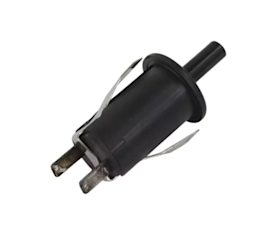
- If the oven light area is damaged or shorting, address it; a failing socket or switch can create electrical issues (see light socket W11594027 or light switch (black) WP4314961).
What the symptoms usually mean
| What you notice | Most common cause | What to do next |
|---|---|---|
| F2 appears during preheat | Sensor circuit issue or control reading wrong temp | Reset power; test sensor and wiring |
| Oven seems extremely hot, burning food | True overheat or stuck relay on control | Stop using Bake; check control and sensor |
| F2 comes and goes | Loose connection | Reseat connectors; inspect terminals |
Why it matters
An F2 code is a safety-related temperature fault. Fixing it quickly helps prevent repeated shutdowns, inaccurate baking temperatures, and potential damage to wiring, the bake circuit, or the control.
Last updated: January 2026