 Installation guide
 Owner’s manual


How do I remove the front panel of my Kenmore dryer?
To remove the front panel on your Kenmore dryer model 11073102101, we start by disconnecting power, then release the top (clips or screws), remove the front-panel mounting screws (often inside the door opening), and lift the panel up and off while supporting any wiring.
Safety first
- Unplug the dryer (or switch off the breaker) before opening any panels.
- If this is a gas dryer, close the gas shutoff valve if you plan to disconnect any gas components.
- Wear cut-resistant gloves; cabinet edges can be sharp.
- Take a quick photo of wire connections before unplugging anything.
For model-specific panel fastener locations and the correct disassembly order, follow the steps in the 11073102101 owner's manual.
Typical front panel removal steps (most Kenmore 110-style dryers)
- Disconnect power.
- Open the top:
- Insert a putty knife under the front corners of the top to release spring clips, or
- Remove screws at the back of the top (varies by build).
- Remove the front panel screws:
- Look for screws along the top inside edge of the front panel, and
- Screws inside the door opening (door frame area).
- Lift and remove the front panel:
- Tilt the panel forward slightly.
- Lift up to unhook it from the lower retaining tabs.
- Disconnect wiring as needed (door switch harness, drum light harness on some versions).
What you can access once the front panel is off
Removing the front panel is a common first step for belt and drum support repairs. These parts are frequently involved:
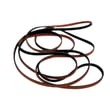
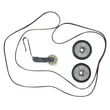
- Dryer drum belt 341241 (broken belt, drum not turning)
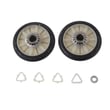
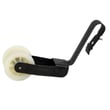
- Dryer idler pulley WP691366 (squealing, belt slipping)
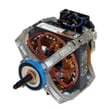
- Dryer motor 279827 (hums but will not start, no tumble)
- Drum rollers and shafts (thumping, rumbling)
Quick symptom-to-part guide
| Symptom | Most common area to inspect | Example part on this model page |
|---|---|---|
| Drum will not turn, motor runs | Belt and idler system | Dryer drum belt 341241 |
| Loud squeal while tumbling | Idler pulley | Dryer idler pulley WP691366 |
| Hums, then stops or trips | Motor or blower wheel jam | Dryer motor 279827 |
Why it matters
Removing the front panel the right way prevents bent cabinet panels, broken plastic tabs, and damaged door-switch wiring. It also makes reassembly easier so the door closes and seals correctly.
Last updated: February 2026
Where is the part number on a Kenmore dryer?
On Kenmore dryer model 11073102101, the model and serial number label (the tag you use to identify parts) is located at the top inside the dryer door well. We use the model number and serial number from that label to match the correct replacement parts.
How to find it fast
- Open the dryer door fully.
- Look along the top edge inside the door opening (the door well).
- Find the model and serial number label (often a silver or white sticker/plate).
- Write down the full model number and serial number exactly as shown.
- Use that information when ordering parts or checking diagrams in the 11073102101 owner's manual.
What you will see on the label
Most Kenmore dryers list these items together on the same tag:
| Label item | What it’s used for | Example (format) |
|---|---|---|
| Model number | Identifies the exact dryer design | 11073102101 |
| Serial number | Identifies the production unit | Letters and numbers |
| Purchase date (sometimes recorded by owner) | Helpful for service history | Month/day/year |
Why it matters when ordering parts
Kenmore dryers can look similar across multiple model numbers, but internal components can differ. Using the exact model number from the door-well label helps us match the right parts the first time, such as a dryer drum belt 341241 or a thermostat.
Tips if the label is hard to read
- Wipe the label gently with a damp cloth to remove lint and residue.
- Use your phone camera and zoom in to capture faint printing.
- Copy characters carefully; 0 (zero) and O (letter O) can look alike.
Last updated: February 2026
How do I tell what model my Kenmore dryer is?
Your Kenmore dryer’s model number is printed on the model and serial number label in the dryer door well. On Kenmore model 11073102101, that label is located at the top inside the door opening; write down the full model and serial numbers to match the correct parts and instructions.
Where to look on the dryer
Check these common Kenmore dryer label locations:
- Top inside the dryer door well (most common)
- Inside the door opening on the cabinet frame
- On the back panel (less common)
- Near the lint screen housing (varies by design)
For this model, the manual calls out the label location as the top inside the dryer door well. See the 11073102101 owner's manual for the exact label description and product record section.
What to write down (and why)
Record these items exactly as shown on the label:
- Model number (example format in the manual: starts with 110.)
- Serial number
- Purchase date (helpful for service history)
Why it matters
The model number is what we use to ensure parts like a drum belt, thermostat, or igniter match your exact Kenmore dryer configuration. The serial number helps identify production details when there are multiple versions of the same model family.
Quick guide: model number vs. serial number
| Item | What it identifies | Used for |
|---|---|---|
| Model number | The dryer design and parts list | Ordering correct replacement parts and checking features |
| Serial number | The specific unit | Service records and version details |
Tip for faster parts matching
If you are ordering common wear items for this dryer, having the model number ready helps us confirm fit quickly. For example, the dryer drum belt 341241 is a frequent replacement on many Kenmore 110-series style dryers.
Last updated: February 2026
What size dryer is a Kenmore 80 series?
For Kenmore model 11073102101 (an 80 Series-style, Whirlpool-built 29-inch gas dryer), the “size” most people mean is the cabinet width: it’s a 29-inch class dryer. Capacity (cubic feet) varies by exact 110-series design, but many are in the about 3.2 cu. ft. range.
What “size” can mean (and what we use for this model)
When customers ask about dryer size, it usually refers to one of these:
- Width (cabinet size): 29-inch class for this Kenmore 11073102101
- Overall dimensions: height and depth for fit in a laundry space
- Drum capacity (cu. ft.): how much laundry it holds
- Installation clearance: space needed for venting and door swing
For the most accurate fit details for your laundry room, use the dimensions and clearance diagrams in the 11073102101 installation guide.
Typical dimensions and clearance guidance
Most 29-inch Kenmore 110-series gas dryers are roughly:
- Width: about 29 inches
- Height: about 43 inches
- Depth: commonly in the high-20s inches (varies by door style and console)
- Rear clearance for venting: many installs need about 5 inches behind the dryer for the exhaust elbow
Quick reference table
| Measurement type | What it helps with | What to use |
|---|---|---|
| Cabinet width | Side-to-side fit | 29-inch class |
| Height | Under-shelf fit | Check guide diagram |
| Depth | Door clearance, walkway space | Check guide diagram |
| Rear clearance | Vent routing and airflow | Plan for vent elbow space |
Why it matters
Getting the “size” right prevents common headaches like a dryer that will not slide into the alcove, a crushed vent that causes long dry times, or a door that cannot open fully. Using the installation dimensions for Kenmore 11073102101 also helps you plan proper ventilation openings for closet installs.
Last updated: February 2026
How do I know if my Kenmore dryer thermal fuse is blown?
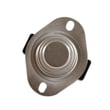
A blown thermal fuse in your Kenmore dryer model 11073102101 typically shows up as a dryer that won’t start or runs but won’t heat. The sure way to confirm is a continuity test with a multimeter after unplugging the dryer; an open (no continuity) reading means the fuse is blown.
Quick symptoms to look for
- Dryer will not run at all (no motor, no tumble)
- Drum tumbles but there’s no heat (common when a heating circuit is interrupted)
- Cycle runs unusually long because heat is cutting out (often tied to overheating issues)
- You recently had restricted airflow (lint screen or vent clog)
How we confirm it (safe, reliable test)
- Unplug the dryer (or shut off power at the breaker).
- Access the thermal fuse area (location varies by design; use the 11073102101 owner’s manual for access guidance).
- Remove at least one wire from the fuse terminal.
- Set a multimeter to continuity or lowest ohms.
- Test across the fuse terminals.
What the meter reading means
| Multimeter result | What it means | What to do next |
|---|---|---|
| Beep or near 0 ohms | Fuse is good | Keep troubleshooting (airflow, thermostat, gas heat parts) |
| No beep or OL/infinite | Fuse is blown | Replace the fuse and fix the overheating cause |
Why it matters (and what usually causes it)
A thermal fuse is a one-time safety device that opens when the dryer overheats. If you replace the fuse without correcting airflow, the new fuse can blow again.
Common overheating causes:
- Lint screen clogged
- Exhaust vent crushed, kinked, or packed with lint
- Outside vent hood blocked
- Blower or airflow restriction (for example, a damaged blower wheel)
Related checks if you have a gas dryer and “no heat”
Your installation steps include a simple heat verification: after the dryer runs about 5 minutes, open the door and feel for heat; if there’s no heat, confirm the gas shutoff valve is open and follow the 11073102101 installation guide guidance for next steps.
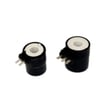
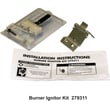
If airflow is good but heat still fails, common gas-heat suspects include the dryer gas valve coil kit 279834 and the igniter 279311.
Last updated: February 2026
What is the code F01 on a Kenmore dryer?
On Kenmore dryer model 11073102101, the F01 (F1) error code indicates an electronic control problem (a fault the main control board detects). It is not a venting or thermostat code; the fix focuses on power reset, wiring connections, and control diagnostics.
What to do first (safe, quick checks)
- Unplug the dryer (or switch off the breaker) for 2 minutes, then restore power and try a Timed Dry cycle.
- Confirm the door fully closes and the door strike lines up with the latch.
- Check for a loose console connection (vibration can loosen plugs at the control).
- If the code returns immediately, stop and move to diagnostics in the manual.
- If you smell gas on a gas dryer, follow the safety steps in the installation guide.
What F01 usually points to
F01 is typically triggered when the control detects an internal failure or a problem in a key input circuit it monitors.
| Symptom pattern | Most common direction | What we check next |
|---|---|---|
| F01 appears as soon as you press Start | Control board fault or power issue | Reset power; verify tight wiring at control; check outlet voltage |
| Dryer starts, then beeps and shows F01 | Intermittent control or harness connection | Reseat connectors; inspect harness for rubbed or broken wires |
| F01 repeats after reset and wiring check | Failed electronic control | Follow diagnostic steps in the 11073102101 manual and replace the control if indicated |
Why airflow and thermostats are not the first focus
Airflow restrictions and overheating usually cause heating or temperature-related symptoms (long dry times, cycling heat issues). F01 is a control-detected fault, so correcting venting alone rarely clears it.
Why it matters
When the control detects an F01 condition, it can stop the cycle to prevent unreliable operation. Addressing power, connections, and control diagnostics gets you to the correct repair faster and avoids replacing unrelated parts.
Last updated: February 2026








