Installation guide
 Owner’s manual


How to hard reset a Kenmore dryer?
To hard reset your Kenmore electric dryer model 11063012102, unplug the dryer (or switch off the breaker) for 1 to 5 minutes, then restore power and try starting a cycle again. If it still will not run, focus on power supply, door closure, and airflow checks in the 11063012102 owner's manual.
Hard reset steps (safe and effective)
- Turn the Cycle Selector to OFF.
- Unplug the dryer from the grounded outlet (or turn both dryer breakers off).
- Wait 1 to 5 minutes.
- Restore power.
- Close the door firmly.
- Select a cycle and press PUSH TO START.
If the reset does not fix it
A reset clears a temporary control issue, but it will not fix a failed safety device or a mechanical problem.
Common next checks for model 11063012102:
- Confirm the dryer is plugged into a grounded outlet.
- Check for a tripped breaker or blown fuse; many dryers use 2 fuses/breakers.
- Make sure the door is fully closed; a failed door switch can prevent starting.
- Verify the controls are set to a running position (not OFF).
- Check the vent path for crushing or kinks behind the dryer.
Quick symptom guide
| What you see | Most likely cause | What to do next |
|---|---|---|
| No lights, no response | Power supply issue | Check both breakers/fuses, outlet, cord |
| Runs but no heat | Heating circuit or airflow problem | Check venting, then heating components |
| Will not start, door feels “loose” | Door switch or latch issue | Inspect door closure; consider dryer door switch WP3406107 |
Why it matters
Hard resets are useful for clearing a stuck cycle or minor electronic glitch, but repeated “no start” or “no heat” symptoms usually point to power, door-switch safety, or restricted airflow. Fixing the root cause prevents repeat shutdowns and overheating.
Last updated: January 2026
What is the lifespan of a Kenmore dryer?
Most Kenmore electric dryers like model 11063012102 last 10 to 13 years with normal household use; with consistent care (especially lint and vent cleaning), it’s common to get 15 years or more before major repairs become frequent. See the maintenance schedule in the 11063012102 owner's manual.
Typical lifespan and what changes it
A dryer’s life is mainly driven by heat stress, airflow restriction, and wear on drum support parts.
- Usage frequency: multiple loads daily shortens life faster than a few loads weekly
- Airflow and venting: restricted venting overheats components and increases wear
- Maintenance habits: lint buildup is the biggest preventable cause of problems
- Load size: overloading strains the drive system and drum supports
- Repair history: repeated heat or motor issues usually signal end-of-life is approaching
Maintenance that extends life (high impact)
The manual for this Kenmore dryer calls out regular lint and vent cleaning; lint should be removed from the exhaust vent at least every 2 years (more often with heavy use). Use these habits to keep drying times short and temperatures stable.
- Clean the lint screen every load (do not wash it; wet lint is harder to remove)
- Keep the vent run straight and short; avoid crushed or kinked flexible metal duct
- Use a 4-inch exhaust hood and seal joints with clamps (not screws into the duct)
- Clean the exhaust vent every 2 years (or sooner if drying slows)
- Avoid packing the drum; load loosely so clothes tumble freely
What “end of life” looks like
| Symptom | Common cause | Typical fix |
|---|---|---|
| Long dry times, very hot cabinet | Vent restriction, lint buildup | Vent cleaning, airflow check |
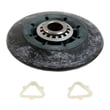
| Thumping/squealing | Worn rollers or idler | Rebuild with a kit such as dryer repair kit 4392067 |
| Runs but no heat | Heater or thermostat issue | Diagnose heat circuit; replace failed part |
Why it matters
A dryer that can’t move air efficiently runs hotter and longer, which accelerates failure of the heating element, thermostats, motor, and drum support components.
Last updated: January 2026
Is it worth replacing the heating element in a dryer?
Yes, it’s usually worth replacing the heating element in your Kenmore 11063012102 electric dryer when the dryer otherwise runs normally, because the part cost is typically far less than replacing the whole dryer and it restores proper heat. Use the 11063012102 installation guide heat-check steps to confirm a true no-heat condition first.
When replacement makes sense
Replacing the heating element is a strong choice when the dryer tumbles but does not heat, and the cabinet, drum, and controls are in decent shape.
- The dryer runs but clothes stay cold or take much longer than normal
- You have verified power is correct (many electric dryers use two fuses or breakers)
- Airflow is good (no crushed or clogged vent)
- The dryer is not showing signs of major wear (loud rumbling, burning smell that persists, repeated shutdowns)
- You want a repair that typically restores full drying performance
Quick checks before you buy a heating element
Our goal is to avoid replacing a good heater when the real issue is power, airflow, or a safety device.
- Run the dryer about 5 minutes, then open the door and feel for heat (per the installation instructions).
- If there’s no heat, check both house fuses or both circuit breakers for the dryer.
- Check venting for restrictions; poor airflow can cause overheating and repeated heater or thermal cut-off failures.
Common “no heat” causes vs. what you’ll notice
| What’s wrong | What you’ll notice | What to check next |
|---|---|---|
| No 240V supply (one breaker tripped) | Dryer runs but no heat | Reset/check both breakers/fuses |
| Restricted venting | Long dry times, hot cabinet | Clean/replace venting |
| Failed heating circuit part | No heat even with good power/airflow | Heater, thermal cut-off, thermostat |
Parts that are often replaced together
On Kenmore electric dryers, a heater failure is sometimes related to overheating or a failed safety control. If you’re already opening the cabinet, it’s smart to inspect these common companions.
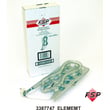
- Dryer heating element WP3387747
- Thermal cut-off and related safety parts (often replaced as a set)
- Operating thermostat
- Heating element wiring and terminals for heat damage
Why it matters
A dryer that runs without heat is often a straightforward repair, but ignoring airflow and power checks can lead to repeat failures. Confirming proper venting and correct electrical supply helps the new heating element last.
Last updated: January 2026
How do I know if a dryer heating element is bad?
If your Kenmore electric dryer model 11063012102 runs but won’t heat (or takes much longer to dry), the heating element is a top suspect. We confirm it by safely disconnecting power, checking airflow first, then testing the element for continuity with a multimeter; an open circuit points to a failed element.
Quick symptoms that point to a bad heating element
- Dryer tumbles normally but there’s no heat
- Clothes stay damp after a full cycle
- Dry times suddenly get much longer
- You notice a burning smell during normal use (stop the cycle and inspect venting)
- Heat is intermittent (can also be a thermostat or wiring issue)
Safe checks to do before you test the element
- Unplug the dryer (electric shock risk).
- Confirm the dryer is set to a heated cycle (not Air/No Heat).
- Check house power: many electric dryers use two breakers/fuses; if one trips, the dryer can run but not heat.
- Check airflow: clean the lint screen and make sure the vent is not crushed or clogged.
What the installation guide says about “no heat”
During the initial heat check, if you don’t feel heat after the dryer runs a few minutes, the guide points you to verify both fuses/breakers and then contact a qualified technician if heat still doesn’t return. See the 11063012102 installation guide.
How to test the heating element (basic method)
After disconnecting power and accessing the heater terminals:
- Set your multimeter to continuity or ohms (Ω).
- Touch one probe to each heater terminal.
- Good element: shows continuity (or a measurable resistance).
- Bad element: shows no continuity (open circuit).
| Test result | What it usually means | Next step |
|---|---|---|
| Continuity present | Element may be OK | Check thermostats, thermal cut-off, wiring, airflow |
| No continuity (open) | Element is failed | Replace the heating element |
Parts that are commonly involved
If you confirm the element is open, the correct replacement for this model is the dryer heating element WP3387747. If the element tests good, a temperature control part such as the dryer operating thermostat WP3387134 is another common cause of no-heat symptoms.
Why it matters
A restricted vent or failed temperature safety device can overheat the heater housing and shorten element life. Keeping airflow strong helps the dryer heat correctly and protects key parts like the heating element, thermal cut-off, and operating thermostat.
Last updated: January 2026