Owner’s manual
 Error Codes


Why is my refrigerator not getting cold at the bottom?
If your Kenmore Elite refrigerator model 79571052010 is warmer at the bottom, the most common causes are restricted airflow (blocked vents or overpacked shelves), temperature controls needing adjustment, or a cooling system issue such as dirty condenser coils or a weak evaporator fan. Use the steps below and confirm control settings in the 79571052010 owner's manual.
- Make sure air vents inside the refrigerator are not blocked by food containers.
- Avoid packing items tightly against the back wall; leave space for air circulation.
- Confirm doors close fully and seals are making contact all the way around.
- Set temperatures, then wait 24 hours before changing them again (this model needs time to stabilize).
- Verify the room is within 55°F to 110°F; extreme room temps reduce cooling performance.
On this model, the refrigerator control acts like the main thermostat, and the freezer control adjusts how much cold air is sent to the refrigerator section.
| Symptom | Adjust first | What to do | Wait time |
|---|---|---|---|
| Refrigerator bottom is warm | Refrigerator control | Set 1 step colder | 24 hours |
| Freezer OK but fridge still warm | Freezer control | Set 1 step colder to push more cold air to fridge | 24 hours |
| Temps swing after changes | Both controls | Make only 1 change at a time | 24 hours |
If airflow is clear and settings are correct but the bottom stays warm, these parts are common suspects:
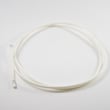
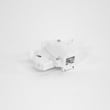
- Evaporator fan not running or noisy: consider the lg refrigerator evaporator fan motor 4681JB1027C.
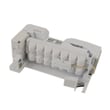
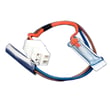
- Door not signaling closed (lights stay on, fan behavior changes): check the refrigerator door switch 6600JB1010A.
- Frost buildup restricting airflow (often after door left ajar): inspect vents and the back panel for heavy ice.
Bottom-warm symptoms usually mean cold air is not circulating properly. Fixing airflow and control settings protects food safety, reduces compressor run time, and helps prevent frost and moisture problems.
Last updated: January 2026
How to level a Kenmore refrigerator with wheels?
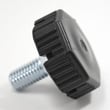
To level your Kenmore Elite refrigerator model 79571052010, adjust the two front leveling legs (not the wheels) so the cabinet is stable and the doors close easily. Turn the leg clockwise to raise that side and counterclockwise to lower it; the adjustment screw stays in place.
- Plug the refrigerator into a properly grounded outlet.
- Roll the refrigerator into its final position.
- Open the freezer drawer and remove the base cover screws, then remove the base cover.
- Use an 18 mm (11/16-inch) wrench or a flat-blade screwdriver on the leveling legs.
- Turn the leveling legs to adjust height; make small changes and re-check stability.
- Reinstall the base cover when finished.
| What you want to do | Turn the leveling leg | Result |
|---|---|---|
| Raise the front on that side | Clockwise | Front lifts, tilt increases |
| Lower the front on that side | Counterclockwise | Front drops, tilt decreases |
| Help doors close easier | Clockwise on both legs (equal turns) | Slight rearward tilt |
After leveling, confirm these basics:
- Doors close smoothly without popping back open.
- Refrigerator does not rock when you press on the corners.
- Gaps between the two fresh food doors look even.
- If the door gap is uneven, adjust the hinge nut using the included wrench (counterclockwise raises, clockwise lowers).
Proper leveling reduces door seal leaks, helps the ice maker and water dispenser work more reliably, and prevents vibration noise from the compressor and fans.
For the exact access points and illustrations for your unit, follow the 79571052010 owner's manual.
Last updated: January 2026
What are the common problems with Kenmore Elite refrigerators?
Common problems we see on the Kenmore Elite 79571052010 bottom-mount refrigerator include weak or no cooling, ice maker or water dispenser issues, water leaks, door sealing problems, and unusual noises. Many fixes start with cleaning condenser coils, checking door closure, and following the troubleshooting steps in the 79571052010 owner's manual.
- Not cooling or warm temperatures: dirty condenser coils, airflow blockage, evaporator fan issues, or control problems
- Compressor seems to run too much: frequent door openings, warm room temperature, or heavy food load (often normal after loading groceries)
- Ice maker not making ice: ice compartment door not closed tightly, ice bin ice piled unevenly, or water supply/filter restriction
- Bad-tasting or smelly ice: old ice, unwrapped foods, dirty ice bin, or water quality issues
- Vibration or rattling: refrigerator not level or floor is uneven
- Clean the condenser coils (dust buildup is a top cause of poor cooling and long run times).
- Confirm doors seal and close fully; check gaskets for gaps and keep the ice compartment door tightly closed.
- Reset expectations after loading food; longer run time is normal while temperatures recover.
- Dump old ice and wash the bin if taste or odor is the complaint.
- Check the water filter schedule; a restricted filter can reduce water flow and affect ice production.
| Symptom | Common part to check | Example part for model 79571052010 |
|---|---|---|
| No water or slow water to dispenser/ice maker | Water filter | Genuine Kenmore refrigerator water filter 9690 AGF80300801 |
| Lights do not work when door opens | Door switch | Refrigerator door switch 6600JB1010A |
| Ice maker not producing ice | Ice maker assembly | Refrigerator ice maker assembly AEQ73110205 |
Catching airflow, cleaning, and door-seal issues early helps the refrigerator hold safe food temperatures, reduces compressor run time, and prevents secondary problems like frost buildup, leaks, and ice quality complaints.
Last updated: January 2026
Why is my Kenmore Elite refrigerator leaking water out of the bottom?
Water leaking from the bottom of your Kenmore Elite 79571052010 refrigerator is typically caused by a clogged or frozen defrost drain (defrost water cannot reach the drain pan) or a leak in the water supply tubing/valve for the ice maker or dispenser.
- Look for ice or a shallow puddle under the freezer drawer; this points to a defrost drain issue.
- Check whether the leak happens after dispensing water or after the ice maker refills.
- Inspect the rear lower area for drips at the inlet valve and tubing connections.
- Confirm the refrigerator is level; a forward tilt can let water spill out.
- Check the drain pan area for overflow after a defrost cycle.
- Unplug the refrigerator.
- Remove the freezer drawer and locate ice or water at the bottom.
- Melt ice with warm air (hair dryer on low) and flush the drain with warm water.
- Clear the drain opening with a flexible plastic tube or pipe cleaner (avoid sharp tools).
For model-specific access steps and diagrams, use the 79571052010 owner's manual.
The water line setup instructions call for checking connections and tightening any that leak.
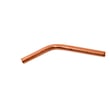
- If tubing is cracked or kinked, replace it with refrigerator water tubing MJU62070602.
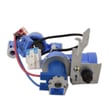
- If the valve seeps or leaks during/after ice maker fill, replace lg refrigerator water inlet valve AJU72992601.
| When it leaks | Most likely source | First thing to do |
|---|---|---|
| After defrost cycle | Defrost drain/drain pan | Clear ice, flush drain |
| After dispensing water | Dispenser tubing/fittings | Inspect tubing and fittings |
| During/after ice maker fill | Inlet valve/tubing | Check valve and connections |
Bottom leaks can create freezer ice buildup, restrict airflow, and cause floor damage. Clearing the drain or fixing a water line leak early helps prevent repeat puddles and ice maker problems.
Last updated: January 2026