Owner’s manual
 Error Codes


How many cubic feet is the Kenmore Elite?
Kenmore Elite is a product line, not a single refrigerator size. For your Kenmore model 10658142800 side-by-side refrigerator, the exact cubic-foot capacity is listed on the model’s rating label and in the 10658142800 owner's manual; capacities vary widely across Kenmore Elite models.
How to find the exact cubic feet for your refrigerator
We recommend using one of these quick checks:
- Check the model rating label (commonly inside the fresh food compartment on a side wall or ceiling area).
- Look in the specifications section of the 10658142800 owner's manual.
- If you have the original sales paperwork, capacity is often listed with the model number.
- If shelves or bins were replaced, that does not change cubic feet; it only changes usable layout.
Typical capacity ranges (so you know what to expect)
Most side-by-side refrigerators like Kenmore model 10658142800 fall into a fairly consistent range.
| Refrigerator style | Typical capacity range (cu. ft.) | Notes |
|---|---|---|
| Side-by-side | 20 to 26 | Narrower compartments; strong freezer access |
| French door | 25 to 33 | Larger fresh food section; wider shelves |
| Top freezer | 14 to 22 | Often smaller overall footprint |
Why it matters
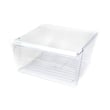
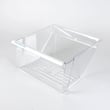
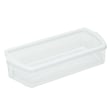
Cubic-foot capacity helps you compare storage space, but it also affects day-to-day choices like shelf organization, how much airflow you need around food, and which accessories fit best (for example, a replacement refrigerator crisper pan WP2188656 if a bin cracks).
Last updated: February 2026
How much does a Kenmore side by side refrigerator weigh?
Most Kenmore side-by-side refrigerators, including model 10658142800, weigh about 250 to 320 lb when empty. The exact shipping and net weight varies by configuration (ice maker, dispenser, door panels), so we recommend confirming the listed weight in the 10658142800 owner's manual.
Typical weight ranges (what to expect)
For a 36-inch side-by-side refrigerator like this Kenmore, these ranges are common:
- Empty (net) weight: 250 to 320 lb
- Shipping weight (boxed): 270 to 350 lb
- Fully loaded with food: often +80 to +150 lb more, depending on how you stock it
How to estimate weight for moving day
Use this quick planning guide before you move the refrigerator:
- Remove all food, bins, and glass shelves to reduce weight and prevent breakage
- Empty the ice bin and turn off the ice maker and water supply
- Tape doors and secure loose parts (crisper pan, meat pan, door bins)
- Protect floors; use an appliance dolly rated for at least 400 lb
- Measure clearances and plan turns; side-by-sides are typically moved upright
Quick planning table
| Scenario | Weight you should plan for | Why |
|---|---|---|
| Empty refrigerator | 250 to 320 lb | Typical net weight range |
| With packaging | 270 to 350 lb | Added carton and packing |
| Loaded with food | 330 to 470 lb | Food and ice add significant weight |
Why it matters
Weight affects safe handling, stair planning, and floor protection. It also helps you choose the right dolly, straps, and number of helpers, especially for a side-by-side with an ice and water dispenser.
Last updated: February 2026
What are the dimensions of a Kenmore Elite refrigerator?
Kenmore Elite refrigerator dimensions vary by style and capacity, so there is no single size. For your Kenmore side-by-side refrigerator model 10658142800, the owner's manual focuses on installation clearances and cabinet opening needs rather than listing exact overall height, width, and depth.
What we can size from the model 10658142800 manual
These measurements help you plan the space even when the exact exterior dimensions are not the focus.
- Minimum cabinet cutout width: 36 in (91.44 cm)
- Recommended cabinet opening width: 54 in (137.16 cm) if the refrigerator sits against an extended wall and you want full crisper pan removal
- Side and top clearance: 1/2 in (1.25 cm)
- Wall clearance for door swing: 2 in (5.08 cm) minimum (varies by setup)
- Back clearance: allow extra space if you have an ice maker water line connection
Quick planning table
| What you are measuring | Typical requirement for 10658142800 | Why you need it |
|---|---|---|
| Cabinet opening width | 36 in minimum | Fits the refrigerator into the cutout |
| Cabinet opening width (tight-to-wall installs) | 54 in recommended | Lets you remove crisper pans fully |
| Side/top clearance | 1/2 in | Air circulation and heat dissipation |
| Clearance near a fixed wall | 2 in minimum | Door swing and access |
How to get the exact exterior dimensions (height, width, depth)
Use these steps to get the numbers you need for moving, delivery, or a tight kitchen layout.
- Check the specs section in the owner's manual for your model
- Measure the refrigerator at the widest points (handles and hinges often add depth/width)
- Measure height to the top hinge cover, not just the cabinet
- Confirm you have room to pull out bins and pans with doors fully open
- If you are replacing a broken interior bin or pan after measuring, match parts by model; for example, the refrigerator crisper pan WP2188656
Why it matters
A refrigerator can physically fit a 36-inch opening but still be hard to use if door swing is restricted or if you cannot remove crisper pans. Planning for clearances prevents dents, poor airflow, and day-to-day access problems.
Last updated: February 2026