Owner’s manual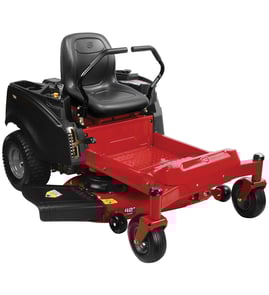






What brand engine does Craftsman use?
For the Craftsman 107277680 zero-turn rear-engine riding mower, the operator’s manual specifies a Briggs & Stratton engine (19 HP) paired with a 42-inch mower deck. For other Craftsman riding mowers, engine brands can vary by model and series, so always match parts and service info to your exact model number.
When you know the engine brand, you can choose the correct tune-up and repair parts (filters, ignition parts, gaskets) and follow the right service intervals.
- Use the engine make and model from the ID tag when ordering engine-related parts.
- Check the underside of the seat for the mower’s identification tag.
- Record the engine code/serial number for accurate parts matching.
- Follow the maintenance schedule in the owner's manual to reduce hard-starting and power-loss issues.
The manual notes the identification tag is under the seat; tilting the seat forward gives access. That tag is where you’ll typically find:
- Model description name/number
- Unit serial number
- Engine make (brand)
- Engine model
- Engine type/spec
- Engine code/serial number
| Item | Craftsman 107277680 | Other Craftsman riding mowers |
|---|---|---|
| Engine brand | Briggs & Stratton | Varies by model |
| Best way to confirm | Operator’s manual and ID tag | ID tag and model-specific manual |
| Parts matching | Use model number + engine model/spec | Use model number + engine model/spec |
Engine brand and engine model/spec determine the correct replacement parts and adjustments. Using the wrong engine parts can cause poor performance, leaks, or premature wear.
Last updated: February 2026
What are common problems with Craftsman riding mowers?
Common problems on the Craftsman 107277680 rear-engine riding mower include no-start conditions (controls not in PARK, PTO ON, stale fuel, weak battery), drive issues (belt slip or broken belt), parking brake not holding, and uneven cutting from dull blades or deck setup. See the owner's manual troubleshooting tables for model-specific checks.
- Engine will not turn over or start: controls not in PARK, PTO switch ON, choke/key position, out of fuel, flooded engine, old or water-contaminated fuel, dirty battery terminals, discharged battery, faulty spark plug, loose/broken wiring
- Engine runs but mower will not drive: transmission release levers left in PUSH position, drive belt slipping or broken
- Parking brake will not hold: brake not fully released, brake incorrectly adjusted
- Uneven or rough cut: tire pressure mismatch, deck not level, ground speed too fast, engine speed too low, dull blades, oily or worn mower drive belt
- Vibration or stalling with blades engaged: loose blade hardware, bent/out-of-balance blades, dirty deck underside, chute plugging
- Set ground speed controls to PARK and confirm the PTO is OFF before starting.
- Verify fresh fuel; drain and replace old fuel if it smells sour or looks dark.
- Check the battery terminals for corrosion and tightness.
- Confirm transmission release levers are in the DRIVE position (not PUSH).
- Set throttle to FULL when mowing and slow ground speed if the engine bogs.
| Problem area | What you notice | Most likely fix path |
|---|---|---|
| Starting/safety interlocks | No crank or no start | PARK and PTO OFF checks; fuel and battery basics; spark plug and wiring inspection |
| Drive system | Engine runs, no movement | Verify release levers; inspect drive belt for wear, glazing, or breakage |
| Parking brake | Mower creeps or won’t hold on flat ground | Confirm full release; adjust brake per manual |
| Cutting quality | Uneven cut, rough look, stalls with blades on | Level deck, match tire pressure, sharpen/replace blades, clean deck underside |
Catching belt slip, stale fuel, and brake adjustment issues early prevents bigger problems like overheating belts, hard starting, poor traction, and unsafe handling on slopes.
Last updated: February 2026
What is the advantage of a rear engine mower?
A rear-engine riding mower like the Craftsman 107277680 puts the engine weight over the drive wheels, which improves traction on flat lawns and makes the mower compact and easy to maneuver around trees, beds, and tight gates. It is a practical choice for smaller to mid-size yards.
- Better traction: rear weight bias helps the drive wheels grip when starting and turning.
- Compact footprint: typically easier to store and fit through narrower openings than larger tractors.
- Good maneuverability: shorter overall length helps you trim around obstacles with fewer back-and-forth moves.
- Simpler deck access: many rear-engine riders are designed for straightforward deck height changes and belt routing.
- Comfortable visibility: the hood area is lower than many front-engine tractors, so it is easier to see ahead.
Rear-engine riders are optimized for maneuvering and routine mowing, not heavy towing or steep terrain.
- They are best on level to gently rolling lawns.
- They usually have less ground clearance than larger lawn tractors.
- They are not the first pick for frequent heavy attachments.
| Feature | Rear-engine riding mower (like 107277680) | Lawn tractor (front-engine) |
|---|---|---|
| Maneuverability | High | Medium |
| Storage space needed | Lower | Higher |
| Best yard size | Small to mid-size | Mid to large |
| Heavy towing/ground work | Limited | Better |
Choosing the right layout affects cut quality and safety. For example, the owner's manual emphasizes shutting the engine off, removing the key, and disconnecting the spark plug wire before clearing blockages or servicing the mower deck. Following those steps is easier when the mower is sized and configured for your yard.
Last updated: February 2026
What year is a Craftsman 107277680 riding mower?
Craftsman model 107277680 is a ZTS 7500 zero-turn rear-engine rider (19 HP Briggs & Stratton with a 42-inch mower deck), but the model number by itself does not identify a single model year. To get the exact year for your mower, match the manufacture date on the ID tag to the date format shown in the 107277680 owner's manual.
Look for the product identification label, then use the date information on that label to determine the year.
- Check under the seat and around the seat deck/frame rails for the model and serial label.
- Clean the label gently so the serial/date code is readable.
- Write down the full serial number exactly as shown.
- Compare the serial/date code format to the identification details in the 107277680 owner's manual.
- If the label is missing or unreadable, use the manual’s illustrated parts sections to confirm you have the correct mower family (ZTS 7500, 42-inch deck).
The model number confirms the mower platform and major configuration, but not a single production year.
| What you have | What it confirms | What you still need for the year |
|---|---|---|
| Model number: 107277680 | ZTS 7500 rear-engine rider platform | Serial/date code from the ID tag |
| 42-inch deck references | Deck size and related assemblies | The manufacturing date on the label |
| Briggs & Stratton 19 HP | Engine family used on this configuration | Engine date code (optional cross-check) |
Knowing the exact year helps us match the correct parts diagrams, hardware, and deck or control group components so you order parts that fit the first time (for example, deck hardware like the carriage bolt 703185 or deck height components).
If you are confirming you have the 42-inch deck setup used on this model, these parts are commonly tied to the deck and support groups:
- Lawn tractor deck height adjuster crank 1727681SM
- Craftsman lawn tractor blade idler pulley arm 1732502ASM
- Rod hitch m 1713578SM
- Chute deflector 94707MA
Last updated: February 2026