Owner’s manual
 Error Codes



What does DH mean on Kenmore Elite refrigerator?
On Kenmore Elite refrigerator model 79579022313, dH (often shown as Er dH) points to a defrost heating problem. The refrigerator is detecting that the defrost heater is not warming the evaporator as expected, which can lead to frost buildup and poor cooling.
What you should check first
- Unplug the refrigerator before removing panels or touching wiring.
- Look for heavy frost on the rear freezer panel; that is a common sign of a defrost failure.
- Confirm the doors are sealing and closing fully; warm air leaks can mimic defrost issues.
- Check that the freezer vents are not blocked by packages.
- Review the diagnostics and troubleshooting section in the 79579022313 owner's manual.
Common causes of a dH / Er dH condition
In this style of Kenmore Elite bottom-mount refrigerator, the most common causes are in the defrost circuit:
| Likely cause | What you may notice | Typical next step |
|---|---|---|
| Defrost heater issue | Frost blanket on evaporator, warmer fridge temps | Test heater circuit for continuity and proper connections |
| Temperature sensing issue | Temps read incorrectly, defrost timing seems off | Test/inspect the sensor wiring and placement |
| Control problem | Defrost never starts or stops correctly | Verify outputs during diagnostics; replace control if needed |
Parts that may be involved
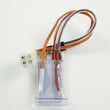
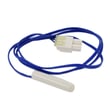
If testing points to a temperature feedback problem, a common related component is the refrigerator temperature sensor 6500JB2002X.
Why it matters
A true dH/Er dH condition usually means the evaporator can ice over. When airflow drops, the refrigerator section warms up, the freezer may struggle to hold temperature, and the compressor can run longer than normal.
Last updated: January 2026
What size is Kenmore refrigerator model 79579022313?
Kenmore Elite refrigerator model 79579022313 is a bottom-freezer style unit in the 795.7902* / 795.7904* family shown in the 79579022313 owner's manual. For exact exterior dimensions (width, depth, height), use the specifications section in the manual; capacity for this platform is commonly around the low-20 cu. ft. range.
How to confirm the exact dimensions for 79579022313
The most reliable way to get the precise size is to pull the measurements from the model’s specification information and then measure your actual unit (handles and leveling can change real-world fit).
- Check the “specifications” or “installation” section in the 79579022313 owner's manual
- Measure width at the widest point (often door/hinge area)
- Measure depth both with and without handles
- Measure height from floor to top of cabinet (include hinge cover if present)
- Confirm door swing and drawer clearance in your kitchen layout
Installation clearances (space you should plan for)
Even if the cabinet size fits, you still need operating clearance so doors and the freezer drawer open fully.
| What to allow | Typical guidance for this model family | Why it matters |
|---|---|---|
| Space in front to open doors | At least 33 3/4 in. | Prevents binding and makes drawers usable |
| Space behind to wall | At least 2 in. | Helps airflow and reduces heat buildup |
| Room for water line (if equipped) | Plan access to supply line | Supports icemaker operation |
Why it matters
Correct “size” is more than just width. Depth (especially with handles) and required clearances affect whether the refrigerator will sit flush, whether doors hit nearby walls, and whether the freezer drawer can open without scraping.
Last updated: January 2026
Why is my refrigerator not getting cold at the bottom?
If your Kenmore Elite refrigerator model 79579022313 is warm at the bottom, the most common causes are blocked air vents (cold air cannot circulate), frequent door openings, or the unit not having enough time to stabilize after a change. Use the airflow and control guidance in the 79579022313 owner's manual.
Quick checks that fix many “warm bottom” complaints
- Wait for temperatures to stabilize after any control change; allow up to 24 hours.
- Make sure air vents are not blocked by food packages or bins.
- Reduce long or frequent door openings (warm, humid air quickly raises compartment temps).
- Confirm the refrigerator is operating within normal room temperatures (about 55°F to 110°F).
- Avoid loading a large amount of warm food at once; it can overwhelm cooling temporarily.
What to inspect next (in order)
- Airflow path: Rearrange items so air can move from the vents to the lower shelves and drawers.
- Door closing and sealing: A door that does not close fully can keep the lower area warm.
- Fan-driven circulation: If you do not hear normal fan operation or cooling is uneven, the evaporator fan system may need attention; the refrigerator evaporator fan motor EAU65058315 is one part in that airflow system.
Symptoms and likely causes
| What you notice | Most likely cause | What to do first |
|---|---|---|
| Top shelves cool, bottom warm | Blocked vents or overloaded shelves | Clear vents, reorganize food |
| Temps rise after shopping | Warm food load, doors open often | Wait 24 hours, limit openings |
| Whole fresh-food section warm | Ambient too hot, airflow issue | Check room temp, vents, door seal |
Why it matters
Bottom-warm conditions usually come from restricted airflow, not a lack of cooling capacity. Restoring circulation helps protect food safety, reduces compressor run time, and prevents temperature swings.
Last updated: January 2026
What are the common problems with Kenmore Elite refrigerators?
Common issues on the Kenmore Elite 79579022313 bottom-mount refrigerator include warm temperatures (often airflow or control settings), frost or moisture buildup from frequent door openings, and normal or abnormal operating noises. We start by confirming settings and airflow, then check fans, defrost, and water/ice components using the 79579022313 owner's manual.
Most common symptoms and what usually causes them
- Not cooling or too warm: blocked air vents, doors opened often, recent install (can take up to 24 hours), or unit in a hot location.
- Food freezing in fresh food section: items placed near an air vent, temperature set too cold, or room temperature too low.
- Frost/ice buildup: door left open, warm humid air entering from frequent openings, or a sealing/alignment issue.
- Noises (buzzing, clicking, high-pitched/pulsing): some sounds are normal during compressor operation; repeated clicking can point to a start/overload issue.
- Ice maker not making ice: freezer not cold enough yet (ice maker typically starts once it reaches about 15°F or below), water supply/pressure issues, or a valve problem.
Quick checks we recommend first (no tools)
- Make sure packages are not blocking doors and that bins and shelves are fully seated.
- Confirm air vents are not blocked by food.
- Verify the refrigerator is level so doors close and seal correctly.
- After a move or first install, allow up to 24 hours for temperatures to stabilize.
- Keep the refrigerator in an ambient range of about 55°F to 110°F for proper operation.
Parts that commonly relate to these problems
| Symptom | Part to consider | What it affects |
|---|---|---|
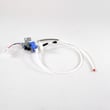
| No ice or slow ice | Lg refrigerator water inlet valve AJU73753101 | Water flow to ice maker |
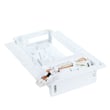
| Ice maker not cycling | Lg refrigerator ice maker assembly model AEQ72909603 AEQ72909603 | Ice harvest and fill cycle |
| Warm temps, poor airflow | Refrigerator evaporator fan motor EAU65058315 | Circulates cold air |
| Clicking, won’t start cooling | Refrigerator compressor overload protector 6750CL0001D | Compressor start protection |
Why it matters
Cooling complaints are often caused by airflow, door sealing, or settings, which are fast to correct. Catching a failing fan motor, control board, or compressor start component early helps prevent food loss and bigger repairs.
Last updated: January 2026