Owner’s manual
 Error Codes



How do you put the bottom grill on a GE refrigerator?
On the GE GWE19JSLKFSS bottom-mount refrigerator, the bottom grille (base grille) installs by aligning it with the lower front opening and snapping or sliding it into its mounting tabs; if your grille uses screws, reinstall them after the grille is seated. For model-specific access points and clearances, use the GWE19JSLKFSS owner's manual.
Steps to reinstall the bottom grille
- Unplug the refrigerator or switch off power at the breaker if your hands will be near wiring.
- Pull the refrigerator straight out a few inches if you need more room; avoid rolling over the power cord or water line.
- Raise the front leveling legs slightly to reduce drag on the floor.
- Line up the grille’s top edge with the slots or tabs along the bottom front frame.
- Press evenly from one end to the other until it seats fully.
- If your grille is screw-retained, reinstall the screws with a Phillips screwdriver and snug them (do not overtighten).
Quick fit check (what “installed” looks like)
| Check | What you should see | What it prevents |
|---|---|---|
| Grille sits flush | No gaps at corners | Rattles and vibration noise |
| Even engagement | Both ends clipped in | Grille popping off |
| Air path clear | No packaging, dust mats, or toe-kick blockage | Overheating and poor cooling |
If it will not snap in
- Confirm the grille is not upside down; many GE grilles only fit one way.
- Look for bent tabs or broken clips on the grille or the refrigerator frame.
- Make sure the leveling legs are not extended so far that they block the grille.
- If the refrigerator was recently moved, re-level it, then try again.
Why it matters
The bottom grille helps protect components and keeps airflow moving across the condenser area. A loose or blocked grille can lead to extra noise and reduced cooling efficiency.
Last updated: February 2026
What is the average lifespan of a GE refrigerator?
Most GE refrigerators average 10 to 15 years of service life. For a GE bottom-mount refrigerator like GWE19JSLKFSS, consistent maintenance (clean airflow, good door sealing, and stable temperatures) is what most often determines whether you land closer to 10 years or closer to 15.
Typical lifespan ranges (what we see most often)
- Average: 10 to 15 years
- Common “long life” outcome with good care: 15+ years
- Most important life-limiting areas: sealed system (compressor), airflow components, and door sealing
| Component area | What it affects | What to watch for |
|---|---|---|
| Sealed system (compressor, evaporator, condenser) | Core cooling performance | Warm temps, long run times, clicking/humming changes |
| Airflow (evaporator fan, damper) | Even cooling between sections | Freezer OK but fridge warm, weak airflow |
| Door sealing (gaskets, alignment) | Run time and frost control | Moisture, frost, doors not closing easily |
| Water system (filter, valve) | Ice and water performance | Slow fill, no ice, leaks |
Maintenance that extends refrigerator life
We recommend these habits for GE units like GWE19JSLKFSS:
- Keep door gaskets clean and sealing evenly; fix gaps quickly.
- Maintain good airflow around the cabinet; do not block vents inside.
- Set stable temps (avoid frequent big changes that increase run time).
- Replace the water filter on schedule if your model uses one (a restricted filter can reduce water flow to the icemaker).
- Address unusual noises early; fans and controls are easier to fix before they cause secondary issues.
For model-specific care and operating guidance (including features and filter information), follow the GWE19JSLKFSS owner's manual.
Why it matters
A refrigerator that runs longer than necessary (from poor sealing, restricted airflow, or temperature swings) puts extra wear on the compressor and fans. Reducing run time is the most reliable way to push lifespan toward the high end of the typical range.
Last updated: February 2026
What is the most common problem with a GE refrigerator?
The most common GE refrigerator problem is a cooling complaint (fresh food section warm, freezer too warm, or temperatures swinging). On the GE GWE19JSLKFSS, the most frequent root causes are airflow restrictions (blocked vents or overpacked shelves), dirty condenser coils, or an evaporator fan issue that prevents cold air from circulating.
Quick checks we recommend first
- Confirm the temperature settings are correct; adjust one step at a time and allow 24 hours to stabilize (see the GWE19JSLKFSS owner's manual).
- Make sure food is not pushed against the rear air vent; the manual notes food too close to the vent can cause freezing or poor cooling.
- Avoid overstuffing; blocked vents cause warm spots and inconsistent temps.
- Clean the condenser coils (dust buildup commonly reduces cooling performance).
- Listen for the evaporator fan in the freezer; a failed fan often causes a warm refrigerator section.
Common symptoms and the most likely causes
| Symptom | Most likely cause | What to do next |
|---|---|---|
| Refrigerator warm, freezer cold | Airflow problem or evaporator fan not moving air | Check vents; consider the refrigerator evaporator fan motor WR60X32614 if the fan is not running |
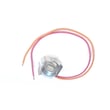
| Temps swing up and down | Sensor or control reacting to bad readings | Inspect/replace the GE profile refrigerator temperature sensor WR55X10025 if readings are erratic |
| Food freezing in fresh food section | Food blocking rear vent or control set too cold | Move food away from vent; raise temp setting per manual |
| Water drips after dispensing | Air in water line or glass removed too soon | Hold glass 2 to 3 seconds after release; dispense water for at least 2 minutes to purge air |
Why it matters
Cooling problems are usually airflow or maintenance related; fixing them early helps protect food, reduces compressor run time, and prevents frost buildup that can lead to bigger repairs.
Related GE help
- If the door alarm is part of the complaint, use how to reset the door alarm on a GE refrigerator.
- If you see a code on the display, check GE refrigerator error codes to narrow the cause.
Last updated: February 2026