Owner’s manual
 Error Codes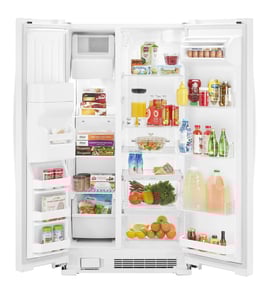

What is the average lifespan of a GE refrigerator?
Most GE refrigerators, including the GE PSS26PSTASS side-by-side, typically last 12 to 16 years. With consistent care (clean airflow, stable temperatures, and timely filter changes), it’s common to see 10 to 20 years of service from this style of refrigerator.
What affects lifespan the most
- Condenser cleanliness: Dust buildup makes the compressor run hotter and longer.
- Door seal condition: Leaky gaskets cause constant run time and moisture issues.
- Ice and water dispenser use: More moving parts (valves, solenoids, icemaker) means more wear.
- Water quality and filter maintenance: Sediment can stress the water valve and icemaker.
- Room conditions: High ambient heat and tight clearances shorten component life.
Maintenance that helps a GE side-by-side last longer
Use these habits for the PSS26PSTASS to reduce strain on the sealed system and fans:
- Vacuum and brush the condenser area regularly (often every 6 to 12 months).
- Keep freezer vents clear so air can circulate to the fresh food section.
- Replace the water filter on schedule; a restricted filter can reduce flow and affect dispenser performance.
- Confirm doors close fully and the refrigerator is level.
- Follow the care and operating guidance in the PSS26PSTASS owner's manual.
Typical lifespan by major system (what to expect)
| System | Typical lifespan | Notes |
|---|---|---|
| Compressor and sealed system | 10 to 20 years | Strongly affected by heat, airflow, and run time |
| Evaporator fan and airflow parts | 8 to 15 years | Noise and warming are common early symptoms |
| Ice maker and dispenser parts | 5 to 12 years | Heavy use and mineral buildup shorten life |
| Water filtration and valve components | 5 to 10 years | Filter changes and water quality matter |
Why it matters
Knowing the typical lifespan helps you decide whether to repair or replace. If your PSS26PSTASS is within the 12 to 16 year range, maintenance and targeted part replacement (like a filter or valve) often restores reliable performance without replacing the whole refrigerator.
Last updated: January 2026
Is GE Profile considered high end?
Yes. GE Profile is GE’s higher-tier appliance line, positioned above standard GE models with more premium features and design. For the GE PSS26PSTASS side-by-side refrigerator, the PSS26PSTASS owner’s manual also reflects “GE and GE Profile models” coverage, which aligns with Profile being a step up within the GE family.
What “high end” means for GE Profile
GE Profile typically focuses on upgrades you notice in daily use, such as performance features, convenience features, and a more premium look and feel.
Common GE Profile differentiators include:
- More advanced temperature management and food preservation features
- More feature-rich dispenser and ice systems
- More premium finishes and styling details
- More electronic controls and sensors (compared with basic models)
- Longer sealed-system warranty coverage on many Profile models (varies by product)
Warranty and “premium” positioning (what we see in the manual)
The documentation for this refrigerator family references different warranty coverage tiers, including a longer sealed-system coverage for GE Profile models.
| Coverage area | Typical GE models | GE Profile models (often) |
|---|---|---|
| Full appliance limited warranty | 1 year | 1 year |
| Water filter cartridge (if included) | 30 days | 30 days |
| Sealed refrigerating system | Not always extended | Up to 5 years on many Profile models |
For the exact warranty terms that apply to your unit, use the PSS26PSTASS owner’s manual.
Why it matters
If you are comparing refrigerators or deciding whether a repair is worth it, “GE Profile” usually means you are dealing with a more feature-dense platform. That can affect parts selection (controls, sensors, dispenser components) and service approach.
Last updated: January 2026
What is the most common problem with GE refrigerators?
The most common problem we see with GE refrigerators like model PSS26PSTASS is a cooling complaint (fresh food too warm, freezer too warm, or temperatures that swing). In many cases, the root cause is airflow or defrost related, not the temperature setting itself; the PSS26PSTASS owner's manual also notes that longer run times and certain sounds can be normal as the refrigerator manages temperature.
What to check first (fast, high-impact)
- Confirm the doors fully close and are not being held open by packages.
- Make sure vents inside the fresh food and freezer sections are not blocked by food.
- Clean dust from the condenser area (dirty coils can reduce cooling efficiency).
- Listen for the evaporator fan running; weak airflow often points to a fan or frost buildup issue.
- If the unit seems to run a lot, remember newer high-efficiency compressors can run longer, especially with frequent door openings.
Common causes behind “not cooling” on side-by-side models
| Symptom | Most likely area | What it usually means |
|---|---|---|
| Freezer cold, fridge warm | Airflow/damper | Cold air is not moving into fresh food section |
| Both sections warm | Sealed system or compressor start components | Compressor not running correctly or refrigerant system issue |
| Cooling OK, then warms up | Defrost system | Frost buildup blocks airflow over the evaporator |
| Temps seem inaccurate | Sensor/controls | Thermistor or control logic is reading wrong |
Parts that commonly relate to cooling issues on PSS26PSTASS
These are model-matched parts that often come up during diagnosis:
- GE profile refrigerator temperature sensor WR55X10025 (temperature feedback to the control)
- Refrigerator defrost heater WR51X10055 (melts frost off the evaporator)
- Refrigerator defrost thermostat WR50X10068 (helps control defrost heating)
- Refrigerator evaporator motor WR60X10307 (moves cold air through the compartments)
Why it matters
Cooling problems can look like “the refrigerator is bad,” but they are often caused by airflow restrictions, frost buildup, or a failed sensor. Catching it early helps prevent food spoilage and can reduce strain on the compressor.
Last updated: January 2026
Is there a reset button for a GE refrigerator?
GE refrigerators like model PSS26PSTASS usually do not have one universal “reset button.” Most resets are done either by power cycling the refrigerator to clear an electronic glitch, or by using a specific control-panel reset for a feature such as the water filter indicator.
The two resets most people mean
- Power reset (main control reset): Unplug the refrigerator, wait about 1 to 5 minutes, then plug it back in.
- Water filter light reset: After replacing the filter, press and hold the RESET FILTER pad for 3 seconds (this is a true button-style reset on the dispenser). See the steps in the PSS26PSTASS owner's manual.
How to reset the water filter indicator (PSS26PSTASS)
Use this when the “replace filter” light stays on after a new cartridge.
- Install the new filter cartridge.
- Run water from the dispenser for 3 minutes (about 1 1/2 gallons) to clear air and prevent sputtering.
- Press and hold RESET FILTER for 3 seconds.
| What you see | What it usually means | What to do |
|---|---|---|
| Filter light stays on | Reset step was missed | Hold RESET FILTER for 3 seconds |
| Water sputters after filter change | Air in the line | Dispense water for about 3 minutes |
| No water/ice after removing filter | Filter bypass plug needed | Install filter or bypass plug per manual |
If you are trying to “reset” cooling or the ice maker
These steps address common situations that look like a control problem.
- Make sure the refrigerator is fully plugged in and the outlet has power.
- Check the house breaker or fuse and reset/replace if needed.
- Confirm the temperature controls are not set to OFF.
- If the unit is in a defrost cycle, wait about 30 minutes for it to finish.
- If the ice maker is buzzing and the water line is not connected, turn the ice maker OFF to protect the water valve.
Why it matters
Using the right reset prevents repeat problems. A power reset clears temporary electronic glitches, while the RESET FILTER pad only clears the maintenance reminder and does not fix low water flow caused by a clogged filter.
Last updated: January 2026