Installation guide
 Owner’s manual


How do I tell what model my Kenmore dryer is?
Your Kenmore dryer’s model number is printed on the appliance’s ID label; once you find it, use that exact number (for example, 11075212610) to match the correct parts list, wiring diagram, and cycle features in the 11075212610 owner’s manual.
Where to find the model number label
On most Kenmore dryers, the model and serial label is in one of these spots:
- Inside the door opening on the front panel (most common)
- On the door itself or the door frame
- On the back panel of the dryer cabinet
- Near the lint screen housing (some designs)
How to read the number (and why it matters)
Kenmore model numbers are typically a long string of digits. The full model number is what we use to ensure the right fit for parts like a door switch, timer, or drum support roller.
Quick guide
| What you see | What it tells you | What to do next |
|---|---|---|
| Full model number (example: 11075212610) | Exact dryer version | Use it to select parts and diagrams |
| Serial number | Production info | Keep it for service and warranty records |
| A prefix like “110” | Common Kenmore manufacturing family | Still use the full model number for parts |
Tips to avoid common mix-ups
- Write the model number exactly as shown; do not add spaces.
- If your label shows multiple numbers, use the one labeled Model (not Serial).
- If you’re comparing manuals, confirm the model list on the cover; the Use & Care Guide for this series lists 110.65212610 and 110.75212610.
Why it matters
Using the exact model number prevents ordering the wrong Kenmore dryer parts and helps troubleshooting match your dryer’s control panel, cycles, and gas or electric configuration.
Last updated: February 2026
What are common problems with Kenmore dryers?
Common problems on the Kenmore 11075212610 dryer include no-start conditions, no heat, long dry times, the drum not turning, and unusual noises. Most issues trace back to airflow restrictions (lint buildup), a blown thermal cut-off, or normal wear on drive components like rollers and the idler pulley; use the 11075212610 owner's manual troubleshooting chart to narrow it down fast.
Most common symptoms and what usually causes them
- Dryer will not run: door not fully closed, blown house fuse or tripped breaker, failed door switch
- Drum turns but no heat (electric models): one house fuse/breaker open (dryer needs full 240V)
- No heat (gas models): igniter or radiant sensor issue, gas supply shutoff closed
- Long drying times: clogged lint screen, crushed/blocked vent, lint buildup in lint chute
- Loud thumping/squealing: worn drum rollers, idler pulley wear, objects in drum
Quick checks we recommend before replacing parts
- Confirm the door closes and latches firmly; a bad switch can stop the dryer from running.
- Check the home electrical supply; many electric dryers can tumble with a partial power loss but will not heat.
- Clean the lint screen and inspect the vent path for restrictions.
- Listen for changes: thumping after long non-use can be normal for the first few minutes.
- If you smell gas or suspect a gas supply issue, stop and follow the safety steps in the installation guide.
Parts that commonly fix these problems (when symptoms match)
| Symptom | Common wear item | Example part for this model |
|---|---|---|
| Squealing, rumbling, thumping | Drum support rollers | Dryer drum support roller WPW10314173 |
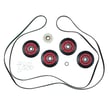
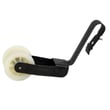
| Drum not turning | Idler pulley (belt tension) | Dryer idler pulley WP691366 |
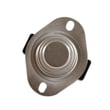
| No heat or shuts off from overheating | Thermal cut-off protection | Dryer thermal cut-off fuse kit W11050897 |
| Dryer will not start when door closes | Door switch | Dryer door switch WP3406107 |
Why it matters
Catching airflow and wear issues early helps prevent repeat overheating shutdowns, reduces dry times, and protects major components like the drive motor and drum.
Last updated: February 2026
What size is a Kenmore Model 11075212610 dryer?
The Kenmore dryer model 11075212610 is a 29-inch wide long-vent dryer. For the exact cabinet dimensions (height, depth, and clearances for closet or recessed installs), we follow the measurements and spacing rules shown in the installation guide.
Typical overall size you can plan around
Most Kenmore 29-inch dryers of this design fit within these planning ranges (final numbers depend on leveling legs, venting, and door swing):
- Width: 29 in (this model family is called out as 29-inch wide)
- Height: typically about 38 to 39 in to the top of the cabinet (adjustable with leveling legs)
- Depth: typically about 28 to 31 in (more if you include the exhaust duct and door clearance)
- Recommended side clearance: 1 in on each side to reduce noise transfer
- Garage installs: place the dryer at least 18 in above the floor
Quick sizing table (planning vs. what to verify)
| Measurement | What we can state for 11075212610 | What to confirm before install |
|---|---|---|
| Width | 29 in (long-vent 29-inch wide model) | Door swing and side clearance |
| Height | Adjustable (leveling legs) | Final height after leveling |
| Depth | Varies by vent hookup | Depth including vent elbow and wall clearance |
| Closet spacing | Minimum spacing rules apply | Ventilation openings if a door is used |
Why it matters
Dryer size affects whether the unit fits your laundry space, whether the door can open fully, and whether the exhaust duct can route without crushing or kinking. Correct spacing also helps the automatic cycles run properly and reduces drying time.
Install tips that affect “real-world” depth
- Use as few 90° elbows as possible in the vent run.
- Leave room behind the dryer for the vent connection so the cabinet is not forced forward.
- Plan extra clearance for servicing (belt, rollers, idler pulley, and motor access).
- Level the dryer after positioning; leveling legs change final height.
For the exact dimension diagram and minimum spacing requirements for the Kenmore 11075212610, use the installation guide.
Last updated: February 2026