Owner’s manual
 Error Codes



How to remove bottom grille on GE refrigerator?
On the GE GFE26JBMAFTS bottom-mount refrigerator, the bottom grille (base grille) typically comes off by releasing the retaining tabs or removing any mounting screws, then pulling the grille straight out from the front. We recommend unplugging the refrigerator first to avoid accidental fan or electrical contact.
Quick steps to remove the bottom grille
- Unplug the refrigerator or switch it off at the controls.
- Open both fresh food doors for better access.
- Look along the top edge of the grille for retaining clips or tabs.
- If you see screws, remove them with a Phillips screwdriver.
- Pull the grille straight toward you; work left to right to release clips evenly.
- Set the grille aside on a non-scratching surface.
What to check if it will not come off
A stuck base grille is usually held by hidden clips, a screw you missed, or the grille catching on the cabinet lip.
- Confirm all visible screws are removed (some models use 2 screws).
- Press in on the grille near each clip while pulling outward.
- Check for debris at the bottom edge (pet hair and dust can “glue” it in place).
- Avoid prying hard with metal tools; use a plastic putty knife if needed.
Reinstalling the grille
To reinstall, align the grille with the slots, push it in until the clips snap, then reinstall any screws.
| Grille style | What you will see | How it releases |
|---|---|---|
| Clip-in | No screws; tabs along top | Press tabs, pull straight out |
| Screw-mounted | 1 to 2 Phillips screws | Remove screws, then pull out |
Why it matters
Removing the bottom grille gives you access for cleaning and inspection around the condenser area. Keeping that area clear helps airflow and can reduce warm temperatures, longer run times, and unusual fan noise.
For model-specific illustrations and safety notes, follow the access and moving guidance in the GFE26JBMAFTS owner's manual.
Last updated: February 2026
Is a top mount or bottom mount fridge better?
For most households, a bottom-mount refrigerator like the GE GFE26JBMAFTS is better for everyday convenience because fresh-food items sit at eye level and the freezer is in a pull-out drawer. A top-mount is often the better pick if you want the simplest layout and typically lower energy use.
Quick comparison
| Feature | Bottom mount (like GFE26JBMAFTS) | Top mount |
|---|---|---|
| Fresh-food access | Easier (less bending) | More bending |
| Freezer access | Drawer, good organization | Shelf-style, simpler |
| Storage/organization | Typically more bins, dividers, baskets | Typically fewer organizers |
| Energy use | Often slightly higher | Often slightly lower |
| Price/complexity | Often higher, more features | Often lower, fewer features |
When a bottom mount is the better choice
- You use the refrigerator section more than the freezer
- You want better organization (bins, drawers, slide baskets)
- You prefer a freezer drawer that helps prevent items getting buried
- You want easier access for kids and shorter users to fresh-food shelves
- You are willing to keep up with feature maintenance (water filter, ice maker)
For model-specific features and layout details, use the owner's manual.
When a top mount is the better choice
- You want a simpler design with fewer moving parts
- You want a freezer at eye level for frequent frozen-food use
- You want a refrigerator that is often more energy-efficient
- You want a typically lower upfront cost
Why it matters
Bottom-mount vs. top-mount is mostly about daily ergonomics and how you shop. If you cook with fresh ingredients often, bottom-mount designs reduce bending and make it easier to see what you have, which can cut down on food waste.
Helpful tip for bottom-mount owners
If your bottom freezer drawer or baskets start sticking or jamming, avoid overfilling baskets above the rim and make sure baskets are seated correctly on the slide tabs (this is a common cause of drag and misalignment). The owner's manual shows the correct basket removal and reinstall steps.
Last updated: February 2026
What is the most common problem with a GE refrigerator?
The most common GE refrigerator issue is a cooling problem (fresh food section warm, freezer warming, or temperatures that do not match the set point). On the GE GFE26JBMAFTS, many “not cooling” complaints trace back to airflow, door sealing, or a defrost-related condition listed in the owner's manual.
Quick checks we recommend first (no parts needed)
- Confirm the controls are not set to OFF and adjust to a colder setting if needed.
- If the unit was just plugged in or had doors open, allow 24 hours for temperatures to stabilize.
- Make sure no package is holding a door open; an open door can cause long run times and warm temps.
- If the refrigerator is beeping, close the door fully and check for gasket folding or sticking.
- Verify the refrigerator is level; leveling legs that need adjustment can cause vibration and door-closing issues.
Common “cooling problem” symptoms and what they usually mean
| Symptom | Most common cause | What to do next |
|---|---|---|
| Runs a lot but temps are OK | Normal operation, adaptive defrost during door openings | Keep doors closed; it should cycle off after the door stays closed for about 2 hours |
| Fresh food too warm, freezer OK | Airflow issue between compartments | Check vents for blockage; if needed, inspect the refrigerator air damper WR60X27396 |
| Temps swing or seem inaccurate | Sensor or control issue | Check for error codes; consider the GE profile refrigerator temperature sensor WR55X10025 |
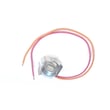
| Warm temps plus heavy frost | Defrost system problem | Inspect defrost components such as the refrigerator defrost bi-metal thermostat WR50X10069 |
When the issue is water or ice (also very common)
Cooling complaints often show up alongside dispenser or ice maker problems. For this model, the manual points to these frequent causes:
- Newly installed filter can cause spurting; run water about 3 minutes to clear air.
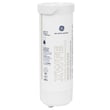
- Low or no water flow is often a clogged filter; replace the GE refrigerator water filter XWFE or install the refrigerator water filter bypass WR17X33825 for testing.
- Drips after dispensing often mean air in the line; dispense water for at least 2 minutes to purge air.
Why it matters
A refrigerator that cannot maintain stable temperatures can spoil food, overwork the compressor, and create secondary symptoms like beeping alarms, moisture, and ice maker failures. Catching airflow and defrost issues early prevents bigger repairs.
Last updated: February 2026