Owner’s manual
 Error Codes




Which is better top mount or bottom mount fridge?
For most households, a bottom-mount refrigerator like the JFC2290VPY5 is the better everyday choice because fresh foods sit at eye level and the freezer uses pull-out drawers for easier organization. A top-mount is usually the better pick when you want the simplest layout and the lowest operating cost.
| Feature | Top-mount (freezer on top) | Bottom-mount (freezer on bottom) |
|---|---|---|
| Fresh food access | You bend more often | You bend less often |
| Freezer access | Easy reach | Drawer-style, easy to sort |
| Organization | Basic shelves and bins | More drawer and basket options |
| Energy use | Typically lower | Typically slightly higher |
| Price and complexity | Usually lower and simpler | Usually higher and more complex |
- Choose bottom-mount if you use the refrigerator section most and want better day-to-day ergonomics.
- Choose top-mount if you want a straightforward design with fewer features to maintain.
- If you have an ice maker or water line, plan for extra space behind the unit for connections.
- Make sure you can fully open doors and drawers in your layout (walls, islands, and cabinets matter).
- Confirm ventilation clearances before you buy or install.
Our JFC2290VPY5 documentation calls out typical placement needs that apply to most refrigerators:
- Allow about 1/2 inch of space on each side and at the top for ventilation.
- Allow about 1 inch behind the refrigerator.
- Leave at least 2 1/2 inches on the hinge side when installing next to a fixed wall so doors can swing.
- Preferred room temperature range for efficient cooling is 60°F to 90°F.
For the exact guidance for this model, use the JFC2290VPY5 owner's manual.
The “better” refrigerator is the one that fits how you cook and shop. Bottom-mount designs reduce bending for everyday items (milk, produce, leftovers), while top-mount designs often win on simplicity and operating cost.
Last updated: January 2026
What are the disadvantages of a bottom freezer refrigerator?
Bottom-freezer refrigerators like the JENN-AIR JFC2290VPY5 make fresh foods easier to reach, but the tradeoff is that frozen items sit lower in a pull-out drawer, so you bend more and may have to dig for items. They also typically cost more than basic top-freezer models.
- More bending for frozen foods: You reach down for the freezer drawer, which can be tough for mobility or back issues.
- Drawer organization can be harder: Stacked bags and boxes can hide items, especially in deep bins.
- Heavier lifting from a lower position: Large frozen items (meat, bulk bags) are awkward to lift up and out.
- More parts in the freezer slide system: Drawer glides, gears, and rails can wear or get misaligned over time.
- Often higher purchase price: Bottom-mount designs are commonly priced above entry-level top-freezer refrigerators.
A bottom freezer works best when you store frozen foods in smaller containers and use bins to separate categories (meals, vegetables, breakfast items). If the freezer drawer front ever needs removal for service or cleaning, follow the steps and safety notes in the JFC2290VPY5 owner’s manual.
| Feature | Bottom freezer (like JFC2290VPY5) | Top freezer |
|---|---|---|
| Fresh food access | Easier (eye level) | More bending |
| Frozen food access | More bending, drawer digging | Easier reach |
| Organization | Drawer bins help, but can stack | Shelves are simpler |
| Typical cost | Higher | Lower |
Choosing the right layout affects comfort, food visibility, and how often you waste food from “lost” freezer items. If you rely heavily on frozen storage or have mobility concerns, the freezer-drawer design is the main drawback to weigh.
Last updated: January 2026
What are common problems with JennAir refrigerators?
Common problems on the Jenn-Air JFC2290VPY5 bottom-mount refrigerator include not cooling or uneven temperatures, ice maker or water dispensing issues, water leaks, and unusual noises. Many of these trace back to airflow restrictions, power/control settings, or failed components like the evaporator fan motor or water inlet valve.
- Fridge warm, freezer cold: blocked air vents, frost buildup, or an evaporator fan problem
- Both sections warm: power issue, controls off, dirty condenser area, or sealed-system/compressor problem
- No ice or slow ice production: ice maker issue, water supply problem, or inlet valve problem
- Water leaking: clogged/iced drain path or a water line connection issue
- Noisy operation: fan blade rubbing ice, worn fan motor, or vibration from panels/lines
Use these steps to narrow the cause quickly:
- Confirm the refrigerator is plugged into a grounded outlet and the outlet has power
- Make sure the controls are turned on and set to normal temperatures
- Allow 24 hours after a new installation or major temperature change for cooling to stabilize
- Check that interior air vents are not blocked by food packages
- If the lights are out, replace bulbs with appliance bulbs no greater than 40 watts (per the JFC2290VPY5 owner's manual)
If basic checks do not resolve the issue, these model-matched parts are common fixes:
| Symptom | Likely system | Model-matched part examples |
|---|---|---|
| Warm fridge, noisy, poor airflow | Evaporator airflow | Refrigerator evaporator fan motor WPW10128551, refrigerator evaporator fan blade WP2169142 |
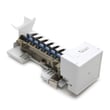
| No ice | Ice maker system | Refrigerator ice maker assembly W10884390 |
| No water, slow fill, no ice fill | Water supply | Refrigerator water inlet valve assembly WPW10420083 |
| Water under crisper or on floor | Defrost drain | Refrigerator drain tube kit W10619951 |
Temperature swings, leaks, and airflow problems can lead to food spoilage, ice buildup, and extra strain on the sealed refrigeration system (compressor, evaporator, condenser, dryer, and tubing). Catching the symptom early usually reduces repair cost and downtime.
Last updated: January 2026
What is the life expectancy of a JennAir refrigerator?
A Jenn-Air refrigerator typically lasts 12 to 18 years with normal household use. For the Jenn-Air JFC2290VPY5 bottom-mount refrigerator, consistent cleaning, correct temperatures, and quick repair of cooling or ice-maker issues are the biggest factors that keep it running closer to the high end of that range.
Most refrigerators fail early due to heat stress, airflow restrictions, or sealed-system wear. These factors have the biggest impact:
- Condenser airflow: Dust buildup and tight clearances make the compressor run hotter and longer.
- Door seal condition: Leaky gaskets cause long run times and moisture problems.
- Ice maker and water system health: Small leaks or slow fills can create recurring service issues.
- Defrost performance: Frost buildup reduces airflow and cooling efficiency.
- Power quality: Frequent outages or surges can shorten control-board life.
A refrigerator is usually nearing the end of its service life when you see repeated cooling problems or expensive sealed-system symptoms.
| Symptom | What it often points to | Typical next step |
|---|---|---|
| Warm fridge or freezer, runs constantly | Airflow issue, dirty condenser, weak compressor | Clean, verify fans, then diagnose sealed system |
| Frost buildup, poor airflow | Defrost issue | Check defrost components and airflow paths |
| No ice or slow ice production | Ice maker or water supply issue | Check fill, valve, and ice maker function |
| Intermittent operation | Electrical/control issue | Verify power, then test controls |
When a major component fails, repair cost versus age matters most.
- Compressor: A sealed-system repair can be a turning point on older units; the compressor for this model family is refrigerator compressor W10233960.
- Ice maker: Ice production issues are often repairable; this model has an available refrigerator ice maker assembly W10884390.
- Water inlet valve: Slow fill or no water to the ice maker can be caused by the refrigerator water inlet valve assembly WPW10420083.
- Evaporator fan motor: Weak airflow can cause warm temps; an available option is refrigerator evaporator fan motor WPW10128551.
Knowing the typical lifespan helps us decide whether to invest in a repair. If your JFC2290VPY5 is under about 10 years old, fixing a fan, valve, or ice maker is usually worthwhile; past the mid-teens, repeated cooling or sealed-system problems often drive replacement decisions.
For model-specific care, temperature settings, and troubleshooting steps, use the JFC2290VPY5 owner’s manual.
Last updated: January 2026