Installation guide
 Owner’s manual
 Error Codes


Are Amana dishwashers made in the USA?
Amana is a Whirlpool-owned brand, but Amana dishwashers (including model ADB1400AGW0) are not all made only in the USA. Manufacturing locations can vary by model and production run, so the most reliable way to confirm is to check the product’s rating label and documentation.
How to confirm where your ADB1400AGW0 was made
Use these quick checks on your actual dishwasher:
- Open the door and look along the inner tub edge for the model and serial label (often on the right or left side near the door opening).
- Find the country of origin statement on that label.
- Record the model number and serial number for reference.
- Compare details with the documentation in the ADB1400AGW0 owner’s manual.
- If you need installation-related identifiers, also review the ADB1400AGW0 installation guide.
What “made in the USA” can mean (and why it varies)
Brands often source components globally, and final assembly locations can change over time. For dishwashers, the label on your unit is the definitive reference.
Common label wording you may see
| Label wording | What it typically indicates |
|---|---|
| “Made in U.S.A.” | Final manufacture occurred in the U.S. |
| “Assembled in U.S.A.” | Final assembly occurred in the U.S.; parts may be imported |
| “Made in …” (other country) | Final manufacture occurred outside the U.S. |
Why it matters
Country of origin can affect expectations for parts sourcing, lead times, and sometimes small design variations across production runs. When ordering parts for Amana ADB1400AGW0, matching by model and serial helps ensure the correct fit.
Last updated: February 2026
Why does my Amana dishwasher not dry?
If your Amana dishwasher model ADB1400AGW0 is not drying, the most common causes are the Heat Dry option being off, low or missing rinse aid, and loading that traps water (especially plastics and concave-bottom cups). Start by confirming the drying settings in the ADB1400AGW0 owner's manual.
Quick fixes that solve most “not drying” complaints
- Turn Heat Dry on for the cycle you are using.
- Fill the rinse aid dispenser and make sure the cap is installed tightly.
- Unload bottom rack first so water does not drip onto lower items.
- Reposition cups and glasses with concave bottoms so they drain better.
- Expect plastics and nonstick items to stay wetter; towel-dry as needed.
Check these settings and conditions
| What to check | What “normal” looks like | What to do if it’s not |
|---|---|---|
| Heat Dry option | Enabled for better drying | Enable Heat Dry for the load |
| Rinse aid level | Rinse aid present | Refill rinse aid and reinstall cap |
| Loading | Water can drain off items | Angle cups, avoid nesting, don’t block vents |
| Item type | Plastics dry poorly | Use Heat Dry plus rinse aid; towel-dry plastics |
When it points to a part problem
If Heat Dry is on and rinse aid is used but dishes are still consistently wet and cool at the end of the cycle, the heating circuit may not be working. On ADB1400AGW0, a common suspect is the element assembly W10518394 (the heater that warms water and boosts drying).
Before replacing parts:
- Make sure the cycle completed normally (no mid-cycle cancel).
- Run a cycle with Heat Dry on and check whether the tub feels warm near the end.
- Confirm incoming hot water is set around 120°F for best performance.
Why it matters
Drying performance affects more than comfort. Proper heat and rinse aid help reduce water spotting and improve evaporation, which keeps dishes cleaner and helps prevent moisture from lingering in the tub.
Last updated: February 2026
Why is my Amana dishwasher leaking?
For Amana dishwasher model ADB1400AGW0, leaks usually come from a failed seal or a crack/leak in the wash system (sump, pump housing, or hoses). Start by identifying where the water appears (front, under the unit, or at the drain connection) and inspect those areas first.
Quick checks that fix many leaks
- Make sure the dishwasher is level and firmly secured; a tilted tub can cause water to spill past the door seal.
- Check the door gasket and bottom door area for food debris, detergent buildup, or damage.
- Confirm you are using the right detergent type and amount; too much detergent can create oversudsing and push water out.
- Look for a loose or split drain connection under the sink.
- Inspect the tub edge and corners for cracks or damage.
Most common leak sources on ADB1400AGW0
| Where you see water | Likely cause | What to inspect first |
|---|---|---|
| Front of dishwasher | Door seal issue, door not latching, oversudsing | Door gasket, latch alignment, detergent use |
| Under the center/bottom | Sump or pump seal leak | Sump area, pump housing, clamps |
| Under left/right side | Hose or valve seep | Fill hose, inlet valve, hose clamps |
| At sink cabinet | Drain hose leak or loose clamp | Drain hose routing and clamp tightness |
Parts that commonly relate to leaking
If you find moisture around the pump, sump, or hose connections, these model-matched parts are common fixes:
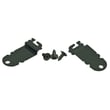
- Dishwasher pump grommet WPW10538166 (seals the pump connection to help prevent seepage)
- Dishwasher water inlet valve W11175771 (can leak at the valve body or fittings)
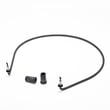
- Dishwasher drain hose 8269144A (replace if split, soft, or leaking at the ends)
- Dishwasher hose clamp W10789434 (use when a clamp is corroded or no longer tight)
Why it matters
Even a small dishwasher leak can damage flooring and cabinets, and it can also lead to electrical issues if water reaches wiring or the junction box. Finding the exact leak location first prevents replacing the wrong part.
What to use for model-specific guidance
Use the ADB1400AGW0 owner's manual for safety steps, troubleshooting guidance, and model-specific checks before disassembly.
Last updated: February 2026
Why are the spray arms not spinning on my Amana dishwasher?
On the Amana ADB1400AGW0, spray arms usually stop spinning because something is blocking them (overloading, a tall item, or debris in the spray holes) or because water flow is too weak from a clogged filter or a pump-related issue. Start by confirming both arms spin freely before you run a cycle.
Quick checks (most common fixes)
- Stop the cycle and open the door; spin the upper and lower spray arms by hand to confirm they rotate freely.
- Re-load so nothing hangs down into the spray path (cutting boards, utensils, long-handled tools).
- Clear food bits and hard-water scale from the spray arm holes using warm water and a soft brush.
- Clean the filter area so water can circulate properly (see ADB1400AGW0 owner's manual).
- Use fresh automatic dishwasher detergent and avoid running a cycle with an empty detergent cup.
- Verify hot water supply to the dishwasher is about 120°F for best wash pressure and performance.
What to inspect if the arms spin by hand but not during the wash
If the arms move freely when the dishwasher is off, the problem is almost always water flow.
| Symptom | Likely cause | What to do next |
|---|---|---|
| Dishes still dirty, little spray noise | Clogged filter or restricted circulation | Clean filter and check for debris in the sump area |
| Standing water after cycle | Drain restriction or weak drain pump | Follow dishwasher not draining video steps |
| Fills slowly or not enough water | Water inlet issue | Check supply valve, then consider dishwasher water inlet valve W11175771 |
| Runs but wash action is weak | Circulation/pump issue or leak at pump seal | Inspect hoses and consider pump service |
Parts that commonly relate to low wash pressure
We replace these parts when cleaning and loading fixes do not restore strong spray:
- Dishwasher filter WPW10463906 (restricted filter reduces circulation)
- Dishwasher water inlet valve W11175771 (insufficient fill reduces spray force)
- Dishwasher drain pump W10876537 (drain problems can leave dirty water behind)
- Dishwasher circulation pump-to-sump hose W10445975 (kinks or internal restriction reduce flow)
Why it matters
Spray arms are driven by water pressure. When the filter, sump area, or fill system is restricted, the arms may not develop enough force to rotate, so detergent does not dissolve well and soil stays on dishes.
Last updated: February 2026