Owner’s manual


How do I know if my Kenmore dryer thermal fuse is blown?
A blown thermal fuse in your Kenmore dryer model 11064742400 commonly shows up as a dryer that will not run at all, or an electric dryer that tumbles but has no heat. The sure way to confirm is a continuity test with the dryer unplugged, following the steps in the 11064742400 owner's manual.
Quick symptoms to look for
- Dryer will not start (no motor run)
- Drum turns but there is no heat (common on electric dryers with a power leg issue or an open safety device)
- Cycle runs but clothes do not dry satisfactorily (often paired with restricted airflow)
- You recently had overheating signs (very hot cabinet, burning smell, repeated shutdowns)
How we test the thermal fuse (continuity check)
- Unplug the dryer (or shut off power at the breaker).
- Access the fuse location (typically on the blower housing or heater housing, depending on design).
- Pull at least one wire off the fuse terminal.
- Set a multimeter to continuity or lowest ohms.
- Touch probes to the fuse terminals.
Expected result
| Meter result | What it means | Next step |
|---|---|---|
| Beep or near 0 Ω | Fuse is good | Check airflow, thermostats, heater circuit, and power supply |
| No beep or OL | Fuse is blown (open) | Replace the fuse and correct the overheating cause |
Why the fuse blows (and what to fix so it does not happen again)
A thermal fuse usually opens because the dryer overheats. Overheating is most often caused by poor airflow.
- Clean the lint screen and make sure it seats fully
- Check the exhaust vent and outside hood for lint blockage or crushing
- Keep vent runs short and avoid plastic or foil accordion ducting
- Clean lint buildup inside the cabinet and venting on a regular schedule (the manual notes periodic lint removal inside the cabinet and vent)
Related parts that often come up with this repair
If you are diagnosing a no-heat or overheating condition on this model, these parts are commonly involved:
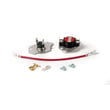
- Dryer thermal cut-off fuse kit 279816 (safety cut-off components)
- Dryer high-limit thermostat WP3977767 (limits heater temperature)
- Dryer operating thermostat WP3387134 (regulates normal cycling temperature)
Why it matters
The thermal fuse is a one-time safety device. Replacing it without fixing the airflow restriction or overheating cause often leads to another blown fuse and continued drying problems.
Last updated: February 2026
How do I tell what model my Kenmore dryer is?
Your Kenmore dryer’s model number is printed on the model and serial number label; on model 11064742400, it’s located at the top inside the dryer door well. Write down the full model number and serial number so you can match the correct parts and specifications.
Where to look on Kenmore model 11064742400
Check these spots in order:
- Top inside the dryer door well (most common for this model)
- Inside the door opening around the frame
- On the back panel (some dryers use a rear label)
- Near the lint screen housing (varies by design)
For the exact label location and how it’s shown in the diagrams, use the 11064742400 owner's manual.
What the model number tells you (and why it matters)
Kenmore model numbers help us match the correct:
- Replacement parts (belt, heating element, door switch, timer)
- Wiring and component layout
- Cycle and temperature features
- Service procedures and troubleshooting steps
Even one missing digit can point to a different dryer design, which can lead to ordering the wrong part.
Quick checklist: what to record
Write these down exactly as shown on the label:
- Model number (example: 11064742400)
- Serial number
- Purchase date (helpful for service history)
Common examples of what you might see
| What you see on the label | What it means for parts lookup |
|---|---|
| 11064742400 | Exact match for this Kenmore dryer model page |
| 110.XXXXXXX | Same Kenmore prefix, but different full model; parts can differ |
| 796.XXXXXXX | Different Kenmore model family; parts often differ significantly |
If you’re already shopping for parts
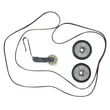
Once you confirm the model number, match symptoms to the right component. For example, a squealing drum or no tumble often points to the dryer drum belt 341241 or related drum support parts.
Last updated: February 2026
What is the average lifespan of 11064742400?
The average lifespan of the Kenmore 11064742400 dryer is about 10 to 13 years with normal household use. Regular vent cleaning and replacing common wear parts on time (belt, rollers, thermal fuse) helps this dryer reach the upper end of that range.
What affects lifespan most
- Airflow and venting: restricted venting overheats the heater and thermostats
- Load size: frequent overloading strains the motor, belt, and drum support
- Maintenance: lint buildup shortens the life of heating and safety components
- Usage frequency: multiple loads daily reduces service life faster
- Timely part replacement: worn drum support parts can cause secondary damage
Typical wear parts and what they do
| Part area | What you may notice | Common fix |
|---|---|---|
| Drum drive | Squealing, thumping, drum not turning | Replace belt/rollers/idler (often as a set) |
| Heating and safety | No heat, overheating, burning smell | Check heater circuit, thermostats, thermal cut-off |
| Airflow path | Long dry times, hot cabinet | Clean lint screen, lint chute, and venting |
For example, a broken belt stops the drum even though the motor may run; the correct replacement for this model is the dryer drum belt 341241.
Maintenance that extends life (do this routinely)
- Clean the lint screen after every load; replace it if damaged (see dryer lint screen W11778253)
- Inspect and clean the exhaust duct and outside hood regularly
- Keep loads balanced and avoid overfilling the drum
- If drying times increase, address airflow first before replacing heating parts
- Follow the care and troubleshooting steps in the 11064742400 owner's manual
Why it matters
Most “dryer is failing” symptoms are actually airflow or wear-part issues. Fixing those early prevents overheating and reduces stress on the motor, heating element, and thermostats, which are the expensive components.
Last updated: March 2026