Owner’s manual
 Error Codes


How big is the Samsung RF217ACBP?
The Samsung RF217ACBP is a 19.7 cu. ft. bottom-mount refrigerator, with about 13.3 cu. ft. of fresh food (refrigerator) capacity and 6.4 cu. ft. of freezer capacity. For the exact exterior dimensions and clearance needs, use the RF217ACBP owner's manual.
- Total capacity: 19.7 cu. ft.
- Refrigerator section: 13.3 cu. ft.
- Freezer section: 6.4 cu. ft.
- Capacity is the internal storage volume, not the outside size
- Shelves, bins, and the ice maker can reduce usable space
| Measurement type | What it tells you | Where to use it |
|---|---|---|
| Capacity (cu. ft.) | How much food it holds | Comparing models, storage planning |
| Exterior dimensions (in.) | How much space it takes | Fit in the kitchen opening |
| Clearance requirements | Space for doors and airflow | Installation and performance |
We recommend checking these items before ordering parts or moving the refrigerator:
- Measure the opening width, height, and depth (include trim)
- Confirm door swing space for the French doors
- Plan for rear and side clearance for ventilation
- Verify the path through doorways and hallways (including the freezer drawer)
Capacity tells you how much the RF217ACBP can store, but exterior dimensions and clearances determine whether it will install correctly and cool efficiently in your space.
Last updated: February 2026
How big is the Samsung RF217ACBP?
The Samsung RF217ACBP is a 33-inch wide bottom-mount refrigerator in the 20 cu. ft. class. Plan on 33 in wide, about 69 3/4 in tall to the top of the hinge, and about 32 7/16 in deep (depth varies depending on whether you include handles). For the full spec list and clearances, use the RF217ACBP owner's manual.
Use these key measurements when planning your cabinet opening and delivery path:
- Width: 33 in
- Height: 69 3/4 in (to top of hinge)
- Depth: 32 7/16 in (overall depth depends on handle configuration)
- Capacity class: 20 cu. ft.
| Measurement | What it helps you plan | Common mistake to avoid |
|---|---|---|
| Width (33 in) | Cabinet opening and side clearance | Measuring trim instead of the opening |
| Height (69 3/4 in) | Overhead cabinets and leveling range | Forgetting hinge clearance at the top |
| Depth (32 7/16 in) | Counter depth alignment and walkways | Not accounting for handles and door swing |
Accurate measuring prevents fit issues and door interference.
- Measure the opening width at the front and back
- Measure height to the lowest overhead cabinet or soffit
- Measure depth to the wall, then decide if you are counting handles
- Check door swing clearance near walls, islands, and adjacent cabinets
- Measure the delivery path (doorways, hallways, turns)
Correct dimensions and clearances help the refrigerator cool properly, reduce noise from restricted airflow, and prevent pinched water lines for the ice maker.
Last updated: February 2026
How does Samsung twin cooling work?
Samsung Twin Cooling (as used on many Samsung refrigerators) cools the fresh food and freezer sections separately, using independent airflow and electronic control to hold steadier temperatures and reduce odor transfer. For your Samsung RF217ACBP, confirm the exact feature set and operating details in the RF217ACBP owner's manual.
Twin Cooling is designed to keep each compartment closer to its target temperature and humidity by limiting shared air between sections.
- The refrigerator and freezer manage cooling demand independently
- Airflow is directed to the compartment that needs cooling (instead of overcooling both)
- Odors are less likely to migrate between freezer and fresh food
- Food in the refrigerator can stay fresher longer because humidity is better controlled
- Temperature recovery after door openings is typically faster and more even
If one section warms up while the other seems normal, the issue is often airflow, frost buildup, or a fan/sensor problem.
- Refrigerator warm but freezer cold
- Freezer warm but refrigerator cold
- Frost or ice buildup on the rear interior panel
- Fan noise, rattling, or no fan sound when the door switch is pressed
- Temperature swings after defrost cycles
| Component | What it affects | What you may notice if it fails |
|---|---|---|
| Evaporator cover and fan assembly | Air circulation across the evaporator | Warm temps, weak airflow, frost buildup |
| Temperature sensor | Temperature feedback to the control | Erratic temps, short cycling, error codes |
| Electronic control board | Coordinates fans, defrost, and cooling | Intermittent cooling, no defrost, odd behavior |
| Condenser fan | Heat removal at the back/bottom | Poor cooling in both sections |
If you suspect an airflow issue in the fresh food section, the refrigerator cover assembly da97-11823a is a common service part tied to the evaporator cover and fan area.
Separate cooling control helps prevent freezer air from drying out fresh food and helps keep freezer conditions stable. When airflow or sensing is off, you can get uneven temperatures that lead to spoiled food or recurring frost.
Last updated: February 2026
How to reset Samsung ice maker bottom freezer?
To reset the ice maker on your Samsung RF217ACBP bottom-mount refrigerator, press and hold the ice maker reset/test button for 3 seconds until you hear a chime or the ejector starts to move. Then give the unit time to refill and produce ice.
- Empty the ice bin so cubes cannot jam the ejector during the test.
- Confirm the ice maker is turned ON (if your model has an on/off switch).
- Press and hold the reset/test button for 3 seconds, then release.
- Watch for the ejector to rotate or listen for a chime.
- Check for new ice after 6 to 12 hours (full recovery can take up to 24 hours).
Use the RF217ACBP manual to confirm the exact reset button location for your ice maker version.
These checks isolate the most common causes on Samsung bottom-freezer models:
- Freezer temperature: set for 0°F to 5°F.
- Water supply: shutoff valve fully open; water line not kinked.
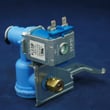
- If the ice maker cycles but does not fill with water, replace the refrigerator water inlet valve DA62-01477A.
- If the ice maker will not cycle at all after reset, replace the ice maker assembly such as refrigerator ice maker DA97-05037C.
| After you press reset | What it points to | What to do next |
|---|---|---|
| Ejector moves, no water fill | Water supply problem | Check valve, line, inlet valve |
| No movement, no sound | Ice maker not running | Check ice maker assembly, wiring |
| Small or hollow cubes | Low water flow | Check restrictions, inlet valve |
Resetting forces a test cycle, which quickly tells you whether the issue is the ice maker mechanism (cycling) or the water supply (filling). That helps you choose the right repair, faster.
For deeper troubleshooting, use why your Samsung fridge stopped making ice and how to fix it.
Last updated: February 2026
What are the 4 types of ice in Samsung fridge?
Samsung refrigerators that advertise “four types of ice” are specific newer models with advanced ice systems. Your Samsung RF217ACBP refrigerator does not have four ice options; it uses a standard freezer ice maker that produces one basic cube style. Confirm your exact ice maker features in the RF217ACBP owner's manual.
These options vary by model and dispenser design:
- Standard cubed ice
- Crushed ice (requires a door dispenser with a crusher)
- Nugget-style ice (often marketed as “Ice Bites” on some models)
- A larger cube or specialty cube option (varies by product line)
Most RF217ACBP configurations are designed for a single ice style from the freezer ice maker:
- No exterior dispenser means no crushed-ice function
- No “Cubed/Crushed” selector means one output type
- Ice is produced into the freezer bin from the ice maker module
| Feature | Fridges with 4 ice types | Samsung RF217ACBP |
|---|---|---|
| Door dispenser | Common | No |
| Crusher mechanism | Required for crushed | No |
| Multiple ice selections | Yes | No |
| Typical output | Multiple styles | One cube style |
If your RF217ACBP stops making ice, a common replacement is the refrigerator ice maker da59-00294b (ice maker module). Match by model and diagram before ordering.
Knowing whether your refrigerator has a dispenser, crusher, or specialty ice system prevents ordering the wrong parts and helps you troubleshoot correctly. For step-by-step checks (water supply, freezer temperature, and ice maker operation), use why your Samsung fridge stopped making ice and how to fix it.
Last updated: February 2026
What is the common problem with Samsung fridges?
On Samsung refrigerators like model RF217ACBP, the most common problems we see are ice maker failures, warm temperatures from airflow issues, and water leaks caused by drain clogs or water-supply faults. These symptoms often trace back to the evaporator area, fan operation, or the water inlet system.
- Ice maker problems: no ice, small cubes, jammed cubes, or ice buildup in the ice room.
- Cooling complaints: fresh food section too warm, freezer temperature swings, or heavy frost.
- Water leaks/puddles: water under crisper drawers or on the floor near the front.
- Noisy operation: buzzing, grinding, or a fan hitting ice.
- Door sealing issues: moisture, frost, or longer run times.
- Confirm settings: refrigerator near 37°F and freezer near 0°F.
- Make sure vents are not blocked by food packages.
- Check door closure: gaskets should seal all the way around.
- If you have an ice maker, verify the household water supply valve is fully open.
- Look for signs of a drain restriction (ice sheet in freezer bottom, water pooling in fridge).
| Symptom | Common area involved | Example part to inspect/replace |
|---|---|---|
| No ice or slow ice | Water supply to ice maker | Refrigerator water inlet valve DA62-01477A |
| Frost, warm temps, fan noise | Evaporator cover and fan area | Refrigerator cover assembly da97-11823a |
| Water pooling/leaks | Defrost drain path | Refrigerator drain cap da97-04049d |
Ice buildup, drain clogs, and airflow restrictions can make the compressor run longer, raise food temperatures, and create repeat leaks. Catching the root cause early helps prevent secondary damage to shelves, liners, and electronics.
For RF217ACBP disassembly guidance, temperature setting details, and component locations, use the RF217ACBP manual. For ice maker troubleshooting steps that match common Samsung symptoms, use why your Samsung fridge stopped making ice and how to fix it.
Last updated: February 2026
Why is my Samsung fridge leaking from the bottom?
A bottom leak on a Samsung RF217ACBP refrigerator is usually caused by a clogged defrost drain that overflows into the fresh food section and runs down to the floor, or by water supply components (ice maker or valve) seeping and pooling underneath. Use the RF217ACBP owner's manual to locate access panels and drain points.
- Defrost drain clogged or frozen: Water from defrost cannot reach the drain pan, so it spills inside.
- Drain tube or cap blocked: Sludge or ice blocks the drain outlet.
- Water inlet valve leaking: Slow seep at the valve or fittings can drip to the bottom.
- Ice maker fill line leaking or misaligned: Water can run down the back wall and collect underneath.
- Door gasket not sealing: Excess moisture creates heavy condensation that can mimic a “leak.”
| Where you see water | Most likely source | What to do next |
|---|---|---|
| Inside fridge, under crisper drawers | Defrost drain clog/freeze | Clear drain channel and flush with warm water |
| Under freezer drawer or on freezer floor | Frozen drain or ice buildup | Defrost, then clear drain path |
| On floor under back of unit | Water line, valve, or drain pan | Inspect fittings and valve for drips |
| Only after using ice maker | Ice maker fill leak | Check fill tube alignment and cracks |
- Unplug the refrigerator.
- Remove items and check for ice or water at the bottom of the fresh food compartment.
- Melt visible ice in the drain trough with warm water (not boiling).
- Flush the drain with warm water until it flows freely to the drain pan.
- If the outlet is restricted, replace the drain cap/tube style part used on this model, such as the refrigerator drain cap da97-04049d.
A recurring bottom leak can lead to ice buildup around the evaporator area, poor cooling, odors, and water damage on flooring. Fixing the drain or a small valve seep early prevents bigger cooling and ice maker problems.
Last updated: February 2026