Installation guide
 Owner’s manual


What code is 016?
On a KitchenAid KUDI01ILWH6 dishwasher, “016” is not a standard dishwasher error code; it is commonly used as a telephone area code (for example, Southern Gauteng in South Africa). For dishwasher troubleshooting, we use the model’s diagnostic indicators and error-code charts in the owner's manual.
Dishwasher error codes are usually shown as flashing patterns, a sequence on the display (if equipped), or a diagnostic indicator, not as a geographic code list.
- Note exactly where “016” appears (control panel display, sticker, paperwork, or a phone number)
- Cancel the cycle and restart a normal wash to see if the code returns
- Check whether any lights are flashing in a repeating pattern
- Confirm the door is fully closed and latched
- Confirm the water supply is turned on
- Check the home breaker or fuse if the dishwasher seems dead
The installation guide’s “If dishwasher does not operate” section points to a few basics that often fix the problem without parts.
| What we check | What it can cause | What to do |
|---|---|---|
| Breaker/fuse | No power | Reset breaker, replace fuse if needed |
| Door latch | Won’t start | Close firmly until it latches |
| Cycle selection | Appears unresponsive | Re-select cycle and press Start |
| Water supply | Won’t fill | Open shutoff valve fully |
Treating “016” as a dishwasher fault can send you down the wrong path. Using the KUDI01ILWH6 troubleshooting steps helps you focus on real causes like power, door latch, filling, draining, or heating.
Last updated: February 2026
What's the average lifespan of a KitchenAid dishwasher?
Most KitchenAid dishwashers, including the KitchenAid KUDI01ILWH6, typically last 10 to 12 years with normal household use. Consistent cleaning, correct loading, and addressing leaks or draining problems quickly are the biggest factors that keep the wash system, heater, and racks lasting longer (see the KUDI01ILWH6 owner's manual).
A dishwasher’s service life depends more on conditions than brand name alone.
- Water quality: hard water speeds up mineral buildup on the heater and in the wash system
- Usage: multiple heavy loads daily shortens life compared to 3 to 5 loads per week
- Maintenance: cleaning filters, spray arms, and door seals prevents strain on the motor and pump
- Installation: poor leveling or drain routing can cause chronic draining and leak issues
- Detergent habits: too much detergent can cause excess suds and poor rinsing
These steps help prevent the most common end-of-life failures (leaks, poor cleaning, no heat, and drain problems).
- Wipe the door seal and inner lip weekly to prevent seepage and odor
- Check the spray arm holes for debris and clear clogs
- Run hot water at the sink before starting a cycle for better wash temperature
- Use a dishwasher cleaner monthly to reduce grease and mineral buildup
- Inspect the drain path and air gap (if used) when you notice slow draining
| Component | Typical outcome over time | What you’ll notice |
|---|---|---|
| Dishracks and wheels | Coating wear, rust spots, rollers binding | Rack won’t roll smoothly, rust marks |
| Heater and thermostat | Heat output drops, temp sensing issues | Poor drying, cool water, long cycles |
| Pump and motor | Bearing wear, reduced circulation | Loud grinding, weak cleaning |
| Door seals and hoses | Hardening, cracking, leaks | Water under unit, damp toe-kick |
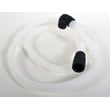
If you’re seeing leaks or chronic draining issues, the drain hose and door sealing surfaces are good first checks; the dishwasher drain hose 8269144A is a common replacement part for this model.
A KitchenAid dishwasher that is cleaned and kept leak-free usually reaches its full service life because the circulation pump, heating system, and racks are not forced to work harder than necessary. The manual’s care and troubleshooting guidance also helps you catch problems early, before they damage the motor or controls.
Last updated: February 2026
What is the most common problem with KitchenAid dishwashers?
The most common issue we see with KitchenAid dishwashers, including model KUDI01ILWH6, is poor cleaning performance (dishes come out with food soil or film). In most cases, the cause is restricted water flow or weak spray action from buildup, loading issues, or a wash system part that is not working correctly; check the KUDI01ILWH6 owner's manual for model-specific care and troubleshooting steps.
- Confirm the water supply valve under the sink is fully open.
- Use fresh detergent and fill the dispenser correctly; a stuck dispenser can prevent proper washing.
- Load so items are stable and not blocking spray paths; crowded racks reduce wash coverage.
- Clean the filter area and remove debris from the sump (glass, labels, seeds).
- Inspect the spray arm holes for clogs; clear mineral buildup with warm water and a soft brush.
- Run hot water at the sink for 30 to 60 seconds before starting to improve wash temperature.
If the quick checks do not help, these parts are frequent contributors to weak wash action or poor detergent release:
| Symptom | Most likely area | Example part for this model |
|---|---|---|
| Weak spray, gritty residue | Circulation system | Motor WPW10757217 |
| Detergent not dispensing well | Dispenser | Dishwasher dispenser WP8558129 |
| Poor drying and greasy film | Heating circuit | Heater element WPW10082892 |
| Low fill or slow fill | Water supply into tub | Dishwasher water inlet valve WP8531669 |
Poor cleaning is usually a “wash coverage” problem: the dishwasher needs the right water level, strong circulation, correct temperature, and unobstructed spray. When any one of those is off, you can get stuck-on soil, cloudy glassware, and detergent residue.
If you are seeing flashing lights or a cycle that stops mid-wash, use our KitchenAid he dishwasher error codes guide to match the symptom to the most likely failure area.
Last updated: February 2026
Can I replace dishwasher parts myself?
Yes, for the KitchenAid KUDI01ILWH6 dishwasher, we can replace many common parts ourselves if the repair is mechanical and easy to access (racks, wheels, hoses, some seals). For electrical or leak-prone repairs, we still DIY safely by shutting off power and water first and following the owner's manual.
These repairs are typically straightforward with basic hand tools and careful reassembly:
- Replace a worn rack wheel such as the dishwasher dishrack wheel WP8268743
- Swap a damaged rack such as the dishrack W10728159
- Replace a kinked or leaking drain line such as the dishwasher drain hose 8269144A
- Replace a leaking fill valve such as the dishwasher water inlet valve WP8531669
- Replace a leaking door seal such as the seal W10864081
Some jobs involve wiring, heating, or higher leak risk. If you do these yourself, follow the safety steps in the installation guide and take photos of wire and hose routing before disassembly.
- Heating and drying components (risk of shock and leaks)
- Pump and motor work (more disassembly, more seals)
- Door balance and hinge work (spring tension)
- Turn off power at the breaker (or unplug if accessible)
- Shut off the dishwasher water supply valve
- Protect the floor with towels and use a shallow pan for water
- Confirm the door is fully closed and latched before testing
- Run the shortest cycle and check for leaks during the first few minutes
| Symptom | Likely area | Example part on this model |
|---|---|---|
| Not draining | Drain path and hose | Dishwasher drain hose 8269144A |
| Not filling | Fill valve or supply | Dishwasher water inlet valve WP8531669 |
| Poor drying | Heater circuit | Heater element WPW10082892 |
| Leaks at door | Door seal | Seal W10864081 |
DIY repairs can restore cleaning and draining performance quickly, but dishwashers combine water and electricity. Following the documented install and operation checks reduces the chance of leaks, nuisance no-start issues, and repeat failures.
Last updated: February 2026
What are the commonly replaced parts in a dishwasher?
In a KitchenAid dishwasher like model KUDI01ILWH6, the most commonly replaced parts are the ones that control water flow, heating, draining, and sealing. When you see leaks, poor cleaning, no-heat drying, or draining problems, these parts are the first places we check; see the owner's manual for model-specific operation details.
- Spray arm: poor cleaning, weak spray, debris in jets (example: dishwasher spray arm WPW10320510)
- Door seals and gaskets: water leaking at the door (examples: seal W10864081, dishwasher vent gasket WP8269259)
- Heating system: wet dishes, cool water, long cycles (examples: heater element WPW10082892, dishwasher thermostat WP661566)
- Water fill parts: not filling, slow fill, no wash action (example: dishwasher water inlet valve WP8531669)
- Drain path parts: standing water, slow drain, sink backup (example: dishwasher drain hose 8269144A)
- Racks and rollers: rack won’t roll, rusted rack, broken wheels (examples: dishrack W10728159, dishwasher dishrack wheel WP8268743)
- Dispenser: detergent door not opening, poor wash results (example: dishwasher dispenser WP8558129)
| Symptom | Most likely parts to check first | What to do first |
|---|---|---|
| Not cleaning well | Spray arm, circulation pump, filters/strainers | Clear spray arm jets; remove debris from strainers |
| Not drying | Heater element, thermostat, vent system | Confirm heated dry option; check for steam at vent |
| Not draining | Drain hose, pump/motor, clogs | Check hose routing and clogs before replacing parts |
| Leaking | Door seal, vent gasket, inlet valve | Look for drip location (door edge vs. under unit) |
- Food soil and labels can clog spray jets and strainers
- Mineral buildup restricts valves, hoses, and heating surfaces
- Normal wear hardens seals and gaskets over time
- Heavy rack loads stress wheels and rack coatings
Replacing the right part early prevents repeat problems like poor wash performance, odors from standing water, and cabinet or floor damage from leaks. It also helps your KUDI01ILWH6 run quieter and more efficiently.
Last updated: February 2026