Installation guide
 Owner’s manual


How many cubic feet is a Kenmore Model 11028002010 washer?
Kenmore washer model 11028002010 is a top-load washer; washers in this Kenmore 110 series typically run about 3.2 to 3.5 cu. ft. capacity. For the exact rated capacity for your specific unit, we recommend confirming it in the 11028002010 owner's manual.
How to confirm the exact capacity
Capacity is usually listed in the specifications section of the manual, and sometimes on the model and serial tag.
- Check the specifications or features pages in the 11028002010 owner's manual
- Look for a model and serial label (commonly under the lid or along the lid opening)
- If you are comparing to a replacement washer, compare basket size and cycle options (HE, deep fill, bulky)
- Use the model number 11028002010 when searching parts and documentation to avoid mix-ups
Typical capacity range (what to expect)
Here is a practical way to interpret capacity when you are choosing load sizes and detergent amounts.
| Capacity (cu. ft.) | Typical load size | Common use case |
|---|---|---|
| 3.0 to 3.5 | Medium to large | Everyday mixed loads |
| 3.6 to 4.0+ | Large to extra-large | Bulky items, larger households |
Why it matters
Knowing the cubic feet helps us match the right wash habits to the tub size; overloading can cause out-of-balance spinning, extra wear on the suspension, and poor cleaning. It also helps when selecting compatible parts and accessories for Kenmore top-load washers.
Last updated: February 2026
How to hard reset kenmore washer?
To hard reset your Kenmore washer model 11028002010, we recommend a simple power reset first: unplug the washer (or switch off the breaker) for 1 minute, then restore power and try a normal cycle. This clears many control glitches without disassembly.
Quick hard reset steps (most common)
- Press Power/Cancel to stop the cycle.
- Unplug the washer (or turn the breaker OFF).
- Wait 60 seconds.
- Plug back in (or turn breaker ON).
- Open and close the lid once, then start a Rinse/Spin or Normal cycle.
If the washer still acts up: check the basics that mimic “needs a reset”
A washer that will not start, will not drain, or seems stuck can look like a control problem when it is actually an installation, drain, or lid-lock issue.
- Confirm the washer is plugged into a grounded 3-prong outlet (no extension cord).
- Make sure the washer is level; leveling reduces vibration and cycle interruptions.
- Verify the drain hose is installed correctly and secured; a poor drain setup can cause stopping or draining problems.
- Check that the lid closes fully and the lock engages.
For model-specific setup and safety details, follow the 11028002010 installation guide.
Common parts involved when “resetting” does not fix it
If the washer powers on but will not run, will not lock, or will not drain, these parts are frequent causes:
| Symptom | What to check first | Related part for 11028002010 |
|---|---|---|
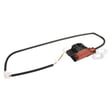
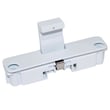
| Won’t start or stops mid-cycle | Lid not locking | Washer lid lock assembly W10404050 |
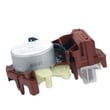
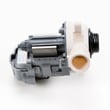
| Won’t drain or drains slowly | Pump jammed or failed | Washer drain pump assembly WPW10276397 |
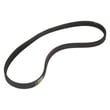
| Agitates/spins poorly | Belt slipping or worn | Washer drive belt WPW10006384 |
Why it matters
A true “hard reset” only clears the control’s temporary state. If the washer is unlevel, the drain hose is misrouted, or the lid lock is failing, the same problem returns immediately, even after power is restored.
Last updated: February 2026
How to identify a Kenmore washer model?
Your Kenmore washer model number is the ID we use to match the correct parts and documentation for your exact washer. For Kenmore model 11028002010, you’ll typically find the model/serial tag under the lid, around the lid opening, or on the back of the cabinet; then match it to the format shown in the 11028002010 owner's manual.
Where to look on Kenmore washers
Check these common locations first:
- Top-load washers: under the lid, along the rim of the opening
- Front-load washers: inside the door opening, around the door frame
- All styles: on the rear panel near the power cord entry
- Sometimes: behind the control panel area (varies by design)
- If the tag is worn: use a flashlight and look for faint stamped characters
What the model number looks like (and why it matters)
Kenmore washer model numbers often start with 110 and are usually 10 to 12 characters long (numbers only for many 110-series models). Using the full model number helps us avoid mismatches when ordering parts like a lid lock, drain pump, or drive belt.
Quick ID checklist
| What you see on the tag | What to do |
|---|---|
| Model number + serial number | Write both down; serial helps with production variations |
| Starts with 110 | Treat it as a Kenmore 110-series washer model |
| Missing characters | Compare carefully to the format in the manual and re-check the tag location |
Tips to avoid ordering the wrong part
- Copy the model number exactly, including any leading zeros
- Don’t use a partial number from the control panel or cycle chart
- If you’re replacing a common failure item, match by model first, then part
- For drive issues, confirm the correct belt and pulley for your model
- Keep the model number handy when checking troubleshooting steps
Why it matters
Kenmore washers can look similar across multiple series, but internal components (like the drive system, lid lock, and water inlet valve) can differ by model. Using 11028002010 ensures the parts list and installation requirements match your washer.
Last updated: February 2026
How to unclog drain hose on Kenmore washer?
To unclog the drain hose on your Kenmore washer model 11028002010, we unplug the washer, remove standing water, then clear the blockage from the drain hose and the drain pump inlet. Most clogs are lint, coins, or small items caught at hose bends or the pump.
Safety and quick prep
- Unplug the washer.
- Turn off both water faucets.
- Put towels and a shallow pan under the hose connection.
- Have a bucket ready for sudden water release.
- If the tub is full, bail water out or use a wet/dry shop vacuum.
Steps to clear the drain hose (and prevent repeat clogs)
- Check the household drain first: Make sure the standpipe or laundry tub is not backing up.
- Inspect the external hose: Look for kinks, crushed spots, or a tight bend behind the washer.
- Confirm correct standpipe placement: Keep about 4.5 in. (113 mm) of hose inside the standpipe; do not force extra hose down the pipe, and use the hose form. See the 11028002010 installation guide.
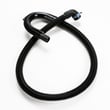
- Remove and flush the hose: Release the clamp at the washer’s drain port, pull the hose off, then flush with hot water; push debris out with a flexible brush or small drain snake.
- Check the pump inlet: With the hose off, feel for obstructions where the hose feeds the pump; remove debris and reattach the hose securely.
If it still will not drain
| Symptom | Most likely cause | Next step |
|---|---|---|
| Slow drain | Partial clog in hose or standpipe | Re-flush hose; clear household drain |
| No drain, pump hums | Debris in pump or failing pump | Inspect inlet; replace pump if needed |
| Intermittent drain | Kinked hose or loose clamp | Re-route hose; secure clamp |
If the hose is clear and draining is still poor, the pump is the next common fix on this model; use the washer drain pump assembly WPW10276397.
Why it matters
A restricted drain path prevents proper draining before spin, leaves dirty water in the tub, and makes the drain pump work harder.
Last updated: February 2026
What is the average lifespan of a Kenmore washer?
A Kenmore washer typically lasts 10 to 15 years with normal household use. For Kenmore model 11028002010, correct installation, keeping the washer level, and avoiding chronic overloading are the biggest factors that help it reach the high end of that range; see the 11028002010 owner's manual for model-specific care guidance.
Typical lifespan and what affects it
Most washers land in the same general window, but these factors move the needle the most:
- Load size and balance: frequent overloading or consistently unbalanced loads shorten suspension and drive life.
- Installation and leveling: an out-of-level washer vibrates more and wears parts faster.
- Water quality and inlet screens: sediment can restrict fill and stress the inlet valve.
- Drain performance: slow draining makes cycles run longer and can overwork the pump.
- Routine cleaning: keeping the tub and hoses clean reduces odor, residue, and strain.
Common wear items as a washer ages
These are some of the parts we most often see involved in “older washer” symptoms (noise, no spin, no drain):
| Symptom | Common cause | Example part for this model |
|---|---|---|
| Won’t spin or weak agitation | Worn/slipping belt or drive components | Washer drive belt WPW10006384 |
| Won’t drain or leaves water in tub | Drain pump issue or blockage | Washer drain pump assembly WPW10276397 |
| Lid won’t lock, won’t start/spin | Lid lock failure | Washer lid lock assembly W10404050 |
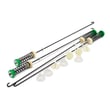
| Excessive vibration or banging | Suspension wear or leveling issue | Suspension (inspect rods and leveling) |
How to help your washer reach 15 years
Use these practical habits to reduce stress on the motor, gear case, and suspension:
- Keep loads evenly distributed; mix large and small items.
- Avoid washing heavy, water-logged items alone (rebalance if it starts banging).
- Verify the washer is level on a solid floor; recheck after moving it.
- Clean inlet hose screens periodically and replace kinked hoses.
- If draining slows, check for clogs before the pump runs hot or noisy.
Why it matters
A washer that is installed correctly and kept level runs with less vibration, which reduces wear on the drive system, tub support, and lid lock. That directly impacts how long your Kenmore 11028002010 can run reliably.
Last updated: February 2026