Installation guide
 Owner’s manual
 Error Codes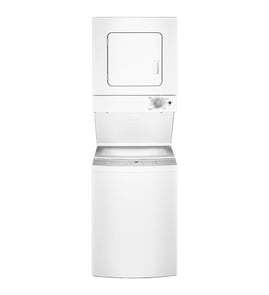


What is the life expectancy of a Kenmore washer and dryer?
For a Kenmore stacked laundry center like model 41797912702, we typically see 10 to 13 years of service life for the washer and dryer with normal household use, proper venting, and routine maintenance. Consistent care (especially lint and airflow maintenance) is what most often separates a 10-year unit from a 13-year unit.
Typical lifespan ranges (what to expect)
| Appliance section | Typical life expectancy | What shortens it fastest |
|---|---|---|
| Washer (top section of the laundry center) | 10 to 13 years | Overloading, chronic out-of-balance loads, worn drive components |
| Dryer (upper dryer section) | 10 to 13 years | Restricted venting, overheating, running without a lint screen |
Maintenance that most improves lifespan
We recommend following the care schedule in the 41797912702 owner's manual and focusing on these high-impact items:
- Clean the lint screen before every load; wash it occasionally to remove waxy buildup from fabric softener sheets.
- Keep the exhaust duct and outside hood clear; restricted airflow causes longer dry times and overheating.
- Have the dryer cabinet interior and exhaust duct cleaned about every 18 months (or sooner with heavy use).
- Do not overload either the washer or dryer; overloading accelerates wear on bearings, belts, and motor components.
- Turn off water faucets when laundry is done to reduce constant hose pressure.
Signs your laundry center is nearing end-of-life
These symptoms usually mean a repair is coming soon, even if the unit still runs:
- Dryer takes multiple cycles to dry (after venting is confirmed clear)
- New squealing, scraping, or rumbling during dryer tumble (often drum support wear)
- Washer struggles to spin, slips, or leaves clothes wetter than normal
- Frequent shutdowns or overheating smells from the dryer
Why it matters
A laundry center is a tight, stacked design; heat and vibration affect multiple systems at once. Good airflow and avoiding overload reduce stress on the dryer’s safety thermostats and the washer’s drive system, helping the entire 41797912702 platform last longer.
Last updated: February 2026
How to reset Kenmore 41797912702 washer?
To reset the washer on your Kenmore 41797912702 stacked laundry center, we recommend doing a simple power reset: turn the washer off, unplug it for about 1 minute, then restore power and restart a cycle. This clears many control and motor-protector interruptions.
Quick reset steps (power reset)
- Push in the cycle selector knob to stop the washer.
- Unplug the power cord (or switch the breaker off).
- Wait 1 minute.
- Plug the washer back in (or turn the breaker on).
- Close the lid fully.
- Turn the cycle selector knob clockwise to a new setting and pull the knob out to start.
If the washer stopped because the motor overheated
This model uses an electrical overload protector. If the motor overheats, it can stop and then restart automatically after a cool-down period of up to 30 minutes (as long as it was not manually turned off).
- Leave the washer powered on and closed so it can complete the cool-down.
- Reduce load size; overloading can contribute to overheating.
- Redistribute the load if it is out of balance.
- After cool-down, restart using the cycle selector knob.
Lid lock timing (common “won’t spin” confusion)
During spin, the lid locks and can stay locked for about 2 to 3 minutes after the tub stops.
| What you see | What it means | What to do |
|---|---|---|
| Lid won’t open right after spin | Normal lid lock delay | Wait 2 to 3 minutes; do not force it |
| Washer won’t spin | Lid not fully closed or lock issue | Close lid firmly; restart cycle |
| Washer stops mid-cycle | Possible overload or imbalance | Reduce and rebalance the load |
Why it matters
A proper reset helps you recover from a paused cycle, a brief power interruption, or an overload-protector shutdown without replacing parts. For operating details specific to your controls and cycle selector knob, follow the 41797912702 owner’s manual.
Last updated: February 2026
Who makes Kenmore 41797912702?
Kenmore is a brand name sold by Sears; the Kenmore 41797912702 stacked laundry center was manufactured for Kenmore by a third-party appliance maker (Kenmore does not operate its own factories). For model-specific identification details, we recommend checking the manufacturer information shown on the unit’s data plate and in the 41797912702 owner’s manual.
How to identify the actual manufacturer for your unit
Use these quick checks on your Kenmore 41797912702:
- Look for the model and serial tag (often inside the washer lid area or on the dryer door opening).
- Note any additional numbers beyond 41797912702 (prefixes, suffixes, or a separate manufacturer model).
- Check the wiring diagram or tech sheet location listed in the manual.
- Compare the control panel layout and cycle names to the manual illustrations.
- Use the parts list diagrams to confirm component style (motor, belt drive, timer layout).
Where to look (common locations)
| What you need | Where it’s usually found on a stacked laundry center |
|---|---|
| Model/serial tag | Washer opening, under lid, or on cabinet frame |
| Dryer data label | Dryer door opening or inside front panel area |
| Wiring diagram/tech sheet | Inside console, behind access panel, or taped to cabinet |
Why it matters
Knowing the actual manufacturer helps you match the correct replacement parts and troubleshooting steps for your exact build. It also helps when diagnosing common issues like no-heat, no-start, or spin problems because component designs can vary by manufacturer even within the Kenmore brand.
Helpful troubleshooting resource
If you are trying to identify the maker because you are seeing a fault on the washer display, use our Kenmore 417 laundry center -washer error codes reference to match the code to the right checks.
Last updated: February 2026
What is the downside to a stackable washer and dryer?
The main downside of a stackable setup like the Kenmore 41797912702 stacked laundry center is convenience: service access is tighter, vibration can feel more noticeable in a tall unit, and controls can be harder to reach. Capacity can also be smaller than full-size side-by-side pairs; check the 41797912702 owner's manual for your exact features.
Common downsides (what customers notice most)
- Harder to service: many repairs require removing panels in a tight space; some jobs may require partial unstacking.
- More vibration transfer: if the washer is out of level, the stacked frame can amplify shaking and noise.
- Control access: dryer controls sit higher; shorter users may find them less comfortable to reach.
- Less “top space”: you typically cannot use the top as a stable folding surface.
- Vent and clearance sensitivity: airflow and vent routing matter more in compact installs.
What to check before you buy or install
Use these quick checks to avoid the most common frustrations:
- Confirm you have enough vertical clearance to open the dryer door fully.
- Level the unit front-to-back and side-to-side; recheck after the first few loads.
- Keep the dryer area clear of items that can block airflow; follow the safety and setup guidance in the installation guide.
- Plan for service access (rear and sides) so a technician can reach the motor, belt, and thermostats.
Stackable vs side-by-side: quick comparison
| Feature | Stackable laundry center | Side-by-side pair |
|---|---|---|
| Floor space | Smaller footprint | Larger footprint |
| Service access | Tighter, more time to open up | Easier access |
| Vibration feel | Can be more noticeable if unlevel | Often less noticeable |
| Ergonomics | Dryer controls higher | Controls at typical height |
Why it matters
Most “downsides” come from installation realities, not the Kenmore design itself. A properly leveled unit with good venting and clearance runs smoother, dries better, and is easier to maintain over time.
Last updated: February 2026