Installation guide
 Owner’s manual


How do I fix error code f3 e3 on Whirlpool dryer?
On the Whirlpool WGD5320SQ0 dryer, start by clearing the code with a simple power reset, then run a Timed Dry cycle to see if it returns. If it comes back, treat it as a control sensing fault and focus on airflow and overheating conditions first; those are the most common triggers.
Step 1: Clear the code (safe reset)
- Turn off the dryer’s circuit breaker(s) for 1 minute.
- Turn the breaker(s) back on.
- Start a Timed Dry cycle.
- Watch operation for about 1 minute.
- If the code returns, stop the cycle and move to airflow checks.
Step 2: Fix airflow and venting (most common root cause)
Poor venting makes a gas dryer run hot and can cause sensor-related faults.
- Clean the lint screen completely.
- Confirm strong airflow at the outside vent hood.
- Check the vent for crushing, kinks, or long runs.
- Use 4-inch heavy metal venting (avoid plastic or foil).
- Remove lint buildup from the exhaust duct; the maintenance guidance in the WGD5320SQ0 owner’s manual recommends periodic lint removal from inside the exhaust vent.
Step 3: Check temperature control parts if airflow is good
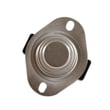
If venting is clear and the code persists, check the temperature control circuit (wiring connections and thermostat operation). A common service part in this circuit is the dryer operating thermostat WP3387134.
| What you observe | What it usually points to | What to do next |
|---|---|---|
| Code returns quickly after reset | Overheating or unstable temperature control | Verify venting, then check thermostat circuit |
| Long dry times plus hot cabinet | Restricted exhaust | Correct venting and clean lint path |
| Heat seems to cycle oddly | Thermostat or wiring issue | Inspect connections; replace failed thermostat |
Why it matters
Correct airflow keeps temperatures stable, improves dry times, and prevents repeat shutdowns. On gas dryers like the WGD5320SQ0, venting problems are the first thing we correct before replacing parts.
Last updated: February 2026
How do I know if my whirlpool dryer thermal fuse is blown?
On your Whirlpool WGD5320SQ0 gas dryer, a blown thermal fuse commonly shows up as a dryer that will not start or runs with no heat. The sure way to confirm is a continuity test with a multimeter; a good fuse reads closed (near 0 ohms), and a blown fuse reads open.
Quick symptoms to look for
- Dryer will not run even with the door closed and a cycle selected
- Drum tumbles but there is no heat (some heat problems can also be gas supply related)
- Dryer stops mid-cycle and will not restart until it cools
- You recently had poor airflow (long dry times, very hot cabinet, lots of lint)
How we test the thermal fuse (basic continuity check)
- Unplug the dryer or disconnect power (and shut off the gas supply valve before servicing).
- Access the fuse location shown in the WGD5320SQ0 owner's manual.
- Remove at least one wire from the fuse terminal.
- Set a multimeter to continuity or ohms.
- Test across the fuse terminals.
| Meter result | What it means | What to do next |
|---|---|---|
| Beep or ~0 ohms | Fuse is good | Keep troubleshooting (timer, door switch, start switch, motor, gas heat circuit) |
| No beep or OL/infinite | Fuse is blown | Replace the thermal cut-off/fuse kit and correct the airflow problem |
Why thermal fuses blow (and how to prevent a repeat)
A thermal fuse is a one-time safety device; it opens when the dryer overheats. Overheating is usually caused by restricted venting.
- Clean the lint screen every load
- Check that the vent is not crushed or kinked behind the dryer
- Use a 4-inch heavy metal vent and clamp-sealed joints (no screws into the duct)
- Make sure the dryer exhausts outdoors (not into a wall, ceiling, or concealed space)
- Remove lint buildup inside the exhaust vent periodically (the manual recommends about every 2 years, more often with heavy use)
Parts that are commonly replaced with an overheat event
For this model, the correct matched kit is typically the dryer thermal cut-off kit W11050897. If you also have no-heat symptoms after airflow is corrected, the dryer operating thermostat WP3387134 is another common check point.
Why it matters
Replacing the fuse without fixing vent restriction often leads to another overheat and another blown fuse. Good airflow protects the burner system, thermostat, and drum components, and it shortens dry times.
Last updated: February 2026
Is there a reset button on a Whirlpool dryer?
Whirlpool dryers such as model WGD5320SQ0 typically do not have a single physical reset button. The practical “reset” is a power reset (turning power off, then back on) and then restarting the cycle correctly; the exact control behavior is outlined in the WGD5320SQ0 owner’s manual.
How to reset a Whirlpool WGD5320SQ0 dryer
- Stop the cycle: open the door or turn the cycle control to Off.
- Remove power: unplug the dryer (or switch the breaker off). Wait about 5 minutes.
- Restore power: plug back in (or turn the breaker on).
- Restart correctly: close the door, select a cycle and temperature, then press START.
Quick checks that often solve “needs a reset” symptoms
- Make sure the door is fully closed and the door switch is engaging.
- Confirm a cycle is selected before pressing START.
- Check the home breaker or fuses; some dryers use two fuses/breakers.
- Clean the lint screen before every load (a blocked screen increases drying time and can contribute to overheating).
- For gas models, confirm the gas supply valve is open.
If the dryer still will not start or heat
Many “reset” complaints are actually a start or heat issue. Use this guide to narrow it down:
| Symptom | Most common cause | What to do next |
|---|---|---|
| Won’t start | Power, door not shut, START not pressed firmly | Verify power, door, cycle selection, then retry START |
| Runs but no heat | Wrong cycle (Air/No Heat), gas valve closed, blown fuse/breaker | Select a heated cycle; confirm gas valve; check breakers/fuses |
| Long dry times | Lint restriction or poor venting | Clean lint screen; inspect venting per the WGD5320SQ0 installation guide |
Why it matters
A proper reset clears a temporary control interruption (like a brief power issue), but airflow and venting problems can cause repeated overheating symptoms and poor drying. Following the venting requirements in the installation instructions helps prevent performance and safety problems.
Last updated: February 2026