Installation guide
 Owner’s manual
 Error Codes



What is Sabbath mode on a KitchenAid oven?
Sabbath mode on the KitchenAid KEBK101SSS04 keeps the oven running in a bake setting until you turn it off (or for a timed portion, if you set a timed Sabbath). While it’s active, tones are disabled and the display will not show messages or temperature changes.
What changes when Sabbath mode is on
In Sabbath mode, the oven is designed to minimize normal feedback and immediate responses.
- Only the number keys and START work
- No beeps or tones will sound
- The display will not show messages or temperature changes
- Heat source icons stay lit during Sabbath mode
- Opening or closing the door will not switch the oven light on or off
- Heating elements will not turn on or off immediately when the door is opened/closed
For the exact key sequence for your control panel, follow the steps in the KEBK101SSS04 owner’s manual.
What to expect after a power outage
If power fails while Sabbath mode is set, the oven will remain in Sabbath mode but it will stop actively cooking. The ON indicator will no longer be lit; use OFF to return to normal operation.
Quick comparison: normal bake vs. Sabbath mode
| Feature | Normal bake | Sabbath mode |
|---|---|---|
| Keypad response | Full keypad functions | Number keys + START only |
| Sounds/tones | On | Off |
| Display updates | Shows messages and temp changes | No messages or temp changes |
| Door/light behavior | Light and heat respond normally | Light does not toggle; heat changes are delayed |
Why it matters
Sabbath mode helps you keep a steady bake cycle without audible alerts or changing display information, which is useful when you need the oven to run with minimal interaction.
Last updated: January 2026
What is the error code F2E1 on a KitchenAid wall oven?
On the KitchenAid KEBK101SSS04 wall oven, error code F2E1 means a keypad button is stuck or a key has been pressed too long. Cleaning the control panel and resetting power often clears it; if it returns, the touchpad or control may need service.
What to do first (safe, quick checks)
- Turn the oven off at the breaker for 1 minute, then restore power.
- Wipe the control panel with a soft, slightly damp cloth; dry it fully.
- Press each key once to confirm none feel physically stuck.
- If the code appears during setup or after power-up, set the clock and retry a cooking mode.
- If the oven will not heat or shows an “F…E…” code during operation checks, follow the guidance in the installation guide.
Why this happens
F2E1 is typically triggered when the control senses a continuous key signal. Common causes include moisture/cleaner residue on the keypad, a stuck membrane switch, or a failing electronic control interface.
When to suspect a part problem
Use this checklist to decide whether you are dealing with a simple keypad issue or a component failure:
| Symptom | Most likely cause | Next step |
|---|---|---|
| Code clears after power reset and stays gone | Temporary keypad signal | Monitor for recurrence |
| Code returns immediately after reset | Stuck key or failed touchpad/control | Schedule service; avoid repeated resets |
| Code appears after cleaning | Moisture under keypad | Let panel dry completely; retry |
Why it matters
A stuck-key condition can prevent normal baking or broiling and can interrupt operation. Addressing it early helps avoid repeated shutdowns and reduces the chance of heat-cycle interruptions.
For model-specific operating steps and control-panel care, use the KEBK101SSS04 owner’s manual.
Last updated: January 2026
How do I find the model of my KitchenAid oven?
To find the model for your KitchenAid wall oven, look for the model and serial tag on the oven frame (most often visible when you open the door). For this parts page, the model number you are matching is KEBK101SSS04.
Where to look on a built-in wall oven
Check these common locations first:
- Open the oven door and inspect the frame around the opening (left or right side)
- Look along the bottom edge of the oven frame near the door hinge area
- Check the front lip of the oven cavity (around the gasket area)
- If you have a double oven, check the frame area for the upper oven door opening
- If the tag is hard to read, use a flashlight and take a close-up photo
For diagrams and model identification details, use the KEBK101SSS04 owner's manual.
What the model number helps us match
The model number is what we use to ensure parts and wiring match your exact KitchenAid configuration (controls, door latch style, heating circuit, and trim).
| What you have | What to record | Why it matters |
|---|---|---|
| Model tag | Model number (example: KEBK101SSS04) | Ensures correct part fit |
| Model tag | Serial number | Helps confirm production variation |
| Parts list | Part ID (example: WPW10131825) | Ensures you order the exact replacement |
If the tag is missing or unreadable
Use these practical options:
- Check your purchase paperwork or installation documents
- Look for a duplicate tag on the side trim area (sometimes visible with the door open)
- Compare your oven’s features to the control panel layout shown in the KEBK101SSS04 installation guide
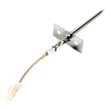
- If you are troubleshooting heating issues, confirm the model before ordering parts like the wall oven temperature sensor WPW10131825
Why it matters
KitchenAid built-in ovens can look similar across model families (KEBK101, KEBK171, KEBK206, KEBK276), but parts can differ by revision. Using the exact model number prevents wrong-part returns and speeds up repair.
Last updated: January 2026