Owner’s manual
 Error Codes



Why is my refrigerator not getting cold at the bottom?
If your Kenmore Elite bottom-mount refrigerator model 79579023313 is warm at the bottom, the most common causes are restricted airflow (blocked vents or overpacked shelves), frequent door openings, or the unit not having enough time to stabilize after installation. Start with airflow and temperature basics from the 79579023313 owner's manual.
Quick checks that fix most “warm bottom” complaints
- Give it time: after a new install or a long power outage, allow up to 24 hours for temperatures to stabilize.
- Unblock air vents: move food packages away from vents so cold air can circulate.
- Reduce door-open time: long or frequent openings let warm, humid air in and raise temps.
- Confirm room temperature: this model is designed to run in roughly 55°F to 110°F ambient conditions.
- Avoid loading hot food: large amounts of warm food can temporarily warm the compartment.
What to do next (step-by-step)
- Set the refrigerator control to your normal setting and wait 24 hours.
- Repack the refrigerator so air can move freely (leave space near vents and the back wall).
- Check that doors close fully and seals are making contact all the way around.
- If the bottom stays warm, listen for the evaporator fan; if airflow seems weak, inspect the rear freezer panel area for heavy frost.
Parts that can contribute when airflow is weak
If airflow is poor or temperatures swing, these parts are commonly involved on bottom-mount designs:
| Symptom you notice | What it often points to | Example part for this model |
|---|---|---|
| Little to no cold air movement | Evaporator fan issue | Refrigerator evaporator fan motor EAU65058315 |
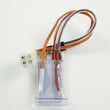
| Temps seem inaccurate or inconsistent | Sensor/thermistor issue | Refrigerator temperature sensor 6500JB2002X |
| Frost buildup, then warming | Defrost/airflow restriction (diagnosis needed) | Use the troubleshooting steps in the manual |
Why it matters
The bottom section depends on steady airflow and stable temperatures. When vents are blocked or warm air keeps entering, cold air cannot circulate properly, so the lower area warms first and food safety can be affected.
Last updated: January 2026
What does DH mean on Kenmore Elite refrigerator?
On Kenmore Elite model 79579023313, dH/DH indicates a defrost heating problem (the refrigerator is not sensing the expected temperature rise during defrost). This commonly points to a defrost heater circuit issue, a sensor problem, or a control issue; use the 79579023313 owner's manual diagnostics and troubleshooting sections to confirm the failure.
What to check first (safe, quick checks)
- Power reset: Unplug the refrigerator for 5 minutes, then restore power and watch for the code returning.
- Airflow basics: Make sure vents are not blocked by food packages in the refrigerator or freezer.
- Door sealing: Verify doors close fully and gaskets seal; warm air intrusion increases frost and defrost demand.
- Heavy frost clue: If the freezer back wall has heavy frost, the defrost system is the likely cause.
- Condenser area: Clean dust from the condenser area (unplug first) to reduce run time and icing.
Likely causes and what they mean
| What you observe | Most likely issue | What to do next |
|---|---|---|
| Heavy frost on freezer back panel, weak cooling | Defrost system not melting frost | Test defrost heater circuit and sensors; inspect wiring/connectors |
| Code appears after a power outage or move | Temporary control confusion or icing | Reset power, allow 24 hours to stabilize, then recheck |
| Intermittent dH with temperature swings | Sensor or control interpretation issue | Check sensor connections; consider testing the temperature sensor |
Parts that commonly relate to DH symptoms on this model
If testing points to a sensor or airflow issue, these model-matched parts are commonly involved:
- Refrigerator temperature sensor 6500JB2002X (reports temperature to the control)
- Refrigerator electronic control board EBR81182754 (manages defrost timing and monitoring)
- Refrigerator evaporator fan motor EAU65058315 (moves cold air; poor airflow can worsen icing)
Why it matters
A defrost heating fault lets frost build up on the evaporator, which restricts airflow and can cause warm temperatures, long run times, and poor ice production. Addressing the root cause restores normal cooling and prevents repeat icing.
Last updated: January 2026
What size is Kenmore refrigerator model 79579023313?
Kenmore Elite bottom-mount refrigerator model 79579023313 is part of the 795.7902*/795.7904* bottom-freezer family. For exact exterior dimensions (W x D x H) and total capacity for your unit, use the specifications section in the 79579023313 owner's manual.
What “size” can mean for this refrigerator
Customers usually need one or more of these measurements:
- Exterior dimensions (W x D x H) to fit a kitchen opening
- Door swing clearance so doors and drawers open fully
- Rear clearance for airflow and proper cooling
- Capacity (cu. ft.) for storage planning
- Water supply requirements if the ice maker is connected
Installation clearances and requirements we use for planning
The manual for this model family lists these installation planning minimums:
- Allow at least 33 3/4 inches in front of the refrigerator to open the doors
- Allow at least 2 inches between the back of the refrigerator and the wall
- Install where ambient temperature stays 55°F to 110°F
- Water pressure should be 20 to 120 psi (models without a water filter) or 40 to 120 psi (models with a water filter)
Quick reference table
| Measurement or requirement | Planning value | Where to verify |
|---|---|---|
| Front clearance for door opening | 33 3/4 in | 79579023313 owner's manual |
| Rear clearance to wall | 2 in | 79579023313 owner's manual |
| Water pressure for ice maker supply | 20 to 120 psi or 40 to 120 psi | 79579023313 owner's manual |
Why it matters
Correct clearances protect airflow across the condenser and evaporator system, help the doors seal properly, and prevent warm temperatures and higher energy use. Water pressure in range helps the ice maker fill reliably.
Last updated: January 2026
What are the common problems with Kenmore Elite refrigerators?
Common problems we see on the Kenmore Elite 79579023313 bottom-mount refrigerator include warm or no cooling, ice maker not producing ice, water dispensing or fill issues, and doors that do not close correctly. The troubleshooting steps and specs are outlined in the 79579023313 owner's manual.
Most common symptoms and likely causes
- Not cooling or both sections warm: controls set to OFF, Demo Mode enabled, or unit is in a defrost cycle; after installation or moving, cooling can take up to 24 hours.
- Refrigerator or freezer too warm: blocked air vents, frequent door openings, hot room conditions (above 110°F), or adding hot food.
- Ice maker not making ice: freezer not cold enough; the ice maker starts once it reaches 15°F or below and the switch is ON.
- Water not dispensing or slow fill: low water pressure (typical spec 40 to 120 psi) or a water valve issue.
- Doors pop open or will not close: bins or shelves out of position, food packages blocking the door, or the refrigerator not leveled.
Parts that commonly fix these issues
| Symptom | Part to check | What it does |
|---|---|---|
| No ice or small cubes | Lg refrigerator ice maker assembly model AEQ72909603 AEQ72909603 | Cycles and harvests ice when freezer temp is cold enough |
| No water to dispenser/ice maker | Lg refrigerator water inlet valve AJU73753101 | Opens to send water to the dispenser and ice maker |
| Warm temps, poor airflow, noise | Refrigerator evaporator fan motor EAU65058315 | Circulates cold air through the compartments |
| Erratic temps or intermittent cooling | Refrigerator electronic control board EBR81182754 | Manages cooling operation and defrost logic |
Quick checks before replacing parts
- Confirm temperature controls are ON and not set to OFF.
- Disable Demo Mode if enabled.
- Clear blocked air vents and avoid overpacking.
- Reduce long or frequent door openings.
- Level the refrigerator; fully seat drawers and bins.
Why it matters
Cooling and ice maker complaints often come from control settings, airflow, or door sealing issues. Checking those first restores normal temperatures faster and prevents unnecessary part replacement.
Last updated: January 2026