Installation guide
 Owner’s manual
 Error Codes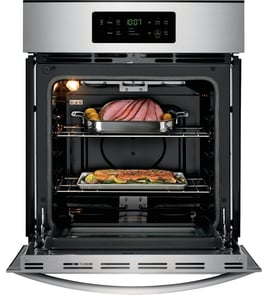


How to use KitchenAid superba convection oven?
To use convection on your KitchenAid built-in electric oven (model KEBC107KSS05), select a cooking mode, enter the temperature, then press START. The oven’s elements cycle on and off during cooking, and it can take time to reach a new set temperature; follow the steps in the KEBC107KSS05 owner's manual.
Quick start: convection baking basics
- Position racks before turning the oven on.
- Select Convection Bake (or the convection cooking mode your control offers).
- Enter the desired temperature using the number pads.
- Press START.
- Avoid blocking airflow; do not cover racks fully with foil.
- For best results, use low-sided pans so air can circulate.
Temperature entry tips (what the keypad does)
On this KitchenAid-style electronic control, number pads can represent common temperatures. Press and hold the pad for at least 1 second.
| Number pad | Common set temperature |
|---|---|
| 1 | 170°F (77°C) |
| 7 | 350°F (177°C) |
| 9 | 400°F (204°C) |
| 0 | 450°F (232°C) |
Common convection results and what to adjust
| What you notice | What to do |
|---|---|
| Food browns too fast | Lower temp 15 to 25°F, or move rack down one position |
| Uneven browning | Use a low-sided pan, center the food, avoid foil blocking airflow |
| Longer than expected preheat or temp change | Allow up to 30 minutes for the oven to fully stabilize at the new temperature |
Why it matters
Convection uses a fan to move hot air, which improves browning and can cook more evenly. Airflow is the key, so rack position, pan choice, and avoiding foil on the rack make a bigger difference than in standard bake.
Last updated: February 2026
How do I reset my KitchenAid wall oven?
To reset your KitchenAid wall oven model KEBC107KSS05, we recommend doing a simple power reset: turn the oven off, cut power at the breaker for about 1 minute, then restore power. This clears many control glitches and returns the display to normal operation.
Quick reset options (most common)
- Power reset (best first step): switch the oven circuit breaker OFF for 60 seconds, then ON.
- Cancel/Off reset: press CANCEL/OFF (or the upper/lower oven Cancel/Off pad on double ovens) to stop a cooking function.
- Control Lock toggle: press and hold CONTROL LOCK for about 3 seconds to lock or unlock the keypad.
- Clear a stuck timer: press TIMER CANCEL to stop the timer and reminder tones.
What you should see after a reset
After power is restored, the control typically returns to an idle state (time of day or blank display). If you start a function but do not press START within a few seconds, the display can prompt you, and if left too long the control can return to inactive mode and cancel the programmed function.
If the display is blank, that can be normal
On this KitchenAid wall oven, the time of day can be removed from the display. To toggle it:
- Press and hold CLOCK SET/START for 5 seconds to remove or return the time of day.
| Symptom | What to do | Why it helps |
|---|---|---|
| Display frozen or acting odd | Breaker reset for 60 seconds | Reboots the electronic control |
| Oven will not respond to most keys | Hold CONTROL LOCK 3 seconds | Unlocks the control panel |
| Timer beeping will not stop | Press TIMER CANCEL | Cancels timer and reminder tones |
| Display looks “off” but oven has power | Hold CLOCK SET/START 5 seconds | Restores time-of-day display |
Why it matters
A reset is the fastest way to clear a temporary control-board glitch, cancel an unintended setting, or recover from a keypad lockout without replacing parts.
For control locations and exact pad names on your console, use the KEBC107KSS05 owner’s manual.
Last updated: February 2026
How do I know which KitchenAid model I have?
For your KitchenAid electric built-in oven, the fastest way to confirm the exact model is to find the model and serial number label on the appliance and match it to your paperwork; for this page, the model is KEBC107KSS05. The KEBC107KSS05 owner’s manual also references the model/serial label location.
Where to look for the model number on a wall oven
Check these common spots first (power off at the breaker before reaching near wiring or hot surfaces):
- Along the oven frame behind the door, near the left or right side trim
- On the front frame around the oven cavity opening
- On the side trim area visible when the door is open
- On the back of the unit (usually only visible after removal)
- In your purchase/installation paperwork (often listed as “Model” and “Serial”)
What to write down before ordering parts or service
The manual recommends having your purchase date and the complete model and serial number ready when you call for help or order parts. Use this checklist:
- Complete model number (example: KEBC107KSS05)
- Serial number
- Purchase date (or installation date)
- A short symptom description (for example: “bake not heating” or “temperature off”)
| Item | Why we need it | Example |
|---|---|---|
| Model number | Ensures correct diagrams and parts fit | KEBC107KSS05 |
| Serial number | Helps confirm production details | From the label |
| Symptom | Narrows likely failed parts | “Won’t heat” |
Why it matters
KitchenAid wall ovens often share similar styling across model families, but parts like the bake element, broiler element, and temperature sensor can vary by model and revision. Using the exact model number prevents ordering the wrong component.
Last updated: February 2026
How old is my KitchenAid Superba oven?
To estimate the age of your KitchenAid Superba wall oven model KEBC107KSS05, we use the serial number date code (not the model number). On most KitchenAid-built appliances, a specific letter in the serial number indicates the manufacturing year, and the following numbers help identify the production week.
Where to find the serial number
For a built-in electric wall oven like KEBC107KSS05, the serial tag is typically found in one of these spots:
- Along the oven frame behind the door (visible when you open the door)
- On the side trim area near the door opening
- On the lower oven frame (double ovens often have it near the upper cavity frame)
Your KEBC107KSS05 owner’s manual also shows common locations for model and serial information and other identification details.
How to decode the age from the serial number
KitchenAid serial numbers commonly use a letter code for the year. Example format:
- Serial number: XL149003
- The second letter (L) indicates the manufacturing year
- The digits that follow help identify the production week/sequence
Quick decoding checklist
- Write down the full serial number exactly as shown
- Identify the year code letter (often the 2nd character)
- Use the remaining digits to narrow down the production timing
- Compare the manufacture date to your purchase/installation date for a realistic age estimate
Why it matters
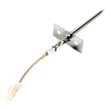
Knowing the manufacture year helps us match the right wall oven parts and troubleshoot issues more accurately, especially for heat-related symptoms (temperature swings, long preheat times, or error codes). For example, if baking temperatures are off, the wall oven temperature sensor WPW10131825 is a common part to check on this model.
Age estimate vs. purchase date
| What you have | What it tells you | Best use |
|---|---|---|
| Serial number | Manufacture year and production timing | True appliance age |
| Receipt/closing date | When it was bought/installed | Warranty and ownership timeline |
| Model number (KEBC107KSS05) | Design and parts family | Parts lookup |
Last updated: February 2026
What does F1 mean on a KitchenAid oven?
On a KitchenAid built-in oven like model KEBC107KSS05, an F1 error points to a problem in the electronic oven control system, most often a stuck keypad (touch panel) input or a control/relay issue that makes the oven think a key is being pressed.
Quick reset you can try first
- Press CANCEL/OFF to clear the display (your control may show CANCEL OFF, UPPER OVEN CANCEL/OFF, or LOWER OVEN CANCEL/OFF).
- If the code returns, turn power off at the breaker for 1 minute, then restore power.
- If F1 comes back after the reset, the issue is in the control circuit (keypad/control board or related wiring).
What usually causes F1 on this type of KitchenAid wall oven
- Stuck or shorted keypad/touch panel input
- Electronic oven control (clock/control board) failure
- Moisture, heat damage, or contamination behind the control panel
- Loose, pinched, or damaged wiring at the control
- Temperature sensing problems that can contribute to abnormal operation (less common for a pure F1, but worth checking if baking temps are erratic)
Parts that commonly relate to “false” error behavior
If you are also seeing temperature swings, long preheat times, or uneven baking along with the F1, check the oven temperature sensor circuit.
| Symptom you notice | Most likely area | Example part for KEBC107KSS05 |
|---|---|---|
| F1 returns quickly after reset | Keypad or electronic control | Control panel/control board (varies by revision) |
| F1 plus erratic temps | Sensor circuit | Wall oven temperature sensor WPW10131825 |
| F1 after heavy use, cabinet very hot | Cooling/airflow issue | Cooling fan assembly (blower) |
Why it matters
When the control “sees” a stuck key or a control fault, it can disable cooking functions or behave unpredictably. Clearing the code is fine for troubleshooting, but a repeating F1 means the underlying control input problem needs correction.
Where to confirm control functions and display messages
Your control pad names and display behavior are listed in the KEBC107KSS05 owner’s manual. Use it to match the exact CANCEL/OFF key labeling on your oven and confirm what the display is telling you.
Last updated: February 2026
Why is my KitchenAid oven display not showing?
If your KitchenAid KEBC107KSS05 oven display looks blank, it is often normal when the oven is idle, or the time-of-day display was turned off. If it stays blank during use, start with a power reset and basic control settings from the KEBC107KSS05 owner's manual.
Quick checks that solve most “blank display” complaints
- Confirm the oven is truly idle: On this model, the oven display is blank when the oven is not in use.
- Look for “PF”: After power is first supplied, the display lights briefly, then “PF” can appear; press CANCEL/OFF to clear it.
- Restore the clock display: Press and hold CLOCK SET/START for 5 seconds to remove or return the time-of-day display.
- Check Sabbath Mode: When Sabbath Mode is enabled, the displays do not show messages or temperature changes.
- Reset power: Turn the breaker off for 5 minutes, then restore power and recheck the display.
If the display is blank even while baking or broiling
A blank display during active cooking usually points to a control, wiring, or temperature feedback issue.
- Verify the oven actually heats in BAKE and BROIL.
- If the oven heats but the display stays dark, inspect for loose connections at the control (power off at breaker first).
- If temperatures seem erratic or the oven shuts down, test the oven temperature sensor; a failed sensor can cause control problems on some ovens.
Common symptoms and what they suggest
| Symptom | Most likely cause | What to do next |
|---|---|---|
| Blank only when not cooking | Normal operation or clock display toggled off | Use the 5-second clock toggle |
| “PF” shown | Power interruption | Press CANCEL/OFF; reset clock |
| Blank during cooking | Control or wiring issue | Power reset; inspect connections |
| Odd temps plus display issues | Sensor feedback problem | Test/replace sensor |
Parts that can be involved
If testing points to a failed component, these model-matched parts are common suspects:
- Wall oven temperature sensor WPW10131825 (temperature feedback to the control)
- Cooling fan issues can also affect operation on some ovens; check for abnormal fan behavior and overheating symptoms.
Why it matters
The display is your main feedback for temperature, timing, and error conditions. Restoring the clock display or clearing a “PF” condition fixes many “no display” reports without replacing parts.
Last updated: February 2026
What is the life expectancy of a KitchenAid oven?
A KitchenAid electric wall oven like model KEBC107KSS05 typically lasts 10 to 15 years with normal household use; 15 to 20 years is common when it is kept clean, properly installed, and not run through frequent high-heat self-clean cycles. For care and operating guidance, follow the KEBC107KSS05 owner's manual.
Typical lifespan and what affects it
Most wall ovens fail from heat stress on electronics, worn heating elements, or door seal and hinge wear. These factors have the biggest impact:
- How often you cook (daily use shortens lifespan)
- Self-clean frequency (high heat is hard on controls and wiring)
- Ventilation and cooling airflow (blocked vents raise internal temperatures)
- Door seal condition (heat leaks make components work harder)
- Power quality and wiring (loose connections can overheat)
What “normal wear” looks like over time
Here is what we see most often as a wall oven ages, and the parts that commonly solve it:
| Symptom | Common cause | Example part for KEBC107KSS05 |
|---|---|---|
| Oven temperature swings, underbakes | Sensor drifting out of range | Wall oven temperature sensor WPW10131825 |
| Takes too long to preheat, weak baking | Bake element weakening | Bake element 4451175 |
| Door won’t close tightly, heat leaks | Hinge wear | Wall oven door hinge, right WP9760575 |
How to extend the life of your KEBC107KSS05
These steps reduce heat stress and prevent avoidable failures:
- Use self-clean sparingly; spot-clean when possible
- Keep the door gasket area clean so the door seals fully
- Avoid slamming the door; it accelerates hinge wear
- Let the oven cool with the door closed so airflow works as designed
- If you smell hot wiring or see flickering power, stop using the oven and have the supply checked
Why it matters
A wall oven can keep cooking well past 10 years, but small issues (temperature accuracy, door sealing, airflow) make the oven run hotter and longer, which shortens the life of expensive components like elements, sensors, and controls.
Last updated: February 2026