Owner’s manual
 Error Codes


What size dryer is a Kenmore 80 series?
Most Kenmore 80 Series dryers like model 11082822101 are full-size, standard-width machines; they typically fall in the about 6.0 to 7.0 cu. ft. capacity range. For the exact cabinet dimensions and required clearances for your specific unit, use the 11082822101 owner's manual.
When customers ask about dryer size, it usually refers to one of these:
- Capacity (cu. ft.): how much laundry the drum holds
- Cabinet width: most full-size Kenmore/Whirlpool-built dryers are about 27 inches wide
- Installation space: room needed for door swing, venting, and airflow
- Venting clearance: space behind the dryer for the exhaust elbow
Your manual calls out key spacing and clearance needs that affect “size” in the real world:
- Plan for the dryer door to fully open
- Most installs need at least 5 1/2 inches of clearance behind the dryer for the exhaust vent and elbow
- In a closet, top and bottom door vent openings are required
- For garage installs, place the dryer at least 18 inches above the floor
| Measurement type | What to expect | Why you care |
|---|---|---|
| Capacity | About 6.0 to 7.0 cu. ft. (typical) | Load size and cycle performance |
| Width | About 27 inches (typical) | Fit through doorways and into alcoves |
| Rear clearance | Minimum 5 1/2 inches (model guidance) | Prevents crushed venting and poor airflow |
Choosing the right “size” prevents tight installs that kink the exhaust, restrict airflow, and increase dry times. It also helps you match washer capacity to dryer capacity so loads dry evenly.
Last updated: February 2026
How do I tell what model my Kenmore dryer is?
Your Kenmore dryer’s model number is printed on the model and serial number label; on model 11082822101, that label is located at the top inside the dryer door well. Once you have the full model number, we can match the correct parts, diagrams, and specifications.
Check these common Kenmore dryer label locations (start with the first one):
- Top inside the dryer door well (most common for this style)
- Inside the door opening on the cabinet frame
- On the back panel of the dryer
- Near or behind the lint screen housing (varies by design)
Use the 11082822101 owner’s manual to confirm the label location and to record the model and serial number for service.
Kenmore model numbers are usually a long string of numbers. Many Kenmore dryers start with a prefix such as 110. (the manual even shows “Model number 110.” as the format), followed by additional digits that identify the exact configuration.
| What you find | What it tells us | What to do next |
|---|---|---|
| Full model number (example: 11082822101) | Exact dryer design and parts match | Use it to look up parts like a heating element or thermal fuse |
| Serial number | Production details used for service | Write it down with the model number |
| Only “110.” or partial digits | Not enough to guarantee correct parts | Keep looking for the complete number |
- Write the model number exactly as printed (no missing digits)
- Take a clear photo of the label before it wears or fades
- Record the serial number too; the manual recommends keeping both for faster service
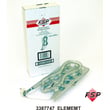
The correct model number prevents ordering the wrong Kenmore electric dryer parts, especially for common repairs like “no heat” (often involving items such as a thermal fuse like dryer thermal fuse WP3390719 or a heater like dryer heating element WP3387747).
Last updated: February 2026
What is an F1 code on a Kenmore dryer?
On a Kenmore dryer, an F1 code typically points to an electronic control problem (the main control board is detecting an internal fault). On model 11082822101, the most reliable fix is to reset power first; if the code returns, the control or its wiring needs service per the 11082822101 owner's manual.
- Unplug the dryer (or switch off the breaker) for 2 minutes, then restore power.
- Press and hold START to try restarting the cycle (the manual uses this approach for some code messages).
- If the code returns immediately, stop using the dryer until the cause is corrected.
- Check that the dryer has proper power; electric dryers need two household fuses/breakers (the drum can run with no heat if one side is out).
- If you smell overheating or notice poor airflow, clean lint buildup and the venting before running again.
F1 is most often triggered by one of these conditions:
- Failed electronic control board (internal relay or logic fault)
- Loose or oxidized wire harness connection at the control
- Power quality issues (surges, repeated power interruptions)
- Heat or vibration stress over time
If the dryer also has heating or overheating symptoms, these parts are frequently checked during diagnosis:
- Dryer thermal fuse WP3390719 (opens if the dryer overheats)
- Dryer thermistor WP8577274 (helps the control regulate temperature)
- Dryer heating element WP3387747 (shorts can cause abnormal heating behavior)
| What you notice | What it usually means | What we check next |
|---|---|---|
| F1 appears right away | Control is failing self-check | Control connections, control board |
| F1 after a power flicker | Control saw unstable power | Reset, verify supply, then control |
| F1 plus long dry times | Airflow restriction or heat control issue | Venting, thermistor, thermal fuse |
An F1 code is the dryer telling you it cannot reliably manage the cycle. Addressing it quickly helps prevent repeat shutdowns, overheating conditions, and unnecessary part replacement.
Last updated: February 2026
How to hard reset a Kenmore dryer?
For Kenmore model 11082822101, the most reliable hard reset is to disconnect power for 1 minute, restore power, then press and hold START to restart. If the controls are locked, unlock them first; a reset will not clear a Control Locked setting. See the 11082822101 owner's manual.
- Unplug the dryer (or switch the breaker off) for 1 minute.
- Restore power.
- If the display shows PF (power failure), press and hold START to restart.
- If you see an E1/E2/E3 style service code, press and hold START once to attempt a restart.
- If the panel is unresponsive, check for Control Locked and unlock it (next section).
This model has a Control Locked feature that prevents changes during operation.
- Press and hold AUTO DRY LEVEL for 3 seconds.
- Confirm the Control Locked indicator turns off.
- Re-select your cycle and press and hold START (about 3 seconds) to begin.
A hard reset clears temporary control states, but it will not fix airflow restrictions or a failed safety device.
- Clean the lint screen and confirm strong airflow at the outside vent hood.
- Check for a crushed or kinked vent; use heavy metal or flexible metal venting.
- If the drum turns but there is no heat, check the house power supply (electric dryers use two fuses/breakers).
- If the dryer overheated, a blown thermal fuse is common; consider testing the dryer thermal fuse WP3390719.
- If heat is weak or intermittent, the heater circuit may need attention; inspect the dryer heating element WP3387747.
| Symptom | Best next step after reset | Likely area |
|---|---|---|
| Display shows PF | Press and hold START | Power interruption |
| Controls won’t change | Unlock Control Locked | User interface lock |
| Runs but won’t heat | Verify 240V supply, then test heater circuit | Breakers, heater, thermostats |
| Long dry times | Check vent airflow and lint buildup | Venting, blower, duct |
Resetting the control gets you running again after a power glitch or a stuck setting, but airflow and heat problems usually come back until the venting and heater safety components are corrected.
Last updated: February 2026