Owner’s manual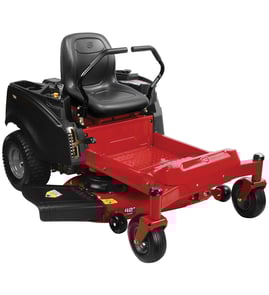



How do you adjust the height of a Swisher rough cut mower?
On the Swisher ZT2760, you adjust cutting height by using the deck height adjust crank: turn it clockwise to lower the mower deck and counterclockwise to raise it, then lock the setting so the deck stays at that height (see the ZT2760 owner's manual).
Step-by-step: set your cutting height
- Park on a flat, level surface and set the parking brake.
- Make sure the PTO (blade switch) is disengaged and the engine is off.
- Turn the height adjust crank clockwise to lower the deck.
- Turn the height adjust crank counterclockwise to raise the deck.
- Push the handle down to lock the height position.
- For tall or dense material, plan on two passes (high cut first, then your final height).
Recommended mowing heights (practical guidance)
The manual’s mowing guidance for lawn grass is a good baseline for most conditions.
| Condition | Practical target height | Notes |
|---|---|---|
| Cool-season growth | About 2 1/2 in. | Helps keep turf dense and healthy |
| Hot months | Over 3 in. | Reduces stress and browning |
| Grass over 6 in. | Two-pass cut | First pass high, second to finish |
Why it matters
Correct deck height on a zero-turn riding lawn mower helps you avoid scalping, reduces clumping, and improves cut quality. It also supports healthier turf because you are less likely to remove more than about one-third of the blade length in a single mowing.
Parts and diagrams
If you are shopping for deck-related replacement parts for your Swisher ZT2760, start with the model parts list; you can also search by model number on Sears PartsDirect.
Last updated: February 2026
What is the best engine for a riding mower?
For a riding mower, the best engine is the one that matches your yard size and mowing load, has strong dealer parts support, and is maintained on schedule. On the Swisher ZT2760 zero-turn, the operator’s manual focuses on safe operation and maintenance practices that extend engine and mower life.
How we choose the “best” engine
We recommend comparing engines by real-world factors that affect starting, power under load, and long-term durability:
- Horsepower and torque for your deck size: more load (taller grass, wider deck, hills) needs more torque.
- Engine family and duty rating: residential engines prioritize cost; commercial engines prioritize cooling, filtration, and service life.
- Air filtration and cooling design: better filtration and cooling typically means longer life in dusty mowing conditions.
- Parts availability and serviceability: common filters, plugs, belts, and accessible service points matter.
- Fuel system and starting: choke and throttle setup should start reliably when cold.
What matters specifically for the Swisher ZT2760
Your ZT2760 is built for efficient mowing of large areas and uses dual hydrostatic transmissions controlled by steering levers. Keeping the machine maintained and operated correctly is a major part of getting “best engine” performance from whatever engine is installed.
- Use the throttle control to run at the correct engine speed for mowing.
- Use the choke control for cold starts.
- Track run time with the hour meter so maintenance stays on schedule.
- Engage blades with the PTO switch only when you are ready to mow.
For the model and engine identification locations and operating guidance, use the ZT2760 owner’s manual.
Quick comparison: residential vs commercial mower engines
| Feature | Residential engine | Commercial engine |
|---|---|---|
| Typical use | Weekly mowing | Daily, heavy mowing |
| Strengths | Lower cost, simpler | Better cooling, filtration, longevity |
| Best for | Flat, smaller to mid lawns | Large acreage, hills, thick grass |
Why it matters
An engine that is “best” on paper can still perform poorly if it is run at the wrong throttle setting, serviced late, or operated with clogged cooling fins or a dirty air filter. Following the ZT2760 operating and maintenance guidance is the fastest way to increase lifespan.
For replacement parts and diagrams for your Swisher ZT2760, start with the parts list for this model; you can also search by model number on Sears PartsDirect.
Last updated: February 2026
What are the benefits of a rear engine mower?
A rear-engine mower like the Swisher ZT2760 is built to mow large areas quickly with tight control; the rear-mounted engine helps keep weight over the drive wheels for traction, and the zero-turn steering levers make it easy to maneuver around trees, beds, and other obstacles.
Key benefits you’ll notice in real mowing
- Fast coverage on big lawns: The ZT2760 is designed for efficiency and rapid mowing of large areas.
- Excellent maneuverability: Dual steering levers let you turn sharply and trim closely around obstacles.
- Strong traction: With the engine weight toward the rear, rear tires typically grip well on level turf.
- Simple, convenient controls: Throttle, choke, PTO (blade) switch, and deck lift are positioned for quick access.
- Easy to move when needed: Hydro bypass (release) lets you disengage the transmissions so you can push the mower short distances.
How rear-engine design compares (quick guide)
| Feature | Rear-engine zero-turn (ZT2760) | Typical front-engine lawn tractor |
|---|---|---|
| Turning radius | Near zero | Wider turns |
| Best use | Open areas plus lots of obstacles | Open areas with fewer obstacles |
| Control style | Steering levers | Steering wheel |
| Traction feel | Weight biased to rear drive wheels | More balanced, varies by model |
Why it matters
If your yard has landscaping, trees, or tight spaces, the ZT2760’s zero-turn controls reduce trimming time and missed strips. For larger, flatter lawns, the design also supports faster, more efficient mowing when operated and maintained as outlined in the ZT2760 owner's manual.
Tips to get the most benefit
- Mow on free and even ground and keep the area clear of obstacles.
- Use the PTO switch to engage blades only when you’re ready to cut.
- Keep the deck at an appropriate height using the deck lift handle.
- Follow routine checks (oil, tire pressure, battery condition) before heavy mowing days.
For model-specific parts and diagrams, start with the parts list for ZT2760, or search by model on Sears PartsDirect.
Last updated: February 2026
Why is my riding mower having trouble going uphill?
On a Swisher ZT2760 zero-turn riding lawn mower, trouble going uphill is usually caused by loss of traction or loss of drive power. The most common fixes are slowing down on slopes, avoiding starts and stops on hills, and inspecting the drive system for a loose or worn belt.
Safety first (slopes)
Our ZT2760 guidance for slope operation is clear: mow up and down, not side to side, and never operate on slopes steeper than 10 degrees. If the tires start to slip, shut down the blades and drive slowly down the slope. See the slope-operation section in the ZT2760 owner's manual.
Quick checks that solve most uphill problems
- Confirm the slope is 10 degrees or less; steeper hills cause wheel slip and loss of control.
- Reduce ground speed before the incline; driving too fast is a top cause of losing grip.
- Avoid starting or stopping on a slope; this commonly triggers tire slip.
- Check for wet grass or soft soil; wet turf is slippery and reduces traction.
- Inspect the drive belt and hydro belt for wear, glazing, cracking, or damage.
- Check idler spring tension; a loose or broken idler spring can let the belt slip.
What to inspect on the mower (drive power)
The troubleshooting guidance for this mower points to drive-belt and hydro-belt issues when drive performance is poor.
| Symptom uphill | Most likely cause | What to do |
|---|---|---|
| Tires spin, mower barely moves | Low traction, wet grass, too steep, too fast | Slow down, avoid wet grass, keep slope at 10 degrees or less |
| Engine runs, mower slows or stops | Hydro belt worn/damaged, idler spring loose/broken | Inspect belt and idler; replace worn parts |
| Jerky movement on incline | Belt slipping or linkage not fully engaged | Check belt condition and linkage position |
Why it matters
When a mower slips on a hill, control does not come back by braking; the safer move is to reduce speed, avoid sudden direction changes, and back down the slope smoothly. Keeping belts and idlers in good condition also protects the transmission and improves cut consistency.
Getting the right replacement parts
We recommend matching parts to the exact model number ZT2760 when ordering. Start with the parts list for this model, or search by model number on Sears PartsDirect.
Last updated: February 2026