 Installation guide
 Owner’s manual
 Error Codes


How can I tell what size my dryer is?
For your GE dryer model DWSR483EB2WW, the most reliable way to confirm “size” is to measure the cabinet width, height, and depth (and note any extra depth from the exhaust duct); you can also use the DWSR483EB2WW installation guide to verify installation clearances that affect fit.
What “size” usually means for a dryer
Dryer “size” can refer to either physical dimensions or drum capacity. When you are planning a replacement, a laundry-room remodel, or an alcove/closet install, dimensions and required clearances matter most.
- Width, height, depth of the cabinet (tape measure)
- Depth with door closed and depth with door open (helps with walkway clearance)
- Depth including vent connection (rear exhaust elbow can add space)
- Installation clearances (front, rear, sides, overhead)
- Drum capacity (cubic feet, if you are comparing load size)
How to measure your DWSR483EB2WW (quick steps)
- Measure width across the front of the cabinet.
- Measure height from the floor to the top.
- Measure depth from the back to the front (exclude knobs if you want cabinet-only; include them if you need total space).
- Add space for the 4-inch exhaust duct and an elbow if used.
- Compare your measurements to the space where the dryer will sit.
Clearances to keep in mind (from installation guidance)
The installation instructions call out common clearance and ventilation requirements that can change whether a dryer “fits,” especially in a closet.
| Installation situation | Key fit requirement to check |
|---|---|
| Standard laundry area | Room behind dryer for venting and to prevent duct kinks |
| Alcove or closet | Minimum clearances plus door ventilation opening area |
| Bedroom/bathroom/mobile home | Must be exhausted to the outdoors |
Why it matters
A dryer that physically fits but has poor vent clearance can kink or crush the exhaust duct, which increases dry time and can cause overheating. Using solid metal ducting and proper elbow routing helps maintain airflow.
Last updated: January 2026
What does DWSR483EB2WW stand for?
DWSR483EB2WW is the GE model number that identifies a specific GE dryer; it tells us the exact design series and configuration so we can match the correct parts, wiring requirements, and installation details for your appliance.
What the model number helps us identify
We use the full model number (not just part of it) to match the right GE dryer parts and service information.
- Confirms the exact dryer platform and revision (important for part compatibility)
- Helps match electrical and venting requirements from the installation instructions
- Ensures you get the correct control components (timer, switches, thermostats)
- Prevents ordering look-alike parts that do not fit your drum or cabinet
Where to find the model number on the dryer
For GE DWSR483EB2WW, the model and serial tag is typically located on a label on the front of the dryer behind the door.
| What to look for | Example | Why it matters |
|---|---|---|
| Model number | DWSR483EB2WW | Matches parts and diagrams to your exact dryer |
| Serial number | (varies) | Helps date the unit and confirm production details |
Why the exact model number matters for repairs
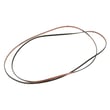
Even small model-number differences can change which belt, thermostat, or switch fits. For example, if your dryer squeals or will not tumble, we match the correct drum-drive components for DWSR483EB2WW, such as the drive belt WE03X29897 and related idler parts.
Helpful next steps
- Use the full model number when searching parts: DWSR483EB2WW
- Confirm your electrical and venting setup in the DWSR483EB2WW installation guide
- Use the DWSR483EB2WW owner’s manual to identify controls, features, and basic troubleshooting
Last updated: January 2026
What is the most common problem with a GE dryer?
The most common issues we see on a GE dryer like model DWSR483EB2WW are no heat or long dry times caused by restricted venting, and a drum that will not turn due to a worn belt or idler. Start with airflow and basic start checks in the DWSR483EB2WW owner's manual.
Most common symptoms and what they usually point to
- Dryer runs but doesn’t heat: house fuses/breakers (many electric dryers use 2), heat circuit parts, or gas shutoff (gas models)
- Clothes take too long to dry: lint filter full, kinked or blocked vent duct, outside hood damper stuck
- Drum won’t turn but motor runs: worn or broken belt, idler pulley issue
- Dryer won’t start: power supply issue, door switch not closing, timer/control problem
Quick checks we recommend first (fast, no parts)
- Clean the lint filter before every load.
- Inspect the vent path: short, 4-inch metal ducting, not crushed or collapsed.
- Check the outside exhaust hood: flaps should move freely and be clear of lint or nesting.
- Confirm power: reset breakers and check fuses (electric dryers commonly need both legs of power).
- If the dryer will not start, test the door closure and listen for a click at the door switch.
Common parts involved on DWSR483EB2WW
| Symptom | Common part to check | What it does |
|---|---|---|
| Drum not turning | Drive belt WE03X29897 | Turns the drum with the motor pulley |
| No start when door closes | Door switch WE4M415 | Proves the door is shut so the dryer can run |
| No heat or overheating | Dryer high-limit thermostat WE4M137 | Helps prevent unsafe temperatures |
Why it matters
Airflow problems (lint filter, ducting, exhaust hood) can cause long dry times, wasted energy, and overheating. Fixing venting first often restores normal drying and helps protect heating components.
Last updated: January 2026





