Installation guide
 Owner’s manual
 Error Codes


How do I tell if my dryer heating element is bad?
If your Kenmore dryer model 11066642501 runs but won’t dry (or takes much longer than normal), the heating element is a top suspect. We confirm it by safely disconnecting power, checking airflow first, then testing the element for continuity with a multimeter as shown in the 11066642501 owner's manual.
Quick symptoms that point to a bad heating element
- Dryer tumbles normally but there is no heat
- Clothes stay damp after a full cycle
- Dry times suddenly get much longer
- Burning smell or visible scorching inside the heater housing area
- Breaker trips shortly after heat should turn on (sometimes caused by a grounded element)
Before you test: rule out airflow problems
Poor venting can mimic a failed heater and can also cause overheating that blows safety fuses.
- Clean the lint screen and confirm it is not coated with fabric softener residue
- Check the vent hose for kinks, crushing, or heavy lint buildup
- Verify strong airflow at the outside vent hood
- Make sure the outside damper opens freely
Why airflow matters
Restricted airflow can overheat the heater box and trip safety devices like the thermal cut-off, leaving you with “no heat” even if the element is still good.
How we test the heating element (basic method)
- Unplug the dryer (or switch off the breaker).
- Access the heater terminals (location varies; follow the 11066642501 installation guide for access and safety notes).
- Remove at least one wire from the element terminal.
- Set a multimeter to resistance (ohms) or continuity.
- Test across the element terminals.
- Good element: shows continuity and a measurable resistance value
- Bad element: shows no continuity (open circuit)
What the readings mean
| Meter result | What it usually indicates | Next step |
|---|---|---|
| Continuity present | Element is likely intact | Check thermostats, thermal cut-off, and airflow |
| No continuity | Element is failed (open) | Replace the heating element |
| Continuity to metal housing | Element may be grounded | Replace the heating element and inspect wiring |
Parts that commonly get replaced with “no heat”
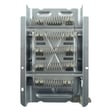
If the element tests bad, replace it with the correct part for this model: dryer element 279838. If the element tests good, the issue is often in the safety circuit.
- Heating element
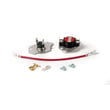
- Thermal cut-off fuse kit
- High-limit thermostat
- Operating thermostat
Why it matters
A dryer that tumbles with no heat is often a simple electrical heating circuit problem, but airflow restrictions can cause repeat failures. Fixing venting at the same time helps the new part last.
Last updated: January 2026
What are common problems with Kenmore dryers?
Common problems with Kenmore dryers (including model 11066642501) are no heat, drum not turning, long dry times, and loud noises. Most causes trace back to airflow restrictions, a failed safety thermostat or fuse, or worn drive components; our 11066642501 owner's manual helps confirm the right checks.
Most common symptoms and likely causes
- Dryer will not heat: heating element, thermal cut-off, high-limit thermostat, restricted venting
- Drum will not turn: broken belt, worn idler pulley, failed drive motor
- Takes too long to dry: clogged lint screen, blocked vent duct, damaged blower wheel
- Won’t start: door switch, push-to-start switch, timer, motor issue
- Loud squealing, thumping, or scraping: worn drum support parts (often addressed with a repair kit), idler pulley, belt
Quick checks we recommend first (fast, high-impact)
- Clean the lint screen and confirm strong airflow at the outside vent hood.
- Inspect the vent path for kinks, crushed flex duct, or heavy lint buildup.
- Verify the door closes firmly and the door switch clicks.
- If the drum does not turn, check the belt and idler system.
- If it runs but does not heat, check the heating circuit safety parts and airflow.
Parts that commonly fix these issues on model 11066642501
| Symptom | Common part to check | Example part for this model |
|---|---|---|
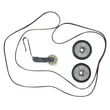
| Drum not turning | Drum belt | Dryer drum belt 341241 |
| No heat (electric) | Heating element | Dryer element 279838 |
| No heat, shuts off early | Thermal cut-off kit | Dryer thermal cut-off fuse kit 279816 |
| Won’t start | Door switch | Dryer door switch WP3406107 |
| Squeals, rumbling | Wear items kit | Dryer repair kit 4392065 |
Why it matters
A dryer that overheats or dries slowly is usually fighting poor airflow. Fixing venting and replacing failed thermostats or fuses helps protect the heater box, wiring, and motor, and it shortens dry times.
Last updated: January 2026
What is the average life of a Kenmore dryer?
Most Kenmore dryers, including model 11066642501, typically last 10 to 13 years. With consistent airflow maintenance (lint screen and venting) and timely replacement of wear items, it is common for a dryer to reach 15 to 20 years of service.
What affects dryer lifespan the most
- Vent restriction (long runs, crushed duct, lint buildup) that overheats components
- Overloading that strains the drum support system and drive motor
- Heat stress from repeated high-heat cycles
- Wear parts aging out (belt, idler pulley, drum rollers, seals)
- Moisture and corrosion in laundry areas (especially garages and basements)
Maintenance that adds years (and prevents breakdowns)
Use the care steps in the 11066642501 owner’s manual and keep airflow strong.
- Clean the lint screen every load
- Vacuum lint from the lint screen housing regularly
- Inspect and clean the exhaust duct and outside hood at least yearly
- Keep the dryer level to reduce drum and bearing wear
- Stop using the dryer if you smell burning or notice weak airflow
Common “end-of-life” symptoms and likely wear parts
| Symptom | What it often points to | Example part for this model |
|---|---|---|
| Drum will not turn, motor runs | Worn or broken belt | Dryer drum belt 341241 |
| Squealing, thumping, rumbling | Idler pulley or drum support wear | Dryer repair kit (rollers/idler) |
| Long dry times, very hot cabinet | Vent restriction or overheating protection opening | Thermal cut-off fuse kit |
| Runs but no heat | Heating circuit issue | Dryer element |
Why it matters
A dryer that cannot move air efficiently runs hotter and longer; that shortens the life of the heating system, thermostats, and thermal fuses. Good venting and routine cleaning are the biggest controllable factors in how long a Kenmore dryer lasts.
Last updated: January 2026