Owner’s manual
 Error Codes


How can I tell how many cubic feet my Kenmore refrigerator is?
For Kenmore model 10650042710, the exact cubic-foot capacity is not identified in the model-specific information we have here. The most reliable way to confirm capacity is to use the model and serial tag details with the specifications section in your 10650042710 use & care manual, or calculate an estimate by measuring the interior.
Best ways to identify capacity
- Check the model/serial tag inside the fresh-food compartment (often on a side wall or near the crisper area) and match it to the specs in the manual.
- Use the manual’s model family listing (this guide covers 106.5004* and related variants) to confirm you are reading the correct spec set.
- Measure interior space (refrigerator and freezer compartments) if you need a quick estimate.
- Do not rely on “digit decoding” from the model number; it is not consistent across Kenmore model families.
How to estimate cubic feet by measuring
- Empty the compartment enough to measure the usable interior.
- Measure height x width x depth in inches (avoid counting door bins and curved corners).
- Multiply to get cubic inches.
- Divide by 1,728 to convert to cubic feet.
| What you measure | Formula | Result type |
|---|---|---|
| One compartment | H x W x D (in.) ÷ 1,728 | Estimated cu ft |
| Whole refrigerator | (Fresh-food cu in. + Freezer cu in.) ÷ 1,728 | Estimated total cu ft |
Why it matters
Knowing cubic feet helps us match the right refrigerator parts and accessories (like shelves, bins, and filtration components) and helps you compare storage space accurately when planning a replacement.
Last updated: January 2026
How to replace water filter in Kenmore side by side refrigerator?
On Kenmore model 10650042710, the water filter is accessed at the base grille. Open the water filter cover door, remove the old filter (either it slides straight out or twists 90° to unlock, depending on the filter style used on your unit), install the new filter, then flush the system. See the 10650042710 use & care manual.
Step-by-step: replace the filter
- Open the water filter cover door in the base grille (near the floor).
- Remove the old filter:
- Eject-and-pull style: pull the filter straight out.
- Twist-to-remove style: turn the filter 90° counterclockwise, then pull it out.
- Prep the new filter: remove packaging and protective caps; make sure the O-rings stay in place.
- Install the new filter:
- Eject-and-pull style: align it with the housing and slide it in until seated; close the door firmly.
- Twist-to-remove style: insert, then turn 90° clockwise until it locks.
- Flush the water system: dispense water in 5-seconds-on/5-seconds-off cycles until about 3 gallons (12 L) runs through.
Choosing the correct replacement filter for 10650042710
This model family can use different filter styles; we cannot confirm a single filter part number from the model number alone without matching the filter currently installed or the housing style.
Use this quick check:
| What you see | Likely filter type | What to do |
|---|---|---|
| Filter releases and pulls straight out | Eject-and-pull | Match the part number printed on the old filter |
| Filter must be turned to remove | Twist-to-remove | Match the part number printed on the old filter |
If your filter housing is damaged or leaking, the compatible housing listed for this model is the refrigerator housing assembly W11162041.
Resetting the filter status light (if equipped)
Some versions have a filter status light on the refrigerator control panel. After replacing the filter, press Refrigerator Temperature within 3 seconds to reset.
Why it matters
Replacing the water filter on schedule helps maintain water flow to the dispenser and ice maker, improves taste and odor, and reduces sputtering caused by air in the line after a filter change.
Last updated: January 2026
How to tell if a Kenmore refrigerator compressor is bad?
If your Kenmore side-by-side refrigerator model 10650042710 isn’t cooling properly and you hear repeated clicking, buzzing, or the unit runs almost constantly, the compressor system may be failing. We recommend confirming airflow and fan operation first, because those problems can mimic a “bad compressor.”
Quick signs the compressor system may be the problem
- Refrigerator and freezer temperatures keep rising even after 24 hours of running
- You hear repeated clicking (start attempt) followed by silence (shutoff)
- The compressor area is unusually hot and the unit still will not cool
- The breaker trips when the compressor tries to start
- You have normal interior lights and controls, but little or no cooling
What to check first (before condemning the compressor)
These checks are faster and often point to a less expensive fix.
- Condenser fan running: If the fan by the compressor is not running, the sealed system can overheat and cooling will suffer.
- Evaporator fan running: If the freezer evaporator fan is out, cold air will not circulate to the refrigerator side.
- Condenser coils: Heavy dust can cause long run times and poor cooling.
- Door sealing: A leaking gasket can cause constant running and warm temps.
For operating basics and troubleshooting steps specific to this model, use the 10650042710 use & care manual.
Parts that are commonly involved
If testing points to a compressor start or sealed-system issue, these model-compatible parts are commonly referenced during diagnosis:
| Symptom | Often related component | Example model-compatible part |
|---|---|---|
| Clicks repeatedly, won’t start | Start components (often capacitor/relay) | Refrigerator run capacitor WPW10350564 |
| Runs but won’t cool well | Sealed system component | Refrigerator compressor W10309988 |
| Poor cooling with overheating at back | Airflow at machine compartment | Condenser motor W11578915 |
Why it matters
A true compressor or sealed-system failure is a high-impact repair. Verifying fans, airflow, and start components first helps avoid replacing major parts when the real cause is a simpler issue.
Last updated: January 2026
Why is the ice maker not working on my Kenmore side by side refrigerator?
On Kenmore model 10650042710, an ice maker that stops producing ice is usually caused by the ice maker being turned off, low water supply/pressure, a clogged water filter, a frozen fill path, or a failed water inlet valve or ice maker assembly. Use the 10650042710 use & care manual to confirm the on/off style and basic checks.
Quick checks we recommend first
- Make sure the ice maker is turned on (wire shutoff arm down or switch set to On, depending on the style).
- Confirm the freezer is cold enough for ice production (ice makers typically need a properly freezing compartment).
- Check the household shutoff valve is fully open and the water line is not kinked.
- If you recently installed the refrigerator or changed the filter, flush/purge air from the water system.
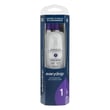
- Replace the water filter if flow is weak or it is overdue; for this model, a common compatible filter is the refrigerator cartridge EDR1RXD1.
When it points to a part problem
If the ice maker is on and the freezer is cold but the mold never fills with water, the most common failure points are the inlet valve or the ice maker itself.
- If you hear no water fill sound and the ice maker stays dry: suspect the refrigerator water inlet valve WPW10179146.
- If water is available but the ice maker won’t cycle/eject: suspect the refrigerator ice maker assembly WPW10300022.
Symptom-to-cause guide
| What you notice | Most likely cause | What to do next |
|---|---|---|
| No ice at all, ice maker off | Shutoff arm up or switch off | Turn ice maker on; wait 24 hours |
| Small cubes or slow production | Low water pressure or restricted filter | Replace filter; verify supply pressure |
| Ice maker dry (no fill) | Inlet valve not opening or fill path frozen | Check for frozen fill area; test/replace valve |
| Ice maker has ice but won’t dispense | Ice bin/auger/dispenser issue | Inspect bin and dispenser mechanism |
Why it matters
Ice makers are sensitive to water flow and freezer temperature. Fixing the root cause (water restriction vs. failed component) prevents repeat clogs, hollow cubes, and unnecessary part replacement.
Last updated: January 2026