Owner’s manual
 Error Codes



Are LG stainless steel refrigerators magnetic?
LG stainless steel refrigerators can be magnetic or not depending on the exact stainless finish used. For LG model LFX25974ST, magnet strength is not something we can confirm from the model-specific information we have; the most reliable way is to test a small magnet on the door.
How to check magnetism on your LG LFX25974ST
Use a lightweight fridge magnet and test a few spots; some doors have a stainless “skin” over a different core material.
- Test the upper door corners and the center (some areas can vary)
- Try both doors and the freezer drawer front
- Use a small magnet first; heavy magnets can slide and scratch
- If it barely holds, the surface may be weakly magnetic (or the core is non-magnetic)
- Avoid testing near the dispenser opening where trim pieces can affect results
What usually determines whether it’s magnetic
“Stainless steel” is a broad category. Many refrigerator exteriors use stainless that looks the same but behaves differently with magnets.
| Exterior type (common) | Typically magnetic? | What you’ll notice |
|---|---|---|
| Austenitic stainless look | Often no | Magnets fall off or barely stick |
| Ferritic stainless look | Often yes | Magnets stick normally |
| Stainless-look panel over other metal | Sometimes | Magnet may stick in some spots only |
Why it matters
If you want to use magnets, message boards, or magnetic organizers, a non-magnetic stainless finish means you may need alternatives like suction-cup accessories or side-panel mounting.
Helpful model-specific reference
For general care, features, and operating guidance for this refrigerator, use the LFX25974ST manual.
Last updated: January 2026
What is the problem with the LG bottom freezer refrigerator?
On the LG LFX25974ST bottom-mount refrigerator, the most common “problem” customers describe is uneven cooling: the fresh food section warms up while the freezer stays very cold. This is usually caused by restricted airflow, a defrost issue, or a temperature-sensing/control problem (not a single universal failure).
Quick checks we recommend first (no parts needed)
- Confirm the controls are set correctly; LG lists default settings of 37°F for the refrigerator and 0°F for the freezer in the LFX25974ST manual.
- Make sure air vents inside the refrigerator are not blocked by food containers.
- Check that the doors close and seal fully; warm air leaks can mimic a cooling failure.
- Listen for the evaporator fan running; a failed fan can leave the refrigerator warm while the freezer still freezes.
- Look for heavy frost on the freezer back panel; that often points to a defrost system problem.
Parts that commonly relate to “freezer cold, fridge warm” symptoms
If the basic checks above do not help, these model-compatible parts are often involved:
- Refrigerator evaporator fan motor 4681JB1027C (moves cold air from the evaporator through the compartments)
- Refrigerator defrost sensor assembly 6615JB2005N (helps the control manage defrost and temperature feedback)
- Refrigerator temperature sensor 6500JB2002E (reports compartment temperature to the control)
- Refrigerator electronic control board EBR73456502 (processes sensor input and runs fans/defrost)
Symptom-to-likely-cause guide
| What you notice | What it often means | What to check next |
|---|---|---|
| Freezer OK, refrigerator warm | Airflow problem | Vents, fan operation, frost buildup |
| Refrigerator warms randomly | Sensor/control issue | Temperature sensors, control board |
| Frost/ice on freezer back wall | Defrost problem | Defrost sensor, heater circuit |
| Buzzing periodically with no water line | Icemaker on without water | Turn icemaker off |
Why it matters
Uneven cooling can spoil food in the fresh food section even when the freezer seems “fine.” Catching airflow or defrost problems early can prevent longer run times, ice buildup, and more expensive repairs.
Last updated: January 2026
Why is my LG refrigerator leaking from the bottom?
On LG model LFX25974ST, a bottom puddle is usually caused by a clogged or frozen defrost drain that overflows during defrost, or a small leak in the ice maker and water-supply tubing that runs down to the base. Use the LFX25974ST manual to identify access points and safe handling steps.
Quick checks to pinpoint the source
- Clear water near the front: often dispenser or water line related.
- Water after a defrost cycle: often a defrost drain restriction.
- Ice sheet on freezer floor: strong sign the drain is frozen/clogged.
- Drips only when ice maker fills: points to the water circuit.
- Wet fittings or mineral tracks: indicates a slow seep at a connection.
Most likely causes on this model type
Defrost drain clogged or frozen
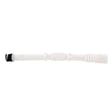
Defrost meltwater should flow through the drain opening, down a tube, and into the drain tray. If it backs up, it can spill into the freezer and leak out the bottom. A common drain-path component is the refrigerator drain tube 5251JA3003D.
Water supply leak (ice maker, valve, tubing)
If your unit is connected to a household water line, a loose fitting or cracked line can drip and collect underneath. Parts often involved include the refrigerator water tubing MJU62070602 and the refrigerator ice maker assembly AEQ72910411.
Symptom-to-cause guide
| What you notice | Most likely cause | First place to check |
|---|---|---|
| Ice in bottom of freezer, then water | Defrost drain blocked | Drain opening and drain tube |
| Leak happens during ice maker fill | Water supply leak | Tubing connections and ice maker |
| Slow puddle even with ice maker off | Drain backup or seep | Drain path, then tubing |
Why it matters
Stopping a bottom leak quickly helps prevent floor damage and reduces the chance of recurring ice buildup that can affect airflow and cooling.
Last updated: January 2026