Owner’s manual
 Error Codes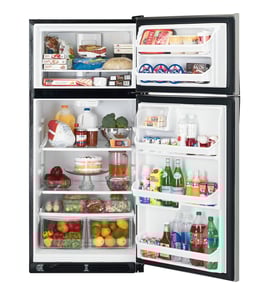




What is the upper part of a fridge called?
On the Frigidaire FRT17B3AW2 top-mount refrigerator, the upper section is the freezer compartment. It’s the coldest area of the appliance and is designed to keep foods frozen and store items long-term; it also typically holds the ice tray or ice maker (if equipped). See the FRT17B3AW2 owner's manual for your exact compartment features.
Common freezer-area components and features include:
- Freezer shelves or door bins for frozen foods
- A freezer temperature control setting (varies by model design)
- Space for ice trays (and sometimes an optional automatic ice maker)
- Airflow paths that help circulate cold air through the refrigerator section
| Section | Primary purpose | Typical temperature range |
|---|---|---|
| Freezer (upper on a top-mount) | Freeze and store food long-term | 0°F to 5°F |
| Fresh food compartment (lower) | Keep food cold without freezing | 34°F to 40°F |
Knowing the correct name helps when you’re ordering parts, reading troubleshooting steps, or following storage guidance. For example, airflow from the freezer is what helps cool the fresh food section, so freezer issues can affect overall refrigerator temperatures.
- Avoid overloading the freezer; leave space between packages for airflow.
- Keep door bins for items that tolerate temperature swings better than ice cream.
- Level the refrigerator so doors close tightly (this helps temperatures stay stable).
- Follow the recommended temperature settings and storage guidance in the manual.
Last updated: January 2026
Is top mounted refrigerator better than bottom mounted?
A top-mount refrigerator like the Frigidaire FRT17B3AW2 is “better” when you want lower purchase cost, strong energy efficiency, and a simple, proven layout. A bottom-mount is “better” when you want fresh-food items at eye level and easier access to the refrigerator section.
| Feature | Top-mount (freezer on top) | Bottom-mount (freezer on bottom) |
|---|---|---|
| Fresh-food access | Requires more bending | Easier, at eye level |
| Freezer access | Easier, at chest height | Requires bending |
| Energy use (typical) | Often lower | Often slightly higher |
| Cost (typical) | Often lower | Often higher |
| Complexity | Simpler design | More drawers, rails, seals |
- You want a straightforward refrigerator with fewer moving parts
- You use the freezer often and want it higher up
- You want good efficiency and lower long-term operating cost
- You have a tighter kitchen space and prefer a simpler door layout
- You want easier door-swing flexibility (many top-mounts support door reversal)
For model-specific setup details like clearances, leveling, and door reversal steps, use the FRT17B3AW2 owner's manual.
- You use fresh-food items most and want them at eye level
- You prefer wide refrigerator shelves and easier organization up top
- You like pull-out freezer drawers for frozen-food sorting
Choosing the right layout affects daily comfort (bending and reaching), kitchen fit (door swing and clearances), and long-term upkeep (more drawers and seals can mean more wear items over time). If you are comparing layouts because of cooling or performance concerns, start with basic operating guidance in the FRT17B3AW2 owner's manual.
Last updated: January 2026
What is the most common problem with a Frigidaire refrigerator?
For the Frigidaire FRT17B3AW2, the most common problem we see is a cooling complaint (refrigerator too warm, freezer too warm, or temperatures swinging). In many cases, the fix is basic: correct temperature control settings, good airflow, and a solid door seal, before any parts are replaced.
- Refrigerator too warm: temperature control set too warm, frequent door openings, airflow blocked by food
- Freezer too warm: freezer control set too warm, door not sealing, frost buildup from a defrost issue
- Unit not running: control set to OFF/0, unit in defrost cycle, power supply issue
- Noisy operation: evaporator fan airflow noise, defrost heater sizzling during defrost (often normal)
- Moisture or frost: door left ajar, gasket not sealing, high humidity from uncovered foods
For model-specific control guidance and the “common occurrences” checklist, use the FRT17B3AW2 owner's manual.
- Confirm controls are set correctly: small adjustments can take up to 24 hours to stabilize.
- Check power basics: plug fully seated, breaker/fuse OK; remember setting the control to 0 stops the compressor but does not cut power to lights.
- Improve airflow: do not pack items against vents; keep space around shelves.
- Reduce moisture load: cover foods and wipe containers dry.
- Listen for normal sounds: gurgling (refrigerant flow) and sizzling during defrost can be normal.
If the refrigerator is warm and you hear the fan struggling, rattling, or not moving air, the evaporator fan area is a common place to inspect. If the blade is cracked or loose, replacing the refrigerator evaporator fan blade 5308000010 can restore proper airflow (after confirming the motor is actually running).
| Symptom | Most likely category | First action |
|---|---|---|
| Fresh food warm, freezer OK | Airflow/control setting | Adjust controls; wait 24 hours |
| Freezer warm, frost buildup | Defrost/door seal | Check door closure; look for heavy frost |
| Not running at all | Power/control/defrost cycle | Check outlet, breaker, control at 0 |
Cooling problems usually get worse over time: food safety, ice buildup, and compressor run time all depend on correct settings, good airflow, and doors sealing tightly.
Last updated: January 2026
Why is my Frigidaire top mount freezer not freezing?
If your Frigidaire FRT17B3AW2 top-mount freezer is not freezing, the most common causes are incorrect temperature control settings, poor airflow from an evaporator fan issue, heavy frost from a defrost problem, or warm air leaking in through the door seal. Start by confirming the freezer is set to 0°F or lower using the guidance in the FRT17B3AW2 owner's manual.
- Make sure the freezer control is set colder (not near “0”); on this model, setting the refrigerator control to “0” turns off the compressor.
- Give the unit time after adjustments; temperature changes can take several hours to stabilize.
- Avoid overloading with warm food; too much warm food at once can slow freezing.
- Confirm the freezer is at least about 2/3 full for best efficiency (use containers of water if needed).
- Verify the doors close tightly and the cabinet is level so the doors seal.
A top-mount freezer relies on strong airflow across the evaporator and into the fresh-food section.
- If you hear the compressor running but airflow is weak, inspect the evaporator fan area for ice buildup.
- If the back freezer panel is heavily frosted, the defrost system is a prime suspect.
- If the freezer door shelves are warmer than the interior, move hard-to-freeze items (like ice cream) to the interior.
| What you notice | Most likely cause | What to do next |
|---|---|---|
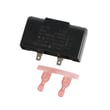
| Heavy frost on back wall | Defrost system issue | Check defrost components; consider refrigerator defrost bi-metal thermostat 5303918202 and refrigerator defrost heater 5303918203 if testing confirms failure |
| No fan sound, poor circulation | Evaporator fan problem | Inspect fan area; replace damaged fan blade such as refrigerator evaporator fan blade 5308000010 if broken |
| Runs constantly, still warm | Dirty condenser coils or poor ventilation | Clean coils and improve airflow around the cabinet |
When the freezer cannot hold 0°F or lower, food safety and ice production suffer, and the compressor can run longer than normal. Correct settings and airflow checks prevent unnecessary part replacement.
Last updated: January 2026